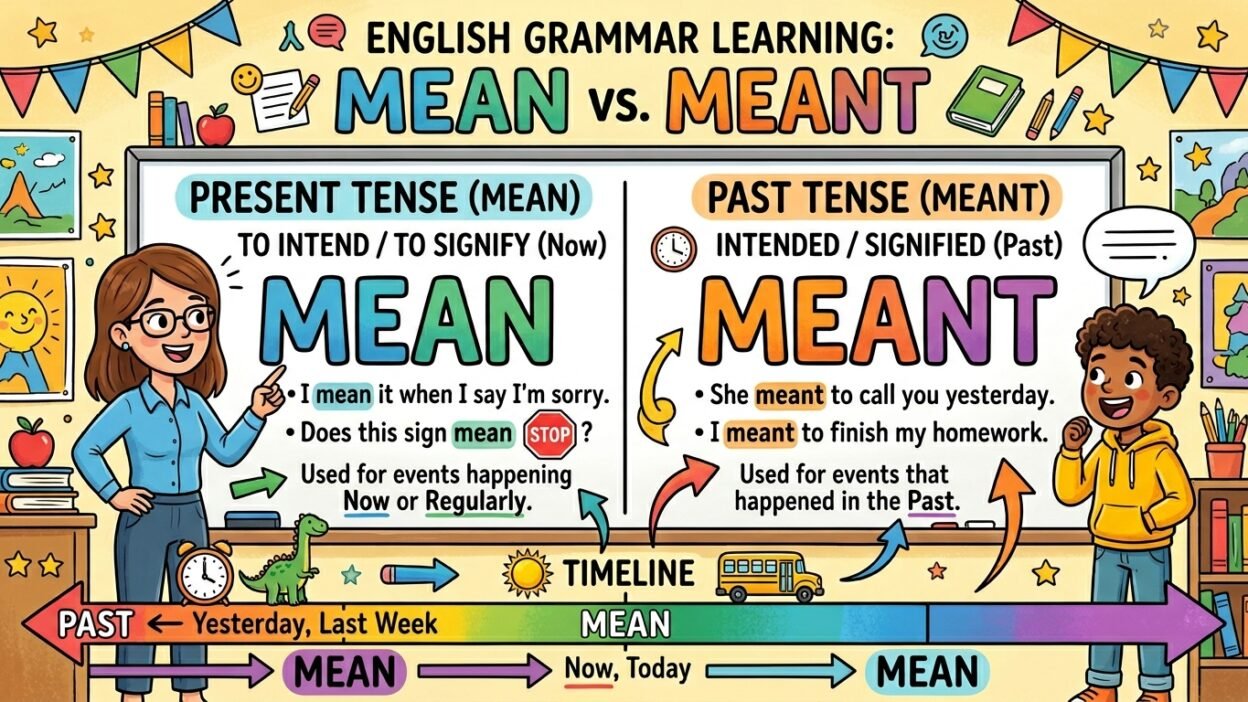
Many English learners get confused between mean and meant because both words come from the same verb. They look similar, sound somewhat alike, and are often used in similar situations.
The good news is that the difference is actually very simple.
Mean is the present form of the verb, while meant is the past form.
Once you understand when something is happening now and when it happened in the past, choosing the correct word becomes easy.
In this guide, you will learn the difference between mean and meant, see examples, avoid common mistakes, and feel more confident using both words correctly.
Quick Answer
- Mean = present tense
- Meant = past tense and past participle
- Use mean when talking about something happening now or generally.
- Use meant when talking about something that happened in the past.
Examples:
- I mean what I say.
- I meant what I said.
- What does this word mean?
- What meant the most to you yesterday?
Origin and Background
The word mean has been part of English for many centuries. It comes from older Germanic languages and has long been used to express an idea, intention, or meaning.
Over time, English developed different verb forms. Just like:
- go → went
- teach → taught
- mean → meant
The word meant became the past form of mean.
Today, English speakers use mean for present situations and meant for past situations.
Understanding the Difference Between Mean and Meant
The easiest way to remember the difference is to think about time.
Mean = Present
Use mean when talking about:
- Current meaning
- Current intention
- General facts
- Things happening now
Examples:
- What does this sentence mean?
- I mean every word.
- This sign means danger.
- What do you mean by that?
In all these examples, the action is happening in the present.
Meant = Past
Use meant when talking about:
- Past meaning
- Past intention
- Something someone wanted to say earlier
- Something that happened before now
Examples:
- I meant to call you yesterday.
- What meant the most to you during the trip?
- She meant no harm.
- We meant to arrive earlier.
These examples refer to past actions or intentions.
Mean vs Meant Comparison Table
| Feature | Mean | Meant |
|---|---|---|
| Part of speech | Verb | Verb |
| Tense | Present | Past |
| Time | Now or general | Earlier or completed |
| Usage | Current meaning or intention | Past meaning or intention |
| Example | I mean what I say. | I meant what I said. |
| Common with | do, does, am, is, are | did, had, was, were |
Which One Should You Use and When?
A simple trick is to look at the time of the sentence.
Use Mean When:
- Talking about the present
- Asking for a definition
- Expressing a current intention
- Giving an explanation
Examples:
- What does this word mean?
- I mean exactly what I said.
- What do you mean?
- This symbol means peace.
Use Meant When:
- Talking about the past
- Describing a past intention
- Explaining what someone wanted to say earlier
Examples:
- I meant to send the email.
- She meant well.
- We meant no offense.
- What meant the most to you last year?
Common Mistakes People Make
Many learners accidentally mix the present and past forms.
Mistake 1
❌ I meant what I say.
✅ I mean what I say.
The sentence is about the present, so use mean.
Mistake 2
❌ I mean to call you yesterday.
✅ I meant to call you yesterday.
The action happened in the past, so use meant.
Mistake 3
❌ What did you meaned?
✅ What did you mean?
After did, use the base verb.
Mistake 4
❌ She has mean to help.
✅ She has meant to help.
After has, use the past participle meant.
Mistake 5
❌ I meaned no harm.
✅ I meant no harm.
The correct past form is meant, not meaned.
Everyday Real Life Examples
Seeing the words in real situations makes them easier to remember.
In Emails
Present:
- I mean to discuss the project today.
Past:
- I meant to reply earlier.
In Social Media Posts
Present:
- I mean every word of this message.
Past:
- I meant that as a joke.
In News Reports
Present:
- Experts say the new law means higher costs.
Past:
- The announcement meant major changes for workers.
In Daily Conversations
Present:
- What do you mean?
Past:
- I meant to tell you yesterday.
At School
Present:
- What does this lesson mean?
Past:
- The teacher meant that we should study more.
Learning Tips for Students and Beginners
If you often confuse mean and meant, try these simple tips.
Remember the Time Rule
Ask yourself:
Is this happening now or in the past?
- Now = mean
- Past = meant
Practice With Questions
Present:
- What does it mean?
Past:
- What did it mean?
Learn Common Phrases
Mean:
- What do you mean?
- I mean it.
- It means a lot.
Meant:
- I meant it.
- I meant to call.
- She meant well.
Read and Listen
Pay attention to how native speakers use these words in:
- Books
- Movies
- Podcasts
- News articles
The more examples you see, the easier it becomes.
Frequently Asked Questions
Is mean or meant correct?
Both are correct. Mean is the present tense, while meant is the past tense.
What is the past tense of mean?
The past tense of mean is meant.
Example:
- I meant to help.
Can I say meaned?
No. Meaned is not a correct English word.
Use meant instead.
What do you mean or what do you meant?
The correct phrase is:
- What do you mean?
After do, use the base verb mean.
Is meant a real word?
Yes. Meant is the correct past tense and past participle of mean.
Which is more common, mean or meant?
Both are common.
- Mean is used for present situations.
- Meant is used for past situations.
Can meant show intention?
Yes.
Example:
- I meant to finish my homework.
This means you intended to do it.
How can I remember the difference?
Think about time.
- Present = mean
- Past = meant
This simple rule works in most situations.
Conclusion
The difference between mean and meant is based on time.
Use mean when talking about the present, current meaning, or something happening now.
Use meant when talking about the past, a previous intention, or something that already happened.
A quick reminder:
- Mean = present
- Meant = past
Examples:
- I mean what I say.
- I meant what I said.
Once you connect the words to time, choosing the correct one becomes simple and natural.