
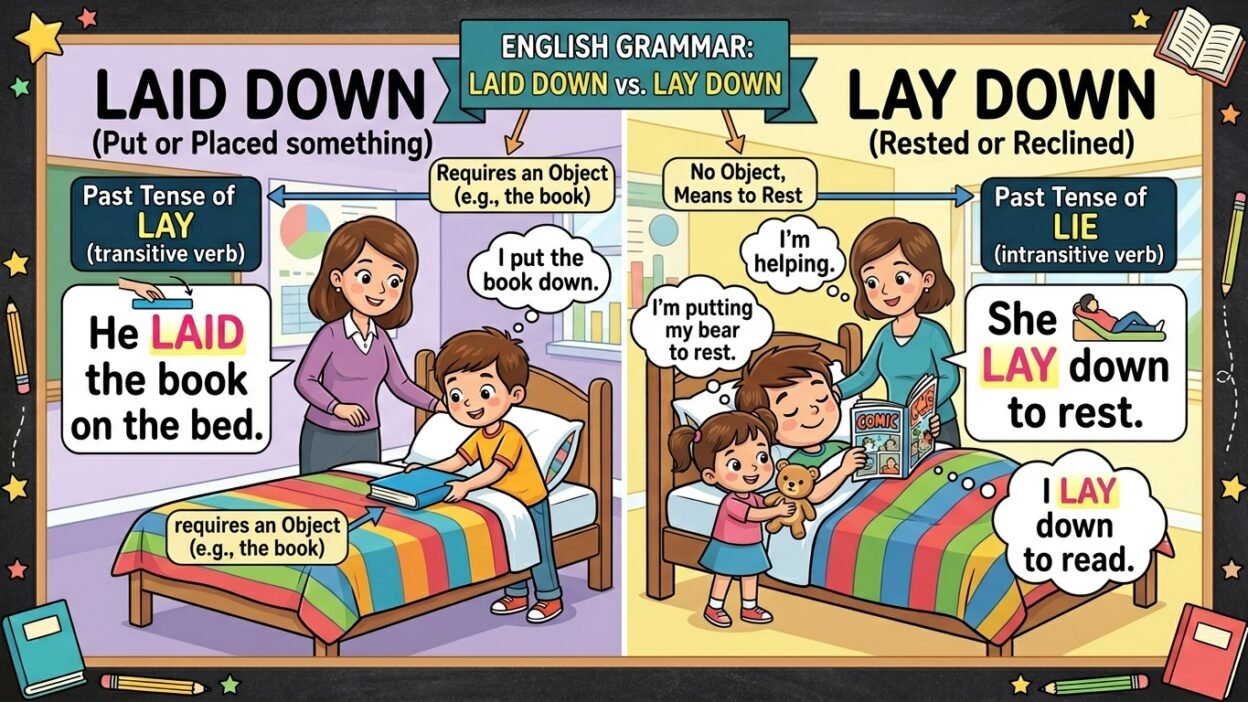
Many English learners get confused between laid down and lied down because both phrases involve resting on a bed, couch, or other surface. The words look similar, and many native speakers mix them up in everyday conversation.
The confusion becomes even greater because the verb lie has an unusual past tense. Most people expect the past tense to be “layed” or something similar, but English does not work that way.
The good news is that there is a simple rule:
- Lied down means someone rested in a horizontal position.
- Laid down means someone put something down.
Understanding who or what receives the action makes the difference easy to remember.
Quick Answer
- Lied down = correct when a person rests or reclines.
- Laid down = correct when someone places something down.
- Use lied down when no object is involved.
- Use laid down when an object receives the action.
Examples:
- I lied down after work.
- She lied down on the couch.
- I laid down my phone.
- He laid down the book.
Origin and Background
The confusion comes from two different verbs:
Lie
Lie means to rest in a flat position.
Verb forms:
- Lie
- Lay
- Lain
Examples:
- I lie down every afternoon.
- Yesterday, I lay down.
- I have lain down before.
Lay
Lay means to put or place something somewhere.
Verb forms:
- Lay
- Laid
- Laid
Examples:
- I lay the book on the table.
- Yesterday, I laid the book there.
- I have laid the book down many times.
Because the past tense of lie is lay, many people become confused.
Understanding the Difference Between Laid Down and Lied Down
The easiest way to remember the difference is to ask:
Was something placed somewhere?
If yes, use laid down.
If no, and a person simply rested, use lied down.
Lied Down = Rested
Use lied down when someone moved into a resting position.
Examples:
- I lied down for a nap.
- She lied down on the sofa.
- They lied down after the hike.
- The child lied down and fell asleep.
The person performs the action on themselves.
Laid Down = Put Something Down
Use laid down when an object is involved.
Examples:
- I laid down my keys.
- She laid down her bag.
- He laid down the newspaper.
- We laid down the tools.
Something receives the action.
Laid Down vs Lied Down Comparison Table
| Feature | Laid Down | Lied Down |
|---|---|---|
| Verb source | Lay | Lie |
| Meaning | Put something down | Rested or reclined |
| Needs an object | Yes | No |
| Action receiver | Object | The person |
| Example | I laid down my phone. | I lied down for a nap. |
Which One Should You Use and When?
A quick trick is to look for an object.
Use Lied Down When:
- Someone rested
- Someone reclined
- No object follows the verb
Examples:
- I lied down early.
- She lied down after lunch.
- We lied down on the grass.
- He lied down for a few minutes.
Use Laid Down When:
- Something is being placed somewhere
- An object follows the verb
Examples:
- I laid down my backpack.
- She laid down the papers.
- He laid down the remote control.
- We laid down the equipment.
Common Mistakes People Make
Mistake 1
❌ I laid down for a nap.
✅ I lied down for a nap.
No object is involved.
Mistake 2
❌ She lied down her purse.
✅ She laid down her purse.
The purse receives the action.
Mistake 3
❌ He laid down on the couch.
✅ He lied down on the couch.
The person is resting.
Mistake 4
❌ I lied down my phone.
✅ I laid down my phone.
The phone is the object.
Mistake 5
❌ We laid down on the bed and slept.
✅ We lied down on the bed and slept.
The people are resting, not placing something.
Everyday Real Life Examples
In Daily Conversation
- I lied down because I was tired.
- She lied down after dinner.
At Home
- I laid down my glasses.
- He laid down the TV remote.
At School
- The student laid down his notebook.
- The sick child lied down in the nurse’s office.
In Social Media Posts
- I lied down and accidentally fell asleep.
- I laid down my phone and enjoyed the view.
In News Writing
- The worker laid down his tools.
- The injured athlete lied down on the field.
Learning Tips for Students and Beginners
Remember the Object Rule
Ask:
Is something being placed somewhere?
- Yes = laid down
- No = lied down
Use This Memory Trick
Think:
- Lie = recline
- Lay = place
If you can replace the verb with place, use laid down.
Example:
- I placed my bag down.
- I laid down my bag.
Practice Short Sentences
Resting:
- I lied down.
- She lied down.
Placing:
- I laid down my book.
- He laid down the pen.
Read the Whole Sentence
Many mistakes disappear when you check whether an object follows the verb.
Frequently Asked Questions
Is it laid down or lied down?
It depends on the meaning.
- Lied down = rested.
- Laid down = placed something down.
Is “I laid down for a nap” correct?
Traditionally, no.
The correct form is:
- I lied down for a nap.
Why do people say “laid down” when resting?
Many native speakers use it in casual speech, but traditional grammar prefers lied down.
What is the past tense of lie?
The past tense of lie (to recline) is lay.
Example:
- Yesterday, I lay down.
What is the past tense of lay?
The past tense of lay is laid.
Example:
- I laid the book on the desk.
Does laid down need an object?
Yes.
Example:
- I laid down my jacket.
Does lied down need an object?
No.
Example:
- I lied down for an hour.
How can I remember the difference?
Use the object test:
- Object present = laid down
- No object = lied down
Conclusion
The difference between laid down and lied down comes from two different verbs.
Use lied down when a person rests or reclines.
Use laid down when someone places an object somewhere.
Quick reminder:
- I lied down on the couch. ✅
- I laid down my phone. ✅
When you remember the object rule, choosing the correct phrase becomes much easier.