
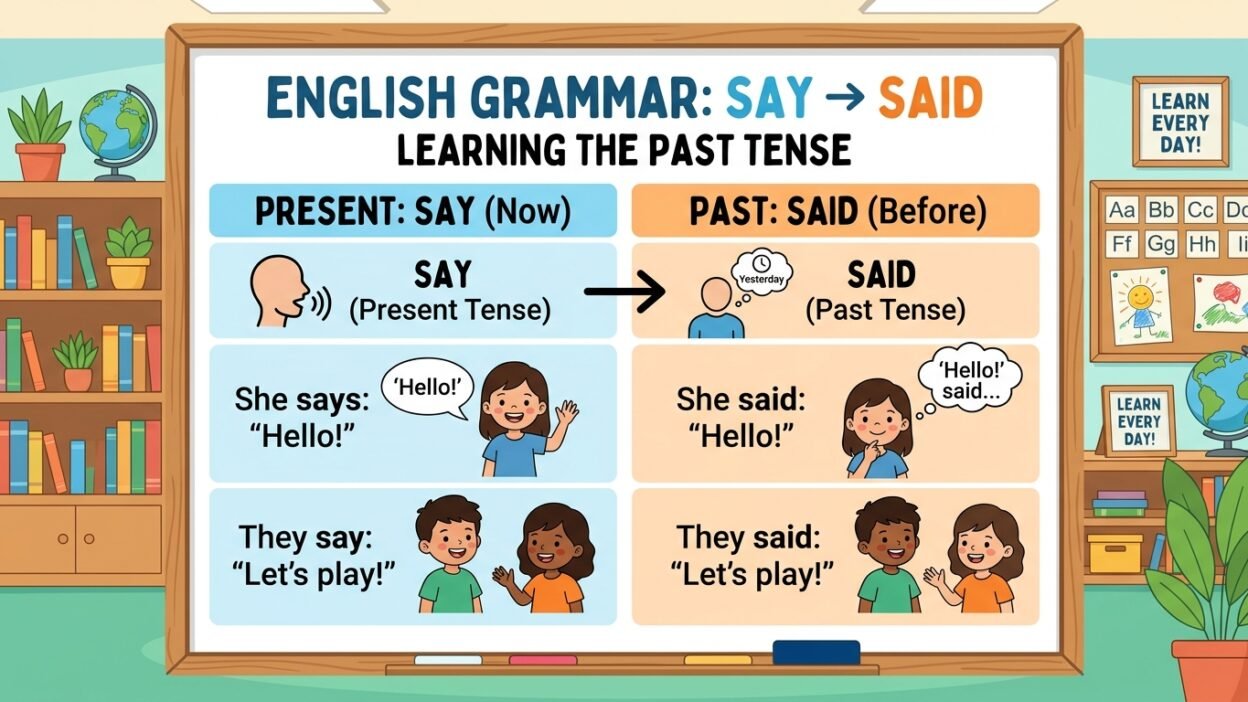
Many English learners get confused between “say” and “said.” These words are closely connected, but they are used in different tenses.
The confusion usually happens because “said” does not look very similar to “say,” even though it comes from the same verb.
The good news is that the rule is simple once you learn the tense difference.
Quick Answer
- Say = present tense
- Said = past tense and past participle
Simple Background
The verb “say” means:
- To speak words
- To tell something verbally
Over time, English changed the past tense form:
- say → said
This is an irregular verb, so it does not use “-ed.”
Clear Explanation of the Difference
What is “Say”?
Say is the present tense form.
Examples:
- “I say hello every morning.”
- “What did she say?”
It is used for:
- present actions
- future actions
- general statements
What is “Said”?
Said is the past tense and past participle form.
Examples:
- “He said he was tired.”
- “They have said this before.”
It is used for:
- past speech
- completed actions
Comparison Table
| Verb Form | Word | Example Sentence |
|---|---|---|
| Base Form | Say | “I say thank you.” |
| Past Tense | Said | “I said thank you yesterday.” |
| Past Participle | Said | “She has said that before.” |
Which One to Use and When
Use say when:
- Talking about the present or future
Use said when:
- Talking about the past
- Using perfect tenses with “has,” “have,” or “had”
Simple Tip to Remember
- Today → say
- Yesterday → said
Example:
- “I say my opinion now.”
- “I said my opinion yesterday.”
Common Mistakes People Make
1. Saying “sayed”
❌ “He sayed hello.”
✔ “He said hello.”
2. Using present tense for past actions
❌ “She say that yesterday.”
✔ “She said that yesterday.”
3. Forgetting irregular verb forms
“Say” changes completely in the past tense.
Everyday Real Life Examples
In School
- “The teacher said the answer was correct.”
In Daily Life
- “I said goodbye before leaving.”
- “They say this restaurant is good.”
In Messages
- “She said she will arrive soon.”
On Social Media
- “I never said that 😅”
Short Learning Section for Students
Here is a simple way to remember:
Step 1: Learn the forms
- Say = present
- Said = past
Step 2: Practice
- “I say thank you.”
- “I said thank you yesterday.”
Step 3: Use memory trick
Think:
Past speech uses “said.”
Step 4: Practice speaking aloud
Repeating helps memory.
FAQ
What is the past tense of “say”?
The past tense is “said.”
Is “sayed” correct?
No, it is incorrect.
Is “say” a regular verb?
No, it is an irregular verb.
What does “said” mean?
It means spoke or expressed words in the past.
Is “said” also a past participle?
Yes, it is both past tense and past participle.
Why is this confusing?
Because the spelling changes a lot.
How can I remember easily?
Think: say → said.
Conclusion
The difference between say and said is mainly about tense.
- Say is the present tense form.
- Said is the past tense and past participle form.
Remember this easy rule:
Never say “sayed.” Always use “said.”
With this, you can use both words correctly and confidently in everyday English.