
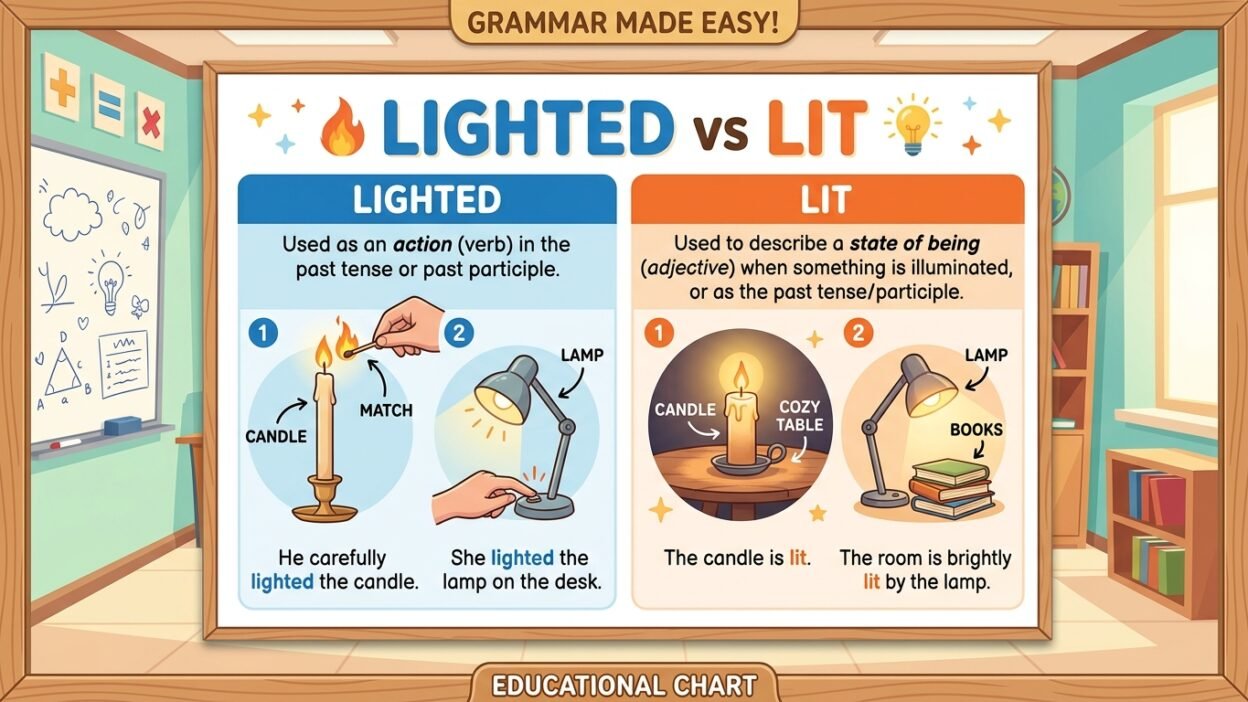
Many English learners get confused between “lighted” and “lit.” Both words are connected to the verb “light,” and both can be correct in English.
The confusion happens because English uses two accepted past forms for this verb.
The good news is that the difference is simple once you understand usage and style.
Quick Answer
- Lit = more common past tense and past participle
- Lighted = also correct, especially in some formal or descriptive uses
Both can mean:
- set on fire
- turned on
- made bright
Simple Background
The verb “light” means:
- To make something bright
- To start a fire
- To turn on a lamp or candle
Over time, English developed two past forms:
- lit
- lighted
Today:
- Lit is more common in everyday English
- Lighted still appears in certain styles and expressions
Clear Explanation of the Difference
What is “Lit”?
Lit is the more common form in modern English.
Examples:
- “She lit the candle.”
- “They lit the room with lamps.”
It sounds shorter and more natural in daily conversation.
What is “Lighted”?
Lighted is also correct.
Examples:
- “The building was lighted beautifully.”
- “A softly lighted hallway appeared ahead.”
It is often used:
- in formal writing
- in descriptive language
- before nouns in some expressions
Comparison Table
| Word | Type | Usage Style |
|---|---|---|
| Lit | Past tense/participle | More common everyday use |
| Lighted | Past tense/participle | Formal or descriptive use |
Which One to Use and When
Use lit when:
- Speaking casually
- Writing everyday English
- Talking about candles, fires, or lights
Use lighted when:
- Writing more formally
- Using descriptive phrases
Simple Tip to Remember
- Lit = shorter and more common
- Lighted = more formal or descriptive
Common Mistakes People Make
1. Thinking one form is wrong
Both are correct.
2. Using awkward combinations
Sometimes “lighted” sounds too formal in casual speech.
3. Forgetting context
Different styles prefer different forms.
Everyday Real-Life Examples
In Daily Life
- “He lit the candle.”
- “The streets were brightly lighted.”
In Stories
- “She lit a fire for warmth.”
In Descriptions
- “They entered a softly lighted room.”
In Messages
- “Who lit the grill?”
Short Learning Section for Students
Here is an easy way to remember:
Step 1: Learn the forms
- Light = present
- Lit / lighted = past
Step 2: Practice
- “I lit the lamp.”
- “The hall was lighted beautifully.”
Step 3: Use memory trick
Think:
Lit is common, lighted is formal.
Step 4: Listen to natural English
You will hear “lit” more often in conversation.
FAQ
Are both “lit” and “lighted” correct?
Yes, both are correct English forms.
Which form is more common?
“Lit” is more common in everyday English.
Is “lighted” formal?
It can sound more formal or descriptive.
Can both be past tense?
Yes, both work as past tense and past participle.
Why are there two forms?
English sometimes keeps both older and shorter verb forms.
Is this confusion common?
Yes, very common among learners.
How can I remember easily?
Think: lit = common, lighted = descriptive.
Conclusion
The difference between lighted and lit is mostly about style and usage.
- Lit is more common in everyday English.
- Lighted is also correct and often sounds more formal or descriptive.
Remember this easy rule:
Both are correct, but “lit” is usually the more natural choice.
With this, you can use both forms confidently and correctly.

Austin Brandon serves as both an author and administrator at GrammerPeak. He manages site operations while creating clear, accurate grammar content that helps readers correct mistakes, understand language rules, and write with confidence, precision, and clarity across academic, professional, and everyday English communication.