
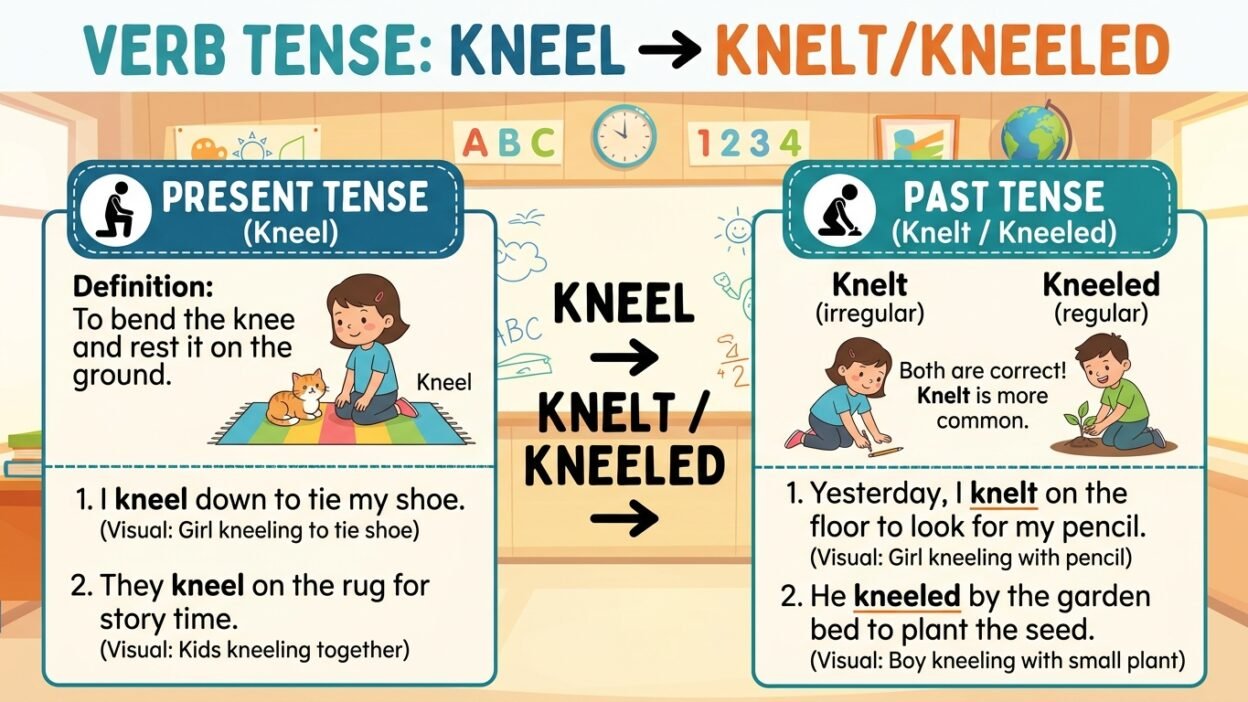
Many English learners become confused about the past tense of “kneel.” The confusion happens because English uses more than one accepted past tense form for this verb.
The good news is that both common forms are correct, and the difference is mostly about style and region.
Quick Answer
- Kneel = present tense
- Knelt = common past tense
- Kneeled = also correct past tense
Simple Background
The verb “kneel” means:
- To go down onto your knees
Over time, English developed two past tense forms:
- knelt
- kneeled
Today:
- Knelt is more common in British English
- Kneeled is also widely accepted, especially in American English
Clear Explanation of the Difference
What is “Kneel”?
Kneel is the present tense form.
Examples:
- “People kneel to pray.”
- “The player will kneel before the ceremony.”
What is “Knelt”?
Knelt is a common past tense and past participle form.
Examples:
- “She knelt beside the child.”
- “They had knelt quietly.”
What is “Kneeled”?
Kneeled is also correct.
Examples:
- “He kneeled during the prayer.”
- “The athlete kneeled before the game.”
Comparison Table
| Verb Form | Word | Usage Style |
|---|---|---|
| Base Form | Kneel | Present tense |
| Past Tense | Knelt | Common, especially British |
| Past Tense | Kneeled | Also correct, common in US |
| Past Participle | Knelt / Kneeled | Both accepted |
Which One to Use and When
Use kneel when:
- Talking about the present or future
Use knelt or kneeled when:
- Talking about the past
Simple Tip to Remember
- Kneel = now
- Knelt / kneeled = past
Which Form Sounds More Natural?
- Knelt often sounds more traditional and natural
- Kneeled sounds more regular and modern to some speakers
Common Mistakes People Make
1. Thinking only one form is correct
Both “knelt” and “kneeled” are accepted.
2. Mixing tenses
❌ “He kneel yesterday.”
✔ “He knelt yesterday.”
✔ “He kneeled yesterday.”
3. Forgetting pronunciation
“Knelt” and “kneeled” sound different.
Everyday Real Life Examples
In Religion
- “They knelt during prayer.”
- “She kneeled beside the bed.”
In Sports
- “The players kneeled before the match.”
In Daily Life
- “He knelt to tie his shoe.”
- “She kneeled on the floor.”
In Stories
- “The knight knelt before the king.”
Short Learning Section for Students
Here is an easy way to remember:
Step 1: Learn the forms
- Kneel = present
- Knelt / kneeled = past
Step 2: Practice
- “I kneel to pray.”
- “I knelt yesterday.”
- “I kneeled yesterday.”
Step 3: Use memory trick
Think:
Both past forms are correct.
Step 4: Stay consistent
Choose one style in your writing.
FAQ
What is the past tense of “kneel”?
Both “knelt” and “kneeled” are correct.
Which form is more common?
“Knelt” is often more common in British English.
Is “kneeled” wrong?
No, it is completely correct.
Is “kneel” a regular verb?
It has both regular and irregular past forms.
Which should I use in exams?
Usually, “knelt” is safer unless your style guide prefers “kneeled.”
Why are there two forms?
English sometimes keeps both old and newer verb patterns.
How can I remember easily?
Think: kneel → knelt or kneeled.
Conclusion
The past tense of “kneel” can be written in two correct ways.
- Knelt is traditional and very common.
- Kneeled is also accepted, especially in American English.
Remember this easy rule:
Both forms are correct just stay consistent in your writing.
With this, you can use the past tense of “kneel” confidently and correctly.