
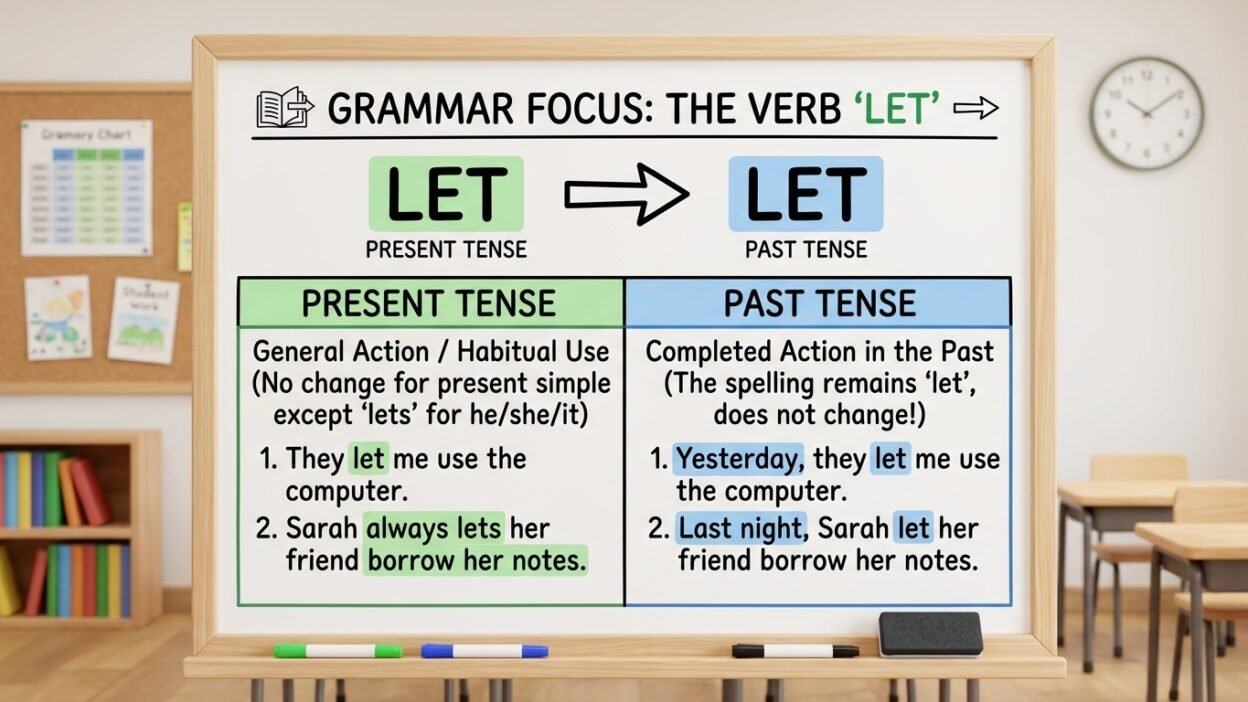
Many English learners become confused about the past tense of “let.” Since many verbs change in the past tense, people often expect “let” to change too.
But this verb is actually much simpler than many other English verbs.
Quick Answer
- Let = present tense
- Let = past tense
- Let = past participle
The spelling stays the same in all forms.
Simple Background
The verb “let” means:
- To allow
- To permit
- To give permission
Unlike many English verbs, “let” is an irregular verb that does not change spelling in the past tense.
This pattern is similar to:
- put → put
- cut → cut
Clear Explanation of the Difference
What is “Let”?
Let is the present tense form.
Examples:
- “My parents let me stay up late.”
- “Please let him speak.”
What is the Past Tense of “Let”?
The past tense is also let.
Examples:
- “They let us enter yesterday.”
- “She let me borrow her book.”
Comparison Table
| Verb Form | Word | Example Sentence |
|---|---|---|
| Base Form | Let | “They let me go.” |
| Past Tense | Let | “They let me go yesterday.” |
| Past Participle | Let | “They have let him stay.” |
Which One to Use and When
Use let for:
- Present tense
- Past tense
- Past participle
Simple Tip to Remember
- Today → let
- Yesterday → let
The spelling never changes.
Common Mistakes People Make
1. Saying “letted”
❌ “She letted me leave.”
✔ “She let me leave.”
2. Adding unnecessary endings
“Let” already works as the past tense.
3. Forgetting it is irregular
Not all verbs use “-ed.”
Everyday Real-Life Examples
In School
- “The teacher let us leave early.”
In Daily Life
- “My friend let me use his phone.”
- “They let the dog inside.”
In Messages
- “She let me know yesterday.”
In Family Conversations
- “Dad let us watch a movie.”
Short Learning Section for Students
Here is an easy way to remember:
Step 1: Learn the forms
- Let = present
- Let = past
Step 2: Practice
- “They let me play.”
- “They let me play yesterday.”
Step 3: Use memory trick
Think:
Let never changes.
Step 4: Avoid adding “-ed”
Do not say “letted.”
FAQ
What is the past tense of “let”?
The past tense is “let.”
Is “letted” correct?
No, it is incorrect.
Does “let” change in the past tense?
No, the spelling stays the same.
Is “let” an irregular verb?
Yes, it is irregular.
What does “let” mean?
It means allow or permit.
Is “let” also the past participle?
Yes, it is.
How can I remember easily?
Think: let always stays let.
Conclusion
The past tense of “let” is very simple.
- Let = present tense
- Let = past tense
- Let = past participle
Remember this easy rule:
Never say “letted.” The word always stays “let.”
With this, you can use the verb correctly and confidently in everyday English.

Austin Brandon serves as both an author and administrator at GrammerPeak. He manages site operations while creating clear, accurate grammar content that helps readers correct mistakes, understand language rules, and write with confidence, precision, and clarity across academic, professional, and everyday English communication.