Many English learners get confused by spring, sprang, and sprung because all three words come from the same verb. Since they look similar and have related meanings, it can be hard to know which one is correct in a sentence.
The simple answer is that these words represent different forms of the verb spring. Understanding when to use each form will help you avoid common grammar mistakes and make your English sound more natural.
In this guide, you’ll learn the difference between spring, sprang, and sprung with easy explanations, simple examples, and practical tips.
Quick Answer
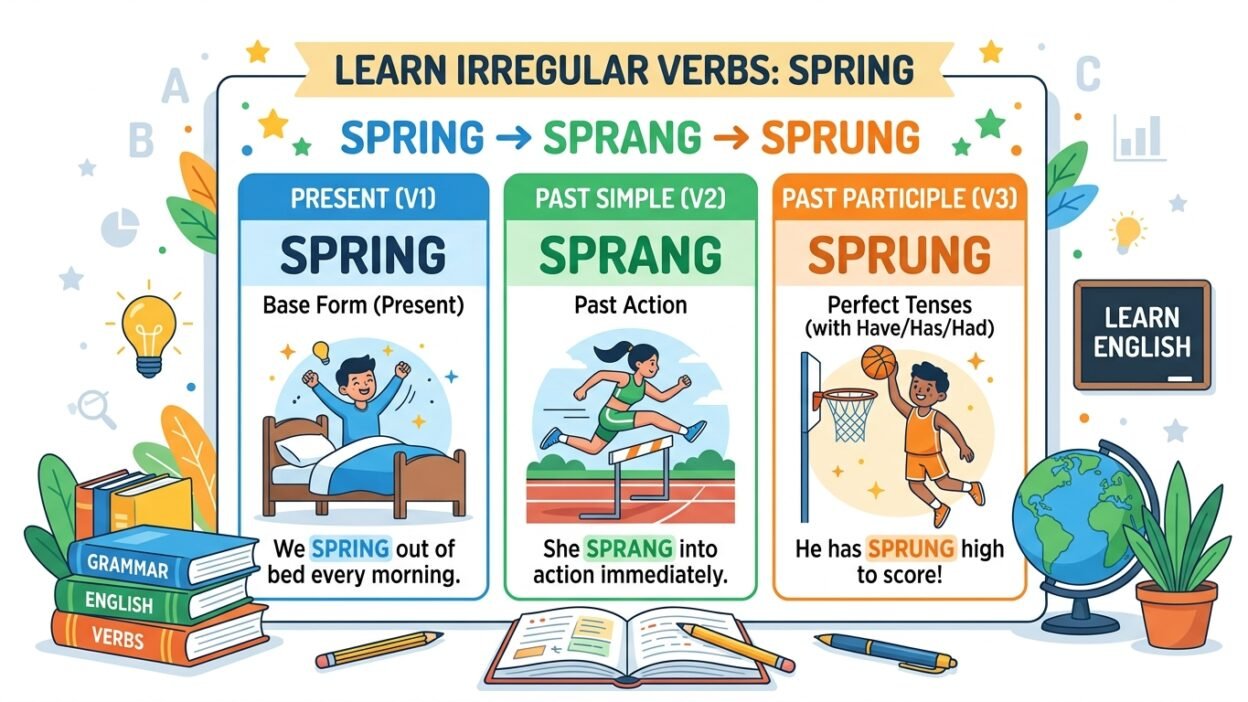
- Spring = base form (present tense)
- Sprang = simple past tense
- Sprung = past participle
- Use spring for present actions.
- Use sprang for actions completed in the past.
- Use sprung with helping verbs such as has, have, had, was, were, be, been.
Examples
✅ The cat sprang onto the table.
✅ The cat has sprung onto the table many times before.
❌ The cat has sprang onto the table.
❌ The cat sprung onto the table yesterday.
Simple Origin or Background Explanation
The verb spring is an irregular verb. Unlike regular verbs, it does not simply add -ed to form the past tense.
For example:
- Walk → Walked
- Jump → Jumped
But spring changes its form completely:
| Verb Form | Word |
|---|---|
| Base Verb | Spring |
| Past Tense | Sprang |
| Past Participle | Sprung |
This pattern has existed in English for hundreds of years, which is why the forms are different from regular verbs.
The Difference Between Spring, Sprang, and Sprung
Spring
Spring is the base form of the verb.
It usually refers to present actions or follows helping verbs like will, can, may, and should.
Examples:
- Cats can spring very high.
- The toy may spring out of the box.
- Watch how quickly he can spring into action.
- I will spring from my seat when I hear the news.
Sprang
Sprang is the simple past tense.
Use it for actions that happened and finished in the past.
Examples:
- The cat sprang onto the fence.
- She sprang from her chair when the phone rang.
- The athlete sprang forward at the start of the race.
- He sprang into action immediately.
Sprung
Sprung is the past participle.
It usually appears with helping verbs.
Examples:
- The cat has sprung onto that fence many times.
- She had sprung from her chair before anyone spoke.
- The trap has sprung unexpectedly.
- He has sprung into action before.
Comparison Table
| Feature | Spring | Sprang | Sprung |
|---|---|---|---|
| Verb Type | Base Form | Past Tense | Past Participle |
| Time Reference | Present/Future | Past | Perfect Tenses |
| Needs Helping Verb? | Sometimes | No | Usually Yes |
| Used Alone? | Yes | Yes | Usually No |
| Example | I spring into action. | I sprang into action. | I have sprung into action. |
Which One to Use and When
Use “Spring” When:
- Talking about the present
- Using modal verbs such as can, will, may, should
Examples:
- Rabbits can spring quickly.
- The lid may spring open.
- I will spring into action if needed.
Use “Sprang” When:
- Talking about a completed past action
- No helping verb comes before it
Examples:
- The cat sprang from the tree.
- He sprang to his feet.
- She sprang into action immediately.
Use “Sprung” When:
- A helping verb comes before it
- You are using perfect tenses
- You are using passive constructions
Examples:
- The trap has sprung.
- He had sprung from his chair.
- The surprise has sprung on everyone.
Easy Memory Trick
Remember this pattern:
Spring → Sprang → Sprung
If you see has, have, or had, you will usually need sprung.
Common Mistakes People Make
Mistake 1: Using Sprang After “Have”
❌ I have sprang into action.
✅ I have sprung into action.
Mistake 2: Using Sprung for Simple Past
❌ Yesterday the cat sprung onto the table.
✅ Yesterday the cat sprang onto the table.
Mistake 3: Forgetting the Irregular Pattern
❌ Springed
✅ Sprang
English does not use springed as the standard past tense.
Mistake 4: Mixing Past Tense and Past Participle
❌ She had sprang from her seat.
✅ She had sprung from her seat.
Mistake 5: Using the Wrong Verb Form in Writing
❌ The trap has sprang.
✅ The trap has sprung.
Everyday Real Life Examples
In Emails
✅ The issue sprang up yesterday.
✅ The problem has sprung up again.
In News Reports
✅ A fire sprang up overnight.
✅ Several concerns have sprung from the new policy.
On Social Media
✅ My cat sprang onto the counter again.
✅ New rumors have sprung up online.
At School
✅ The student sprang from his seat to answer.
✅ Several questions have sprung from today’s lesson.
At Home
✅ The dog sprang toward the door.
✅ The dog has sprung onto the couch before.
At Work
✅ An opportunity sprang up unexpectedly.
✅ New challenges have sprung up this week.
Short Learning Section for Students and Beginners
Memorize these three forms together:
| Base Form | Past Tense | Past Participle |
|---|---|---|
| Spring | Sprang | Sprung |
Practice them aloud:
- Spring
- Sprang
- Sprung
Now use them in sentences:
- Birds spring into the air.
- The bird sprang into the air.
- The bird has sprung into the air.
Repeating the pattern helps you remember it naturally.
FAQ
Is “sprang” correct English?
Yes. Sprang is the correct simple past tense of spring.
Example:
- The cat sprang onto the wall.
Is “sprung” correct English?
Yes. Sprung is the correct past participle form.
Example:
- The cat has sprung onto the wall.
Can I say “I have sprang”?
No.
The correct sentence is:
- I have sprung.
What is the past tense of spring?
The past tense is sprang.
Example:
- He sprang to his feet.
What is the past participle of spring?
The past participle is sprung.
Example:
- He has sprung to his feet.
Is “springed” a word?
In standard English grammar, springed is not the normal past tense form of spring.
Use sprang instead.
What does “spring up” mean?
It means to appear or develop suddenly.
Example:
- New problems sprang up during the project.
How can I remember the difference?
Remember this simple pattern:
Spring → Sprang → Sprung
- Present = Spring
- Past = Sprang
- Past Participle = Sprung
Conclusion
The difference between spring, sprang, and sprung becomes easy once you understand their roles.
- Spring is the base form.
- Sprang is the past tense.
- Sprung is the past participle.
- Use sprang for completed actions in the past.
- Use sprung with helping verbs like has, have, and had.
Remember the pattern spring → sprang → sprung, and you’ll be able to use all three forms correctly and confidently in everyday English.

Austin Brandon serves as both an author and administrator at GrammerPeak. He manages site operations while creating clear, accurate grammar content that helps readers correct mistakes, understand language rules, and write with confidence, precision, and clarity across academic, professional, and everyday English communication.