Many English learners get confused between began and begun because both words come from the verb begin and both refer to the past.
Since the two words look similar and have related meanings, it can be difficult to know which one belongs in a sentence.
The good news is that the difference is very simple.
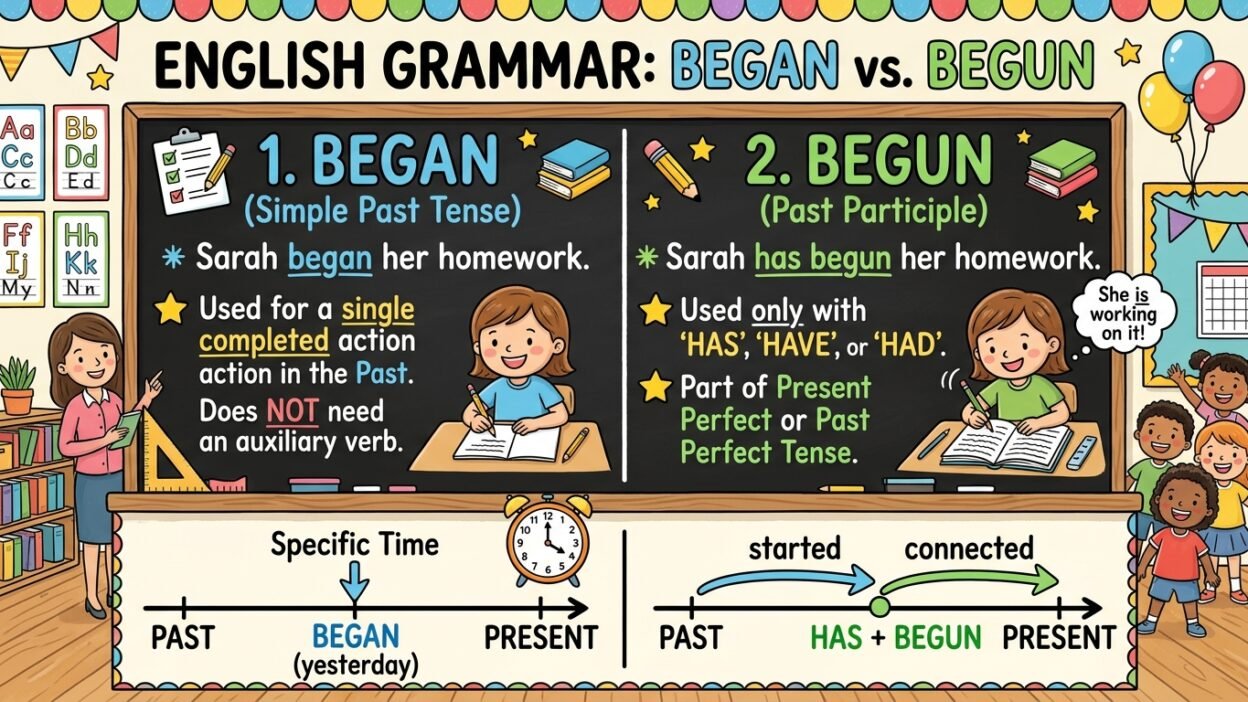
- Began is the simple past tense.
- Begun is the past participle.
Once you learn this basic rule, you can use both words correctly and avoid one of the most common grammar mistakes in English.
Quick Answer
- Begin = present tense
- Began = simple past tense
- Begun = past participle
- Use began for a completed action in the past.
- Use begun with helping verbs such as has, have, had, was, or been.
Examples:
- The meeting began at 9 a.m.
- She began learning English last year.
- The project has begun.
- They had begun working before sunrise.
Origin and Background
The verb begin is an old English word that means to start something.
Like many common English verbs, it is irregular.
Its forms are:
- Begin
- Began
- Begun
This pattern is similar to:
- Drink → Drank → Drunk
- Ring → Rang → Rung
- Sing → Sang → Sung
- Begin → Began → Begun
Because the past tense and past participle are different, many learners accidentally use the wrong form.
Understanding the Difference Between Began and Begun
The easiest way to understand the difference is to remember their grammar roles.
Began = Simple Past Tense
Use began when talking about an action that started in the past.
Examples:
- The class began at eight o’clock.
- I began reading the book yesterday.
- She began her career in 2020.
- They began construction last month.
In these examples, the action happened in the past and does not need a helping verb.
Begun = Past Participle
Use begun with helping verbs.
Examples:
- The movie has begun.
- We have begun our journey.
- She had begun the assignment.
- The process has begun already.
Notice that begun usually appears with words like:
- has
- have
- had
- been
Began vs Begun Comparison Table
| Feature | Began | Begun |
|---|---|---|
| Verb form | Simple past | Past participle |
| Used alone | Yes | Usually no |
| Needs helping verb | No | Yes |
| Time reference | Past action | Perfect tenses |
| Example | The game began. | The game has begun. |
Which One Should You Use and When?
A simple trick is to check for a helping verb.
Use Began When:
- Talking about a past action
- No helping verb is present
Examples:
- The meeting began early.
- She began writing the report.
- We began our trip yesterday.
- He began studying French.
Use Begun When:
- Using have, has, or had
- Forming perfect tenses
Examples:
- The show has begun.
- We have begun planning.
- She had begun the project.
- The work has begun already.
Common Mistakes People Make
Mistake 1
❌ The meeting has began.
✅ The meeting has begun.
Mistake 2
❌ We have began our work.
✅ We have begun our work.
Mistake 3
❌ She begun her homework yesterday.
✅ She began her homework yesterday.
Mistake 4
❌ They had began the project.
✅ They had begun the project.
Mistake 5
❌ The class begun at 9 a.m.
✅ The class began at 9 a.m.
Everyday Real Life Examples
In School
- The lesson began at eight.
- The exam has begun.
At Work
- The meeting began late.
- The project has begun successfully.
In News Reports
- The ceremony began this morning.
- Construction has begun on the new bridge.
In Daily Conversation
- I began learning English last year.
- We have begun discussing the plan.
On Social Media
- My vacation has begun!
- The event began earlier than expected.
Learning Tips for Students and Beginners
Memorize the Three Forms Together
Learn:
- Begin
- Began
- Begun
This makes it easier to remember which form belongs where.
Look for Helping Verbs
If you see:
- has
- have
- had
you will usually need begun.
Practice Short Sentences
Present:
- I begin.
Past:
- I began.
Perfect:
- I have begun.
Remember Similar Patterns
These verbs follow a similar structure:
| Present | Past | Past Participle |
| Sing | Sang | Sung |
| Ring | Rang | Rung |
| Drink | Drank | Drunk |
| Begin | Began | Begun |
Frequently Asked Questions
Is it began or begun?
Both are correct, but they are used differently.
What is the difference between began and begun?
Began is the simple past tense. Begun is the past participle.
Is “has began” correct?
No.
Correct:
- Has begun
Is “begun” a real word?
Yes. It is the past participle of begin.
Can begun be used alone?
Usually no. It normally appears with helping verbs.
What is the past tense of begin?
The past tense is began.
What is the past participle of begin?
The past participle is begun.
How can I remember the difference?
Think:
- Begin = present
- Began = past
- Begun = past participle
Conclusion
The difference between began and begun is based on grammar.
Use began as the simple past tense when talking about something that started in the past.
Use begun as the past participle with helping verbs such as has, have, and had.
Quick reminder:
- Begin = present
- Began = past
- Begun = past participle
Examples:
- The meeting began at 10 a.m.
- The meeting has begun.
Once you remember this simple pattern, choosing the correct word becomes easy and natural.