Many English learners get confused between know, knew, and known because all three words come from the same verb.
The confusion usually happens because they refer to different points in time and have different grammar roles. Some learners write sentences like “I have knew” or “I known him yesterday,” which are common mistakes.
The good news is that the difference is easy to understand.
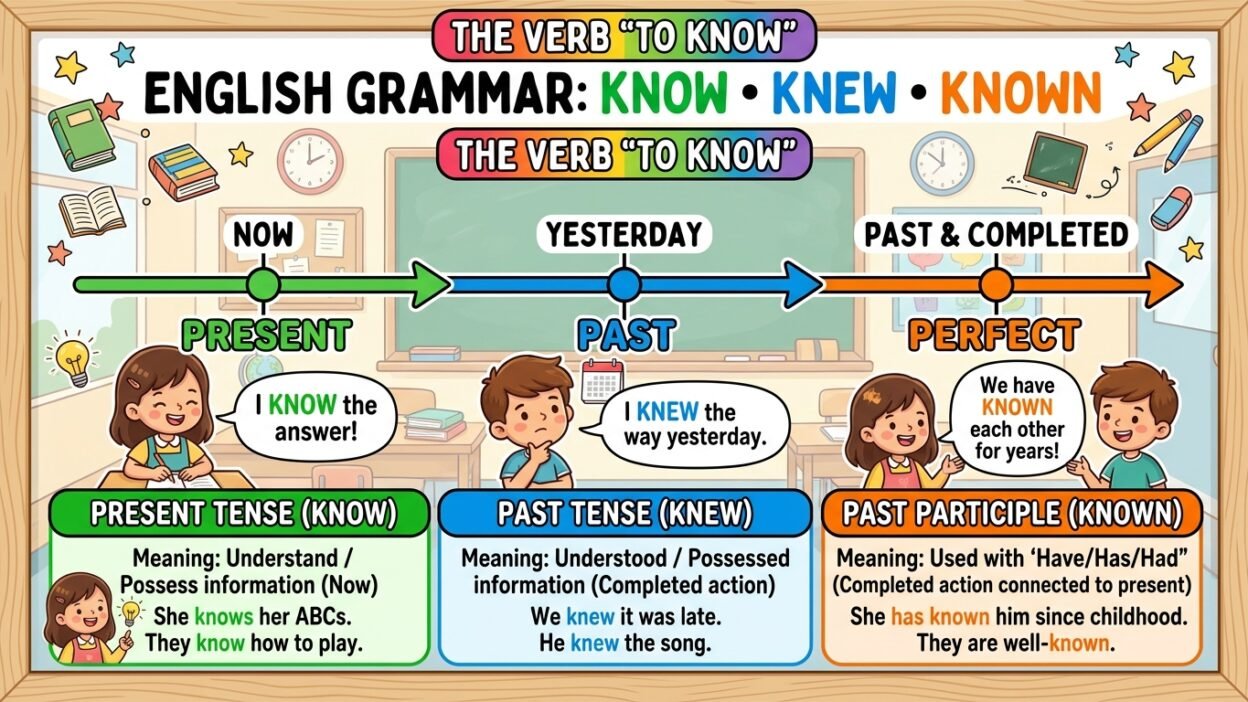
- Know is the present tense.
- Knew is the past tense.
- Known is the past participle.
Once you learn when each form is used, choosing the correct word becomes much easier.
Quick Answer
- Know = present tense
- Knew = past tense
- Known = past participle
- Use know for present situations.
- Use knew for completed actions in the past.
- Use known with helping verbs such as have, has, had, is, was, or been.
Examples:
- I know the answer.
- I knew the answer yesterday.
- I have known the answer for years.
- She has known him since childhood.
Origin and Background
The verb know is one of the oldest verbs in English. It means to understand, recognize, be familiar with, or have information about something.
Like many common English verbs, it is irregular.
Its forms are:
- Know
- Knew
- Known
This pattern is similar to:
- Blow → Blew → Blown
- Grow → Grew → Grown
- Throw → Threw → Thrown
- Know → Knew → Known
Because the forms change completely, many learners mix them up.
Understanding the Difference Between Know, Knew, and Known
The easiest way to understand the difference is to remember what each form does.
Know = Present Tense
Use know when talking about something that is true now.
Examples:
- I know her name.
- We know the answer.
- They know where to go.
- She knows the truth.
These actions or facts exist in the present.
Knew = Past Tense
Use knew when talking about something that was true in the past.
Examples:
- I knew the answer yesterday.
- She knew him in college.
- We knew about the event.
- They knew the rules.
The action happened in the past and does not require a helping verb.
Known = Past Participle
Use known with helping verbs.
Examples:
- I have known her for years.
- She has known the truth since Monday.
- We had known about the problem.
- He is known for his kindness.
Notice that known is usually used with words like:
- have
- has
- had
- is
- was
- been
Know vs Knew vs Known Comparison Table
| Feature | Know | Knew | Known |
|---|---|---|---|
| Verb form | Present | Past | Past participle |
| Time | Present | Past | Perfect/passive forms |
| Used alone | Yes | Yes | Usually no |
| Needs helping verb | No | No | Yes |
| Example | I know her. | I knew her. | I have known her. |
Which One Should You Use and When?
A quick trick is to look at the sentence time and helping verbs.
Use Know When:
- Talking about the present
- Describing current knowledge
Examples:
- I know the answer.
- She knows the teacher.
- We know the rules.
Use Knew When:
- Talking about the past
- No helping verb is present
Examples:
- I knew the answer yesterday.
- He knew the location.
- They knew the facts.
Use Known When:
- Using have, has, or had
- Using passive voice
Examples:
- I have known him for years.
- She has known that fact since childhood.
- He is known worldwide.
Common Mistakes People Make
Mistake 1
❌ I have knew him for years.
✅ I have known him for years.
Mistake 2
❌ She known the answer yesterday.
✅ She knew the answer yesterday.
Mistake 3
❌ We have know the truth.
✅ We have known the truth.
Mistake 4
❌ He knew her since 2015.
✅ He has known her since 2015.
Mistake 5
❌ I known the answer.
✅ I know the answer.
Everyday Real-Life Examples
At School
- I know the answer.
- I knew the answer during the test.
- I have known that rule for years.
At Work
- We know the deadline.
- We knew about the meeting yesterday.
- We have known the client for a long time.
In Daily Conversation
- I know what you mean.
- I knew you would say that.
- I have known her since childhood.
On Social Media
- I know this song.
- I knew this trend would become popular.
- I have known about it for months.
In News Reports
- Officials knew about the issue.
- Authorities have known the risks for years.
Learning Tips for Students and Beginners
Memorize the Three Forms Together
Learn them as a group:
- Know
- Knew
- Known
Look for Helping Verbs
If you see:
- have
- has
- had
- been
you will usually need known.
Practice Short Sentences
Present:
- I know.
Past:
- I knew.
Perfect:
- I have known.
Learn Similar Patterns
| Present | Past | Past Participle |
| Blow | Blew | Blown |
| Grow | Grew | Grown |
| Throw | Threw | Thrown |
| Know | Knew | Known |
Frequently Asked Questions
What is the difference between know, knew, and known?
Know is present tense, knew is past tense, and known is the past participle.
Is “I have knew” correct?
No.
Correct:
- I have known.
What is the past tense of know?
The past tense of know is knew.
What is the past participle of know?
The past participle is known.
Can known be used without a helping verb?
Usually no.
It is commonly used with helping verbs.
Is “I known him” correct?
No.
Correct:
- I know him.
- I have known him.
Why is know an irregular verb?
It changes form instead of adding -ed, making it irregular.
How can I remember the forms?
Remember:
- Know
- Knew
- Known
Think of:
- Grow → Grew → Grown
- Know → Knew → Known
Conclusion
The difference between know, knew, and known is based on grammar and time.
Use know for the present.
Use knew for the past.
Use known with helping verbs and in perfect tenses.
Quick reminder:
- Know = present
- Knew = past
- Known = past participle
Examples:
- I know the answer.
- I knew the answer yesterday.
- I have known the answer for years.
Once you remember these three forms, using them correctly becomes simple and natural.