Many English learners get confused about shook and shaken because both words come from the verb shake. Since they look similar and are related to the same action, it can be difficult to know which one is correct.
The good news is that the difference is actually very simple. Once you understand how English verb forms work, choosing between shook and shaken becomes much easier.
This guide explains everything in clear and simple English with examples you can use in everyday conversations, writing, emails, social media posts, and schoolwork.
Quick Answer
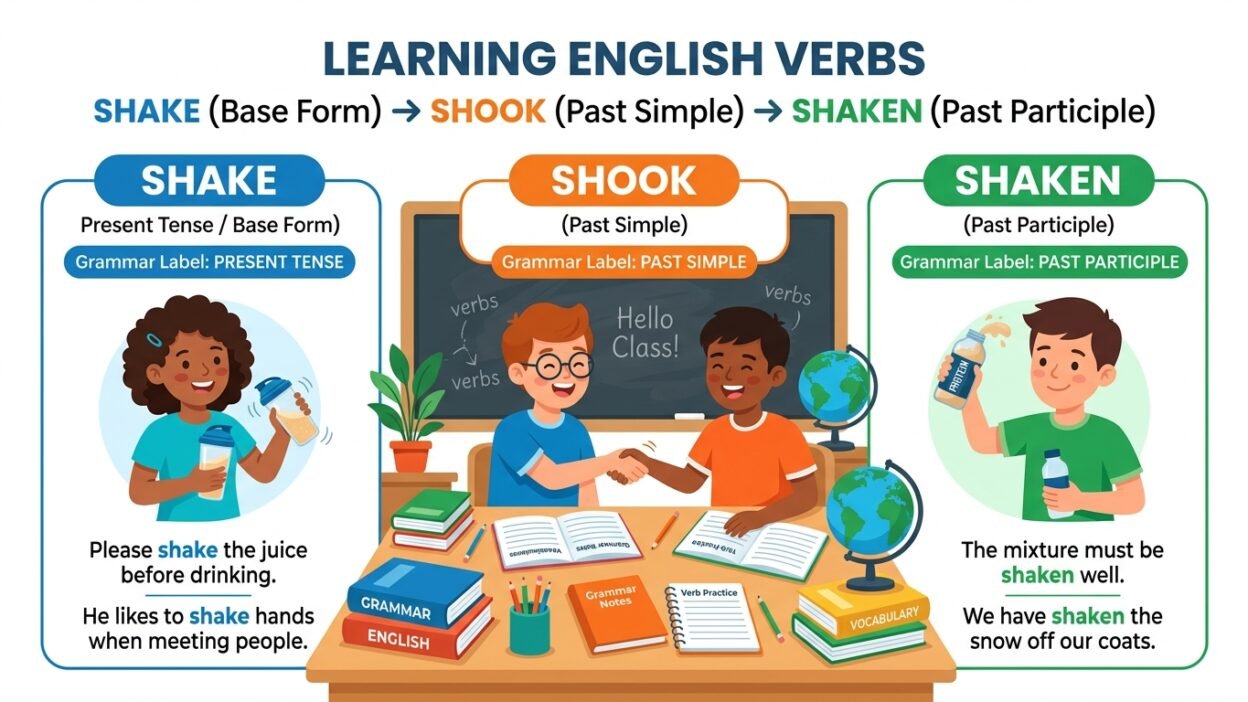
- Shake = base form of the verb
- Shook = simple past tense
- Shaken = past participle
- Use shook when talking about something that happened in the past.
- Use shaken with helping verbs such as has, have, had, was, were, is, are, been.
Examples
✅ I shook the bottle before opening it.
✅ She has shaken the bottle already.
❌ I have shook the bottle.
❌ She shaken the bottle.
Simple Origin or Background Explanation
The verb shake is an irregular verb in English. This means it does not follow the normal pattern of adding -ed to form the past tense.
Many regular verbs work like this:
- Walk → Walked
- Jump → Jumped
- Clean → Cleaned
But shake is different:
| Verb Form | Word |
|---|---|
| Base Verb | Shake |
| Past Tense | Shook |
| Past Participle | Shaken |
Because English has many irregular verbs, learners often mix up the past tense and past participle forms.
The Difference Between Shook and Shaken
The main difference is the grammar structure they belong to.
Shook
Shook is the simple past tense of shake.
Use it when talking about an action that happened and finished in the past.
Examples:
- I shook his hand yesterday.
- The earthquake shook the building.
- She shook the tree to make the fruit fall.
- We shook the bottle before drinking the juice.
In these sentences, no helping verb is needed.
Shaken
Shaken is the past participle form of shake.
It usually comes after helping verbs.
Examples:
- I have shaken the bottle.
- She has shaken hands with the manager.
- The building was shaken by the earthquake.
- They had shaken the package before opening it.
Notice that shaken is not normally used alone.
Comparison Table
| Feature | Shook | Shaken |
|---|---|---|
| Verb Type | Past tense | Past participle |
| Used Alone? | Yes | Usually no |
| Needs Helping Verb? | No | Yes |
| Common Helpers | None | Has, Have, Had, Was, Were, Been |
| Example | I shook the box. | I have shaken the box. |
| Correct for Simple Past? | Yes | No |
| Correct for Perfect Tenses? | No | Yes |
Which One to Use and When
A simple rule can help.
Use “Shook” When:
- Talking about a completed past action
- No helping verb comes before it
Examples:
- He shook the table.
- They shook hands after the meeting.
- The storm shook the windows all night.
Use “Shaken” When:
- A helping verb comes before it
- You are using perfect tenses
- You are using passive voice
Examples:
- I have shaken the bottle.
- She had shaken the package.
- The house was shaken by strong winds.
Easy Memory Trick
If you see:
- has
- have
- had
- was
- were
- been
you will usually need shaken, not shook.
Common Mistakes People Make
Mistake 1: Using Shook After “Have”
❌ I have shook the bottle.
✅ I have shaken the bottle.
Mistake 2: Using Shaken Without a Helping Verb
❌ Yesterday I shaken the tree.
✅ Yesterday I shook the tree.
Mistake 3: Mixing Up Past Tense and Past Participle
❌ She had shook the package.
✅ She had shaken the package.
Mistake 4: Using the Wrong Form in Writing
❌ The building has shook.
✅ The building has shaken.
Mistake 5: Forgetting the Verb Pattern
Remember:
Shake → Shook → Shaken
Learning the full pattern helps avoid mistakes.
Everyday Real Life Examples
In Emails
✅ I shook the folder before opening it.
✅ I have shaken the folder to check its contents.
In News Reports
✅ The earthquake shook the city early this morning.
✅ Several buildings were shaken by the earthquake.
On Social Media
✅ That movie really shook me emotionally.
✅ I have never been so shaken in my life.
At School
✅ The teacher shook the box to demonstrate the experiment.
✅ The box had been shaken before class started.
At Home
✅ Dad shook the carpet outside.
✅ The bottle has been shaken well.
At Work
✅ The manager shook everyone’s hand.
✅ The agreement has shaken the industry.
Short Learning Section for Students and Beginners
The easiest way to learn these words is to memorize all three forms together.
| Base Form | Past Tense | Past Participle |
|---|---|---|
| Shake | Shook | Shaken |
Practice saying them aloud:
- Shake
- Shook
- Shaken
Then make your own sentences:
- I shake the bottle.
- I shook the bottle yesterday.
- I have shaken the bottle already.
This simple exercise helps the forms stay in your memory.
Frequently Asked Questions
Is “shook” correct English?
Yes. Shook is the correct simple past tense of shake.
Example:
- I shook the bottle.
Is “shaken” correct English?
Yes. Shaken is the correct past participle form.
Example:
- I have shaken the bottle.
Can I say “I have shook”?
No.
The correct sentence is:
- I have shaken the bottle.
Which is more common, shook or shaken?
Both are common, but they are used in different grammar situations.
- Simple past = shook
- Perfect tenses = shaken
Is “shaken up” a real phrase?
Yes.
It means emotionally upset, surprised, or disturbed.
Example:
- She was shaken up after the accident.
Why is shake an irregular verb?
English keeps many old verb patterns from earlier forms of the language. Shake is one of those irregular verbs.
Can shaken be used as an adjective?
Yes.
Examples:
- He looked shaken.
- The shaken passengers remained quiet.
How can I remember the difference?
Remember this pattern:
Shake → Shook → Shaken
If there is a helping verb like has, have, or had, use shaken.
Conclusion
The difference between shook and shaken is simple once you know their roles in a sentence.
- Shook is the past tense.
- Shaken is the past participle.
- Use shook for completed actions in the past.
- Use shaken with helping verbs such as has, have, had, was, and were.
Just remember the pattern shake → shook → shaken, and you’ll be able to choose the correct word with confidence every time.

Austin Brandon serves as both an author and administrator at GrammerPeak. He manages site operations while creating clear, accurate grammar content that helps readers correct mistakes, understand language rules, and write with confidence, precision, and clarity across academic, professional, and everyday English communication.