
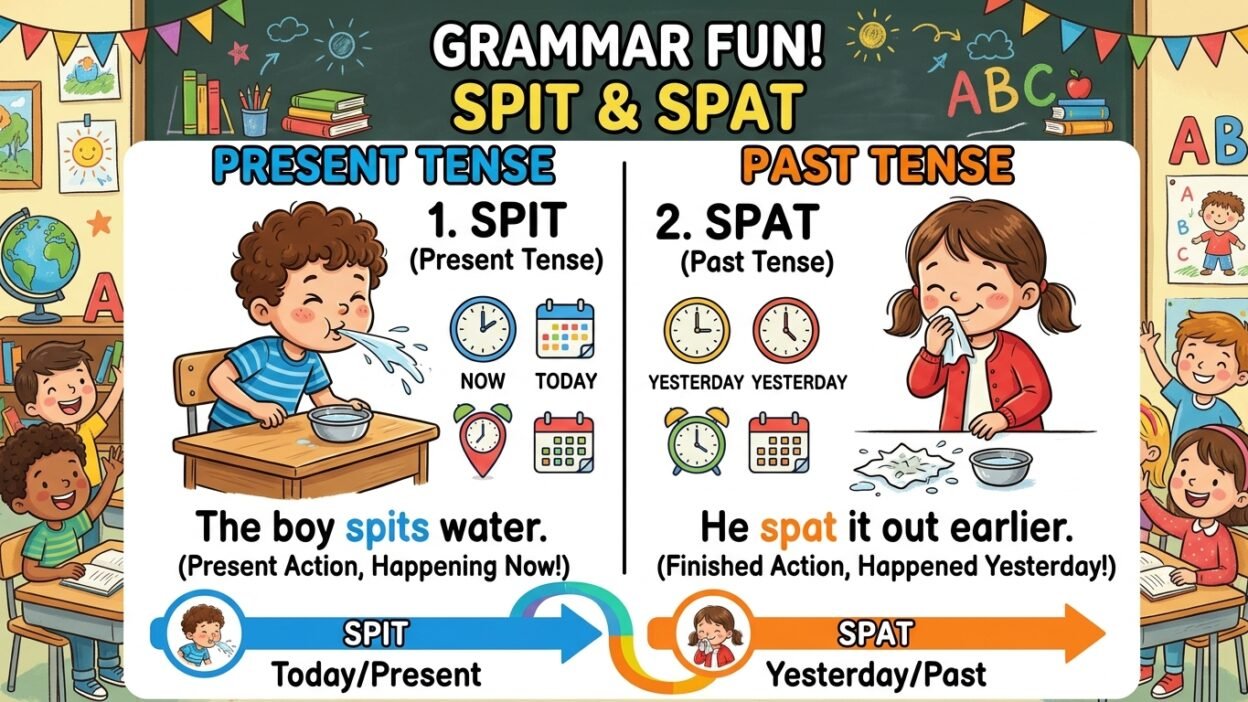
Many English learners get confused between spit and spat because both words are connected to the same verb. When talking about the past, some people say spit, while others say spat.
The confusion exists because English allows both forms in many situations. However, there are differences in usage, style, and preference.
The good news is that both words are correct, but they are not always used in exactly the same way.
In this guide, you will learn the difference between spit and spat, when to use each one, common mistakes to avoid, and plenty of real-life examples.
Quick Answer
- Spit = present tense of the verb.
- Spat = traditional past tense of the verb.
- Spit can also be used as a past tense in modern English.
- Spat is more traditional and often preferred in formal writing.
Examples:
- I spit out the bad-tasting food.
- Yesterday, he spat on the ground.
- She spit the water out after laughing.
- The angry cat spat at the dog.
Origin and Background
The verb spit has been part of English for centuries. It means to force saliva, liquid, or another substance out of the mouth.
Originally, the past tense was spat.
Over time, many English speakers also began using spit as the past tense. Today, both forms are widely accepted.
This makes spit unusual because it has two common past tense forms:
- spit → spat
- spit → spit
Both patterns can be correct depending on the context and style.
Understanding the Difference Between Spit and Spat
The easiest way to understand the difference is to remember their main roles.
Spit = Present Tense
Use spit when talking about an action happening now or regularly.
Examples:
- Do not spit on the ground.
- The baby sometimes spits food out.
- Snakes can spit venom.
- He tends to spit when he talks.
Spat = Traditional Past Tense
Use spat when talking about a completed action in the past.
Examples:
- He spat on the sidewalk.
- The cat spat at the dog.
- She spat out the medicine.
- The child spat the food onto the floor.
Spit = Modern Past Tense
In modern English, especially in everyday speech, many people also use spit as the past tense.
Examples:
- He spit on the sidewalk.
- She spit out the medicine.
- They spit the water out.
These sentences are generally accepted, especially in American English.
Spit vs Spat Comparison Table
| Feature | Spit | Spat |
|---|---|---|
| Present tense | Yes | No |
| Past tense | Yes (modern usage) | Yes (traditional usage) |
| More formal past tense | No | Often yes |
| Common in conversation | Yes | Yes |
| Example | He spit out the gum. | He spat out the gum. |
Which One Should You Use and When?
A simple rule is:
Use Spit When:
- Talking about the present.
- Using modern conversational English.
- Following American English preferences.
Examples:
- Do not spit here.
- He spit the drink out.
- She spit the food onto the plate.
Use Spat When:
- Writing more formally.
- Following traditional grammar patterns.
- Describing a completed past action.
Examples:
- The cat spat angrily.
- He spat on the ground.
- She spat out the bitter medicine.
Common Mistakes People Make
Mistake 1
❌ He spitted on the ground.
✅ He spat on the ground.
✅ He spit on the ground.
Mistake 2
❌ She has spatten the water out.
✅ She has spat the water out.
✅ She has spit the water out.
Mistake 3
❌ The cat spitted at the dog.
✅ The cat spat at the dog.
Mistake 4
❌ He is spatting on the ground.
✅ He is spitting on the ground.
Mistake 5
❌ They have spitted out the food.
✅ They have spat out the food.
✅ They have spit out the food.
Everyday Real Life Examples
In Daily Conversation
- He spit out his drink when he heard the joke.
- She spat out the sour candy.
At School
- Students should not spit on the ground.
- The child spat out the medicine.
In News Reports
- The player spat on the field.
- Witnesses said the suspect spit toward the officer.
In Stories
- The dragon spat fire.
- The snake spit venom at its enemy.
On Social Media
- I nearly spit out my coffee laughing.
- He spat his drink across the room.
Learning Tips for Students and Beginners
Remember Both Forms
Unlike many verbs, both past tense forms are accepted:
- spit
- spat
Avoid “Spitted”
The form spitted is usually incorrect when talking about saliva or liquid from the mouth.
Learn Common Expressions
Examples:
- spit it out
- spat out the food
- spit out the drink
- spat at the cat
Practice Simple Sentences
Present:
- I spit.
Past:
- I spat.
- I spit.
Perfect Tense:
- I have spat.
- I have spit.
Frequently Asked Questions
Is it spit or spat?
Both can be correct as past tense forms.
What is the past tense of spit?
The past tense can be spat or spit.
Which is more common, spit or spat?
Both are common, though spat is often viewed as the more traditional form.
Is “spitted” correct?
Usually no. For the meaning related to saliva, use spit or spat.
What is the past participle of spit?
Both spit and spat are accepted by many dictionaries.
Is spat more formal?
Yes, spat is often considered more traditional and formal.
Can I use spit as a past tense?
Yes. Many native speakers do.
How can I remember the difference?
Think:
- Present = spit
- Past = spat or spit
Both past forms are generally acceptable.
Conclusion
The difference between spit and spat is simpler than many learners think.
Use spit as the present tense.
For the past tense, both spit and spat are accepted, although spat is often considered the more traditional form.
Quick reminder:
- I spit out the food. (present)
- I spat out the food. (past)
- I spit out the food. (past, modern usage)
When writing formally, spat is often the safer choice. In everyday conversation, both forms are widely understood and accepted.