
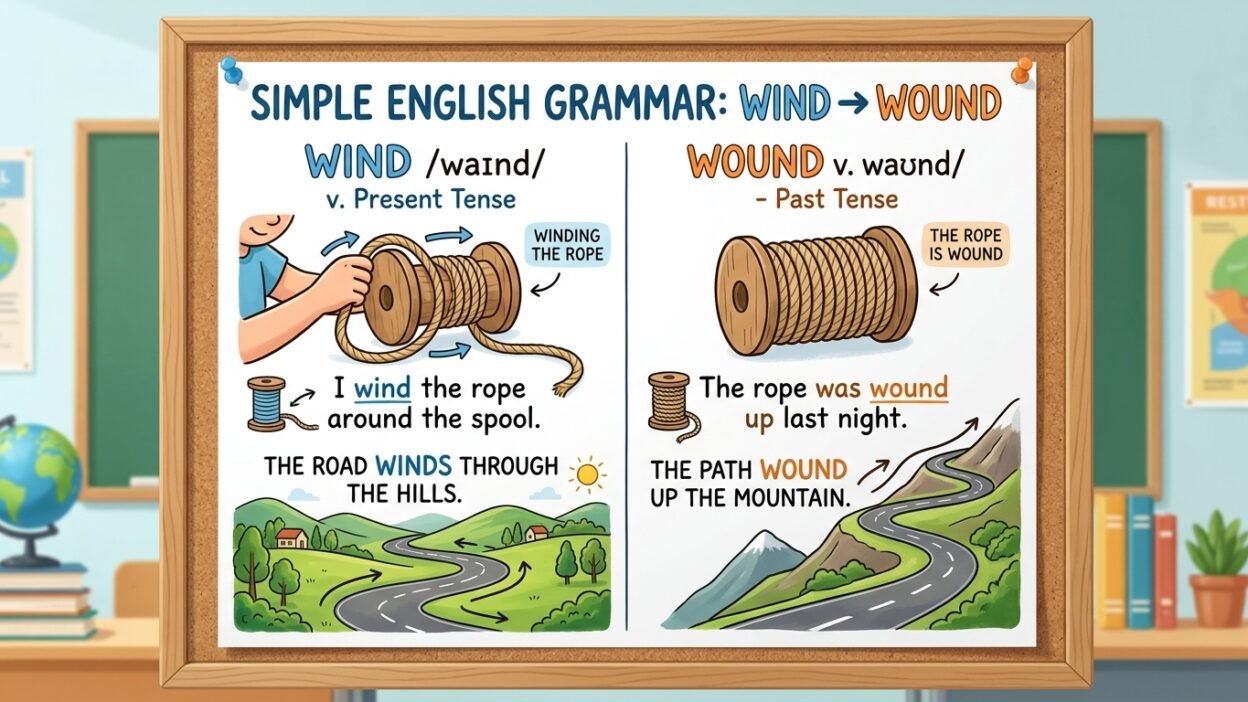
Many English learners get confused about the past tense of “wind.” The confusion happens because the word “wind” has different meanings and pronunciations in English.
As a verb, “wind” means:
- To twist
- To wrap
- To move in a curved direction
The good news is that the past tense rule is simple once you know which meaning you are using.
Quick Answer
- Wind = present tense
- Wound = past tense and past participle
Simple Background
The verb “wind” is pronounced like:
- “wynd”
It means:
- To turn or twist something
- To follow a curved path
Over time, English changed the verb form:
- wind → wound
This is an irregular verb, so it does not use “-ed.”
Do not confuse it with:
- wind (moving air), pronounced differently.
Clear Explanation of the Difference
What is “Wind”?
Wind is the present tense verb.
Examples:
- “They wind the rope carefully.”
- “The road winds through the mountains.”
What is “Wound”?
Wound is the past tense and past participle form.
Examples:
- “She wound the clock yesterday.”
- “The river wound through the valley.”
Comparison Table
| Verb Form | Word | Example Sentence |
|---|---|---|
| Base Form | Wind | “I wind the wire.” |
| Past Tense | Wound | “I wound the wire yesterday.” |
| Past Participle | Wound | “She has wound the thread.” |
Which One to Use and When
Use wind when:
- Talking about the present or future
Use wound when:
- Talking about the past
- Using perfect tenses with “has,” “have,” or “had”
Simple Tip to Remember
- Today → wind
- Yesterday → wound
Example:
- “I wind the clock now.”
- “I wound the clock yesterday.”
Common Mistakes People Make
1. Saying “winded”
❌ “She winded the rope.”
✔ “She wound the rope.”
2. Confusing pronunciation
- wind (verb) = “wynd”
- wind (air) = “wind”
3. Mixing “wound” meanings
“Wound” can also mean an injury.
Example:
- “He had a wound on his arm.”
Everyday Real Life Examples
In Daily Life
- “He wound the cable neatly.”
- “The path wound around the lake.”
In Stories
- “The river wound through the forest.”
In Homes
- “She wound the old clock.”
In Crafts
- “They wound the thread around the spool.”
Short Learning Section for Students
Here is an easy way to remember:
Step 1: Learn the forms
- Wind = present
- Wound = past
Step 2: Practice
- “I wind the string.”
- “I wound the string yesterday.”
Step 3: Use memory trick
Think:
Wind changes to wound in the past.
Step 4: Practice pronunciation
Say both words aloud slowly.
FAQ
What is the past tense of “wind”?
The past tense is “wound.”
Is “winded” correct?
Not for this meaning. Use “wound.”
Is “wind” a regular verb?
No, it is an irregular verb.
What does “wound” mean here?
It means twisted or wrapped in the past.
Is “wound” also a noun?
Yes, it can also mean an injury.
Why is this confusing?
Because “wind” and “wound” have multiple meanings and pronunciations.
How can I remember easily?
Think: wind → wound.
Conclusion
The past tense of “wind” is simple once you know the correct irregular form.
- Wind = present tense
- Wound = past tense and past participle
Remember this easy rule:
Never say “winded” for twisting or wrapping. Use “wound.”
With this, you can use the verb correctly and confidently in everyday English.