
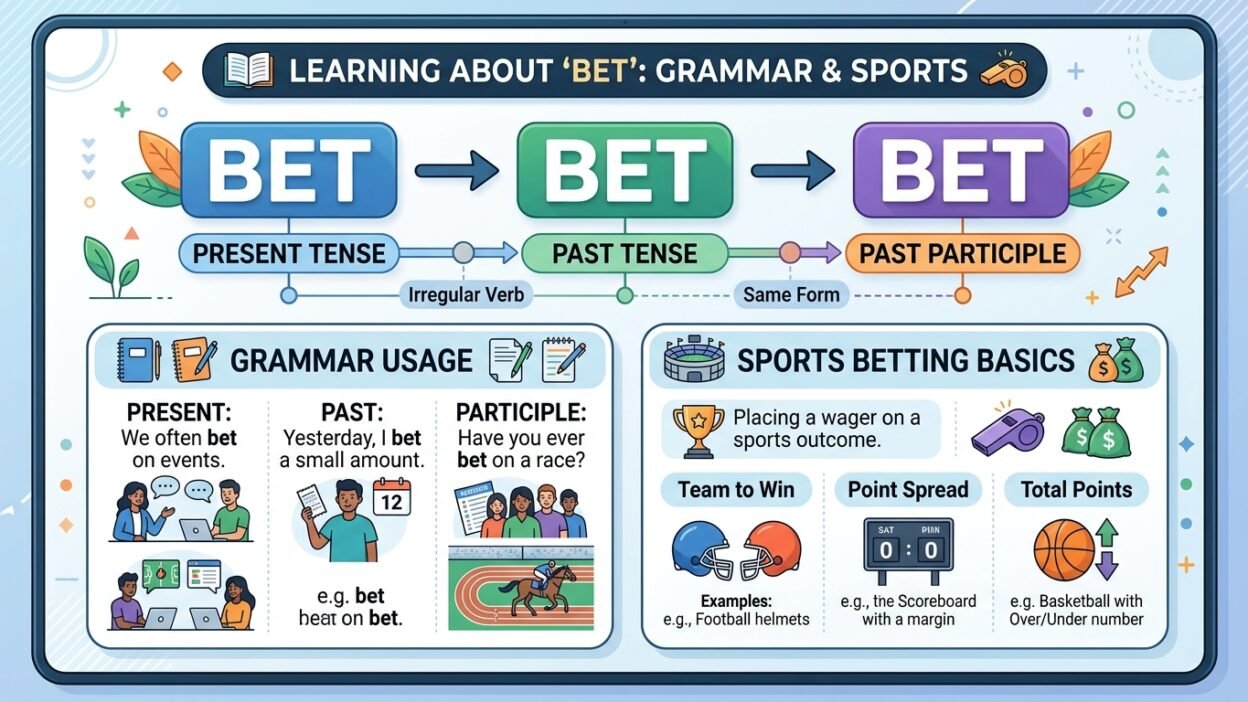
Many English learners wonder whether “bet” is a regular or irregular verb. The confusion happens because the word does not change in the past tense like most regular verbs.
Instead of adding “-ed,” the verb usually stays the same.
The good news is that “bet” is actually one of the easiest irregular verbs to learn.
Quick Answer
- Bet = present tense
- Bet = past tense
- Bet = past participle
The spelling usually stays the same in all forms.
Simple Background
The verb “bet” means:
- To gamble money
- To risk something on an outcome
- To strongly believe something is true
Unlike regular verbs, English kept the same spelling for all forms:
- bet → bet → bet
This pattern is similar to:
- cut → cut
- put → put
Clear Explanation of the Difference
What is “Bet”?
Bet is the present tense form.
Examples:
- “I bet on football games.”
- “They bet small amounts of money.”
What is the Past Tense of “Bet”?
The past tense is also bet.
Examples:
- “He bet all his money yesterday.”
- “We bet on the wrong team.”
What is the Past Participle of “Bet”?
The past participle is also bet.
Examples:
- “She has bet before.”
- “They had bet too much.”
Comparison Table
| Verb Form | Word | Example Sentence |
|---|---|---|
| Base Form | Bet | “I bet carefully.” |
| Past Tense | Bet | “I bet yesterday.” |
| Past Participle | Bet | “They have bet before.” |
Which One to Use and When
Use bet for:
- Present tense
- Past tense
- Past participle
Simple Tip to Remember
- Today → bet
- Yesterday → bet
- Already done → bet
The spelling stays the same.
Common Mistakes People Make
1. Saying “betted”
❌ “He betted on the race.”
✔ “He bet on the race.”
2. Thinking it is a regular verb
“Bet” is irregular.
3. Adding unnecessary endings
The word does not need “-ed.”
Everyday Real Life Examples
In Sports
- “They bet on the final match.”
In Daily Life
- “I bet you are tired.”
- “She bet five dollars.”
In Conversations
- “I bet he forgot again.”
In Movies
- “He bet everything he had.”
Short Learning Section for Students
Here is an easy way to remember:
Step 1: Learn the forms
- Bet = present
- Bet = past
- Bet = past participle
Step 2: Practice
- “I bet on games.”
- “I bet yesterday.”
Step 3: Use memory trick
Think:
Bet never changes.
Step 4: Avoid adding “-ed”
Do not say “betted.”
FAQ
Is “bet” an irregular verb?
Yes, it is an irregular verb.
What is the past tense of “bet”?
The past tense is “bet.”
Is “betted” correct?
Usually no. Standard English prefers “bet.”
Does the spelling change?
No, it usually stays the same.
What does “bet” mean?
It means gamble or strongly believe something.
Is “bet” also the past participle?
Yes, it is.
How can I remember easily?
Think: bet always stays bet.
Conclusion
The verb “bet” is an irregular verb, but it is very easy to remember.
- Bet = present tense
- Bet = past tense
- Bet = past participle
Remember this easy rule:
The word “bet” usually never changes form.
With this, you can use the verb correctly and confidently in everyday English.

Austin Brandon serves as both an author and administrator at GrammerPeak. He manages site operations while creating clear, accurate grammar content that helps readers correct mistakes, understand language rules, and write with confidence, precision, and clarity across academic, professional, and everyday English communication.