Many English learners get confused between “have” and “had.” These words are closely connected, but they are used in different tenses.
The confusion happens because both words talk about possession, experience, or actions, but one is used for the present and the other for the past.
The good news is that the difference is simple once you understand time and tense.
Quick Answer
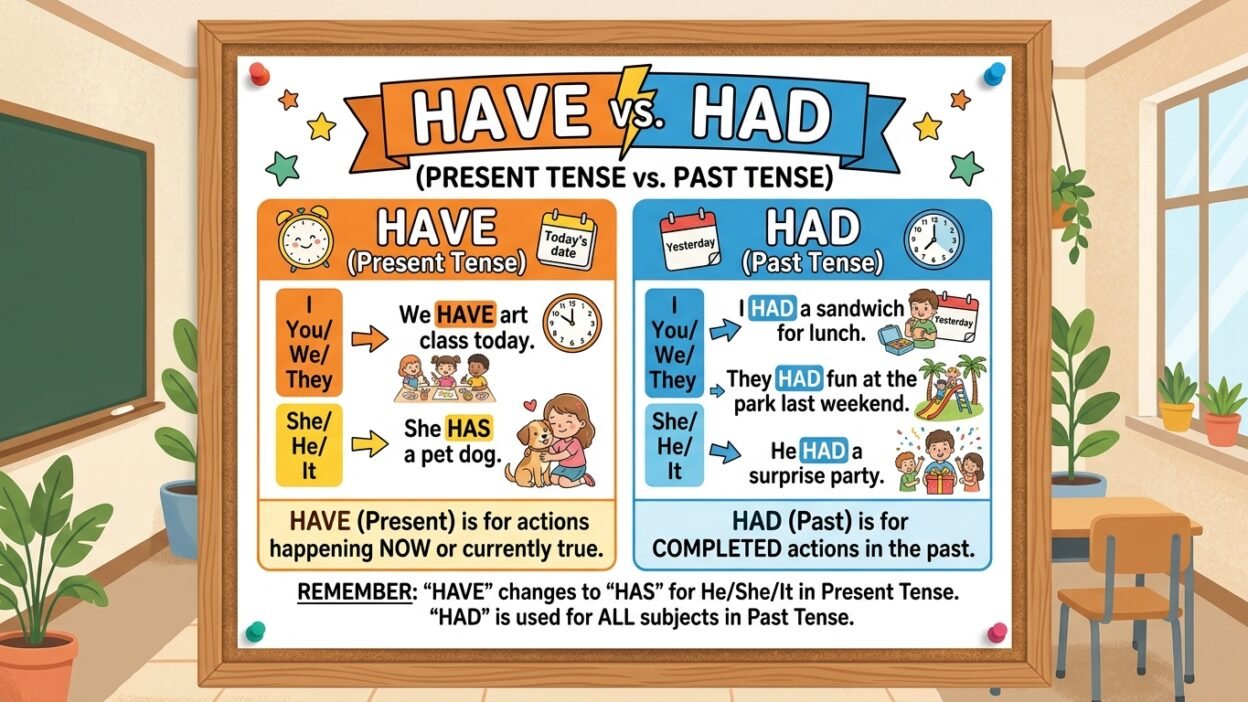
- Have = present tense
- Had = past tense and past participle
Simple Background
The verb “have” is one of the most common verbs in English. It can mean:
- To own something
- To experience something
- To eat or drink something
- To help form perfect tenses
Over time, English changed the past tense form:
- have → had
This is an irregular verb, so it does not use “-ed.”
Clear Explanation of the Difference
What is “Have”?
Have is the present tense form.
Examples:
- “I have a bicycle.”
- “They have lunch at noon.”
It is used for:
- present situations
- things happening now
- general facts
What is “Had”?
Had is the past tense and past participle form.
Examples:
- “She had a cat when she was young.”
- “We had dinner earlier.”
It is used for:
- past situations
- completed actions
- past experiences
Comparison Table
| Verb Form | Word | Example Sentence |
|---|---|---|
| Base Form | Have | “I have a phone.” |
| Past Tense | Had | “I had a phone before.” |
| Past Participle | Had | “They have had this car for years.” |
Which One to Use and When
Use have when:
- Talking about the present
- Talking about things you own now
- Describing current experiences
Use had when:
- Talking about the past
- Describing something completed
- Using perfect tenses
Simple Tip to Remember
- Now → have
- Before → had
Example:
- “I have a headache.”
- “I had a headache yesterday.”
Common Mistakes People Make
1. Using “have” for past situations
❌ “I have a dog when I was little.”
✔ “I had a dog when I was little.”
2. Mixing present and past tenses
❌ “She had a test today.”
✔ “She has a test today.”
3. Confusing helping verb usage
“Had” is also used in past perfect tense.
Example:
- “They had finished before I arrived.”
Everyday Real Life Examples
In School
- “I had homework yesterday.”
- “We have a quiz today.”
In Daily Life
- “She has a new phone.”
- “He had a busy week.”
In Conversations
- “Have you eaten yet?”
- “I had breakfast already.”
On Social Media
- “Had a great day 😊”
Short Learning Section for Students
Here is a simple way to remember:
Step 1: Learn the forms
- Have = present
- Had = past
Step 2: Practice
- “I have a book.”
- “I had a book before.”
Step 3: Use memory trick
Think:
Have is now, had is before.
Step 4: Practice speaking aloud
Repeating helps memory.
FAQ
What is the difference between “have” and “had”?
“Have” is present tense, while “had” is past tense.
Is “had” the past tense of “have”?
Yes, it is.
Can “had” be a past participle?
Yes, it can.
Is “have” an irregular verb?
Yes, it is irregular.
When should I use “had”?
Use it for past actions or past situations.
Why is this confusing?
Because both words are very common and used in many ways.
How can I remember easily?
Think: have = now, had = past.
Conclusion
The difference between have and had is mainly about time.
- Have is used for the present.
- Had is used for the past.
Remember this easy rule:
Use “have” for now and “had” for before.
With this, you can use both words correctly and confidently in everyday English.