Many English learners become confused about whether the correct past tense of weep is weeped or wept.
The confusion happens because most English verbs form the past tense by adding -ed. For example:
- walk → walked
- jump → jumped
- clean → cleaned
Because of this pattern, many people assume that weep becomes weeped.
However, English has many irregular verbs that do not follow the normal rule. The verb weep is one of them.
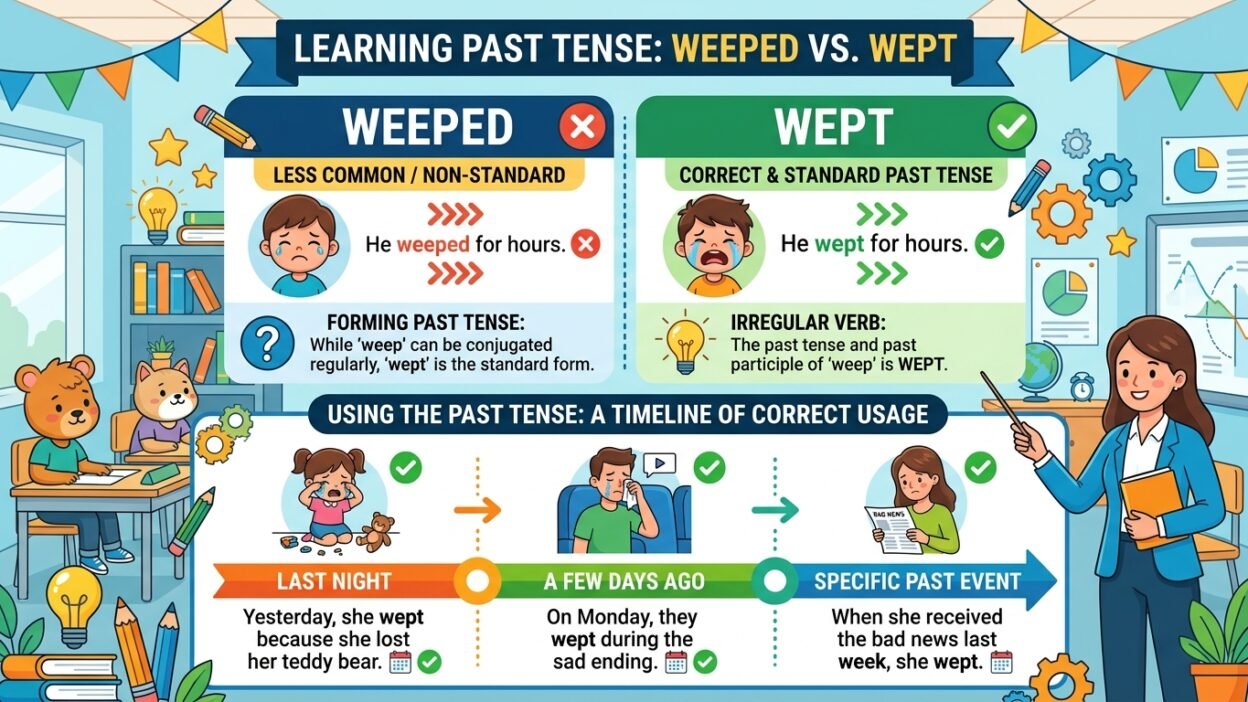
In modern standard English, wept is the correct past tense and past participle. Weeped is generally considered incorrect.
This guide explains the difference, shows examples, and helps you use the correct form confidently.
Quick Answer
- ✅ Wept is the correct past tense of weep.
- ❌ Weeped is not considered standard English.
- Use wept when talking about crying in the past.
- Use wept as both the past tense and past participle.
Examples:
- She wept after hearing the news.
- They wept with joy.
- He has wept many times before.
- We wept during the movie.
Origin and Background
The verb weep has existed in English for hundreds of years. It means to cry, often because of sadness, happiness, or strong emotions.
Unlike regular verbs, weep belongs to a group of irregular verbs that change form in a special way.
Its forms are:
- Weep
- Wept
- Wept
This pattern is similar to:
- keep → kept
- sleep → slept
- sweep → swept
- weep → wept
Because many English verbs add -ed, learners sometimes create the form weeped, but standard English uses wept.
Understanding the Difference Between Weeped and Wept
The simplest explanation is that only one form is correct in modern English.
Wept = Correct
Use wept whenever you need the past tense or past participle of weep.
Examples:
- She wept quietly.
- The child wept for hours.
- They wept after the ceremony.
- He has wept before.
These examples follow standard English grammar.
Weeped = Incorrect
Most grammar books, dictionaries, teachers, and style guides do not accept weeped as the standard past tense.
Examples:
- ❌ She weeped quietly.
- ❌ They weeped all night.
These sentences should use wept instead.
Weeped vs Wept Comparison Table
| Feature | Weeped | Wept |
|---|---|---|
| Correct in standard English | No | Yes |
| Past tense of weep | No | Yes |
| Past participle of weep | No | Yes |
| Commonly accepted | No | Yes |
| Example | She weeped. ❌ | She wept. ✅ |
Which One Should You Use and When?
The answer is simple.
Use Wept
Use wept whenever you need the past tense.
Examples:
- She wept after the speech.
- He wept with happiness.
- We wept during the sad ending.
- The crowd wept openly.
Also Use Wept as a Past Participle
Examples:
- She has wept before.
- They had wept all night.
- He has never wept in public.
- We have wept together.
Avoid Weeped
In formal writing, school assignments, exams, and professional communication, avoid weeped.
Common Mistakes People Make
Mistake 1
❌ She weeped after the movie.
✅ She wept after the movie.
Mistake 2
❌ He has weeped many times.
✅ He has wept many times.
Mistake 3
❌ They had weeped all day.
✅ They had wept all day.
Mistake 4
❌ We weeped when we heard the news.
✅ We wept when we heard the news.
Mistake 5
❌ The family has weeped for years.
✅ The family has wept for years.
Everyday Real Life Examples
In Daily Conversation
- She wept when she saw her old friend.
- He wept during the farewell.
In Social Media Posts
- I wept while watching that video.
- Many people wept after hearing the story.
In News Reports
- Families wept as they remembered loved ones.
- Supporters wept with joy after the victory.
In Books and Stories
- The queen wept beside the window.
- The child wept until he fell asleep.
In School Writing
- The character wept after losing everything.
- The villagers wept during the ceremony.
Learning Tips for Students and Beginners
Remember Similar Verbs
Many verbs follow the same pattern:
| Present | Past |
| Keep | Kept |
| Sleep | Slept |
| Sweep | Swept |
| Weep | Wept |
If you remember kept and slept, it becomes easier to remember wept.
Learn the Three Forms
- Weep
- Wept
- Wept
Practice saying them aloud several times.
Create Your Own Sentences
Examples:
- I wept after reading the letter.
- She wept with happiness.
- They have wept before.
Read More English
Books, articles, and stories often use wept, helping you remember the correct form naturally.
Frequently Asked Questions
Is weeped or wept correct?
Wept is correct in standard English.
What is the past tense of weep?
The past tense of weep is wept.
Is weeped a real word?
Some people may use it informally, but it is generally not accepted as standard English.
Can I use weeped in school writing?
No. Use wept instead.
What is the past participle of weep?
The past participle is wept.
Example:
- She has wept before.
Why is wept irregular?
English contains many irregular verbs that developed over time and do not follow the normal -ed pattern.
Is wept old fashioned?
No. It is still the correct and widely accepted form today.
How can I remember wept?
Think of similar verbs:
- keep → kept
- sleep → slept
- weep → wept
Conclusion
The difference between weeped and wept is simple.
In modern standard English, wept is the correct past tense and past participle of weep.
The form weeped is generally considered incorrect and should be avoided in writing and formal speech.
Quick reminder:
- Weep = present tense
- Wept = past tense
- Wept = past participle
Examples:
- She wept after the news.
- They wept with joy.
- He has wept before.
When in doubt, choose wept. It is the correct form used by native speakers, teachers, and grammar guides.

Austin Brandon serves as both an author and administrator at GrammerPeak. He manages site operations while creating clear, accurate grammar content that helps readers correct mistakes, understand language rules, and write with confidence, precision, and clarity across academic, professional, and everyday English communication.