Many English learners get confused between mistook and mistaken because both words come from the verb mistake. They look similar and are related to the same action, but they are used in different ways.
The confusion usually happens because both words refer to something that happened in the past. However, they do not have the same grammar role.
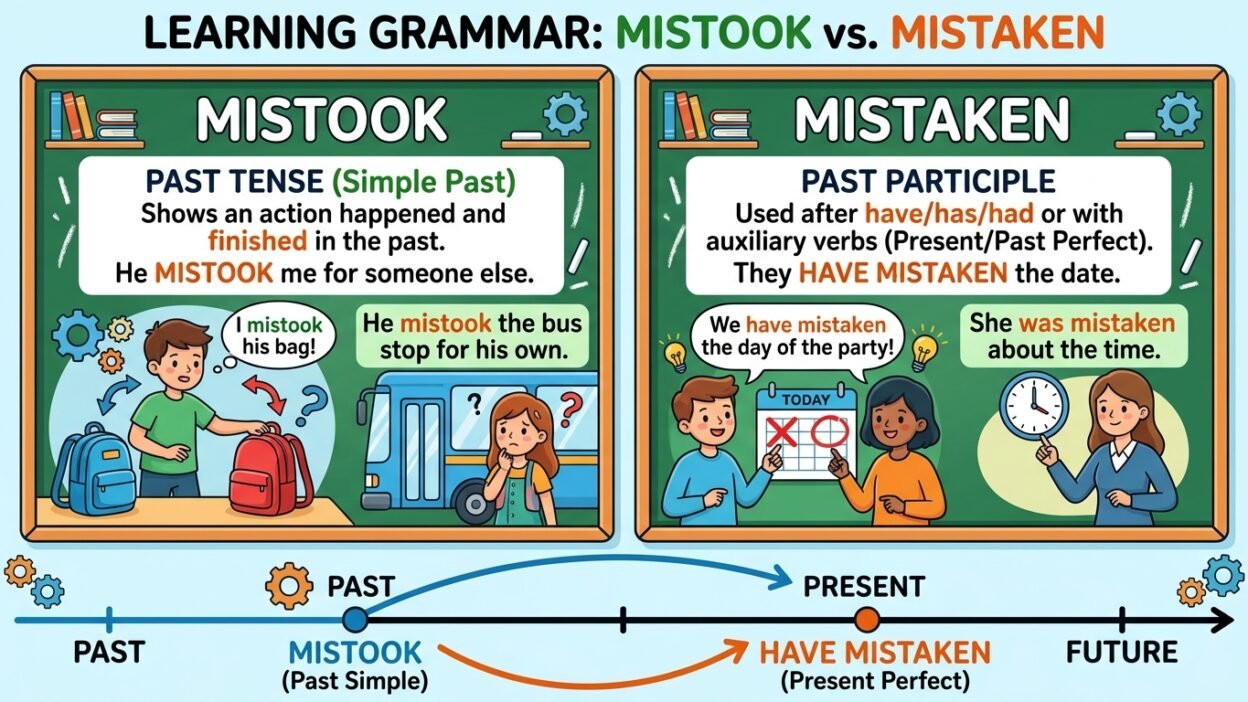
The simple rule is:
- Mistook is the simple past tense.
- Mistaken is the past participle.
Once you understand this difference, choosing the correct word becomes much easier.
Quick Answer
- Mistook = simple past tense of mistake
- Mistaken = past participle of mistake
- Use mistook by itself to talk about a past action.
- Use mistaken with helping verbs such as have, has, had, was, were, or been.
Examples:
- I mistook him for my teacher.
- I have mistaken him before.
- She mistook the date.
- They were mistaken about the time.
Origin and Background
The verb mistake has existed in English for hundreds of years. It means to understand something incorrectly or to confuse one thing with another.
Like many irregular verbs in English, its forms change:
- mistake
- mistook
- mistaken
This pattern is similar to:
- take → took → taken
- speak → spoke → spoken
- break → broke → broken
Because English has irregular verbs, learners often mix up mistook and mistaken.
Understanding the Difference Between Mistook and Mistaken
The easiest way to understand the difference is to remember their grammar jobs.
Mistook = Simple Past Tense
Use mistook when describing something that happened in the past.
Examples:
- I mistook her for my sister.
- He mistook the address.
- We mistook the instructions.
- She mistook the meeting date.
In each sentence, the action happened and finished in the past.
Mistaken = Past Participle
Use mistaken with helping verbs.
Examples:
- I have mistaken his meaning before.
- She had mistaken the room number.
- They were mistaken about the schedule.
- You have mistaken my words.
Notice that mistaken usually does not stand alone as the main verb.
Mistook vs Mistaken Comparison Table
| Feature | Mistook | Mistaken |
|---|---|---|
| Verb form | Simple past | Past participle |
| Used alone | Yes | Usually no |
| Time reference | Past action | Perfect tenses or passive forms |
| Common helpers | None needed | have, has, had, was, were, been |
| Example | I mistook him for John. | I have mistaken him before. |
Which One Should You Use and When?
A quick trick is to check whether there is a helping verb in the sentence.
Use Mistook When:
- Talking about a completed past action
- No helping verb is needed
Examples:
- I mistook the signal.
- She mistook the answer.
- We mistook his joke for a serious comment.
Use Mistaken When:
- Using have, has, or had
- Using passive structures
- Using perfect tenses
Examples:
- I have mistaken your meaning.
- She had mistaken the date.
- They were mistaken about the rules.
- You have mistaken my intentions.
Common Mistakes People Make
Many learners use the wrong form because both words relate to the past.
Mistake 1
❌ I have mistook his name.
✅ I have mistaken his name.
After have, use the past participle mistaken.
Mistake 2
❌ I mistaken him for my uncle yesterday.
✅ I mistook him for my uncle yesterday.
The sentence needs the simple past tense.
Mistake 3
❌ She had mistook the address.
✅ She had mistaken the address.
After had, use mistaken.
Mistake 4
❌ They were mistook about the time.
✅ They were mistaken about the time.
After were, use mistaken.
Mistake 5
❌ We have mistook the instructions.
✅ We have mistaken the instructions.
Perfect tenses require mistaken.
Everyday Real Life Examples
In Emails
- I mistook the meeting date.
- I have mistaken your earlier message.
On Social Media
- Many people mistook the post as real news.
- Some users have mistaken satire for facts.
In School
- I mistook question five.
- Several students had mistaken the instructions.
In News Reports
- Witnesses mistook the sound for thunder.
- Officials were mistaken about the initial report.
In Daily Conversation
- I mistook you for someone else.
- I have mistaken people before.
Learning Tips for Students and Beginners
Remember This Pattern
Think of these common irregular verbs:
- take → took → taken
- break → broke → broken
- mistake → mistook → mistaken
Look for Helping Verbs
If you see:
- have
- has
- had
- was
- were
- been
you will usually need mistaken.
Practice Simple Sentences
Present:
- I mistake names sometimes.
Past:
- I mistook her for my cousin.
Perfect:
- I have mistaken people before.
Read Examples Often
The more examples you read, the easier it becomes to recognize the correct form.
Frequently Asked Questions
Is it mistook or mistaken?
Both are correct, but they are used differently. Mistook is the simple past tense, while mistaken is the past participle.
What is the difference between mistook and mistaken?
Mistook describes a past action. Mistaken is used with helping verbs or passive structures.
Is “I have mistook” correct?
No.
Correct:
- I have mistaken.
Can mistaken be used alone?
Usually not. It is commonly used with helping verbs such as have, has, had, was, or were.
Is mistook the past tense of mistake?
Yes.
- mistake → mistook → mistaken
What does mistaken mean?
It means being wrong or having misunderstood something.
Example:
- You are mistaken.
Which is more common?
Both are common because they serve different grammar purposes.
How can I remember the difference?
Remember:
- Mistook = simple past
- Mistaken = past participle
Think of:
- took → taken
- mistook → mistaken
Conclusion
The difference between mistook and mistaken is simple once you know their grammar roles.
Use mistook as the simple past tense when talking about a completed action in the past.
Use mistaken as the past participle after helping verbs such as have, has, had, was, and were.
Quick reminder:
- Mistake = base verb
- Mistook = past tense
- Mistaken = past participle
Examples:
- I mistook him for my friend.
- I have mistaken him before.
Learning this pattern will help you use both words correctly and confidently.