Many English learners get confused between “spend” and “spent.” Since both words come from the same verb, it can be difficult to know which one is correct in a sentence.
You may hear people say, “I spend a lot of money,” and “I spent a lot of money,” and wonder why the word changes. The answer is simple: these words belong to different tenses.
In this guide, you’ll learn the difference between spend and spent, when to use each one, common mistakes to avoid, and easy examples that make everything clear.
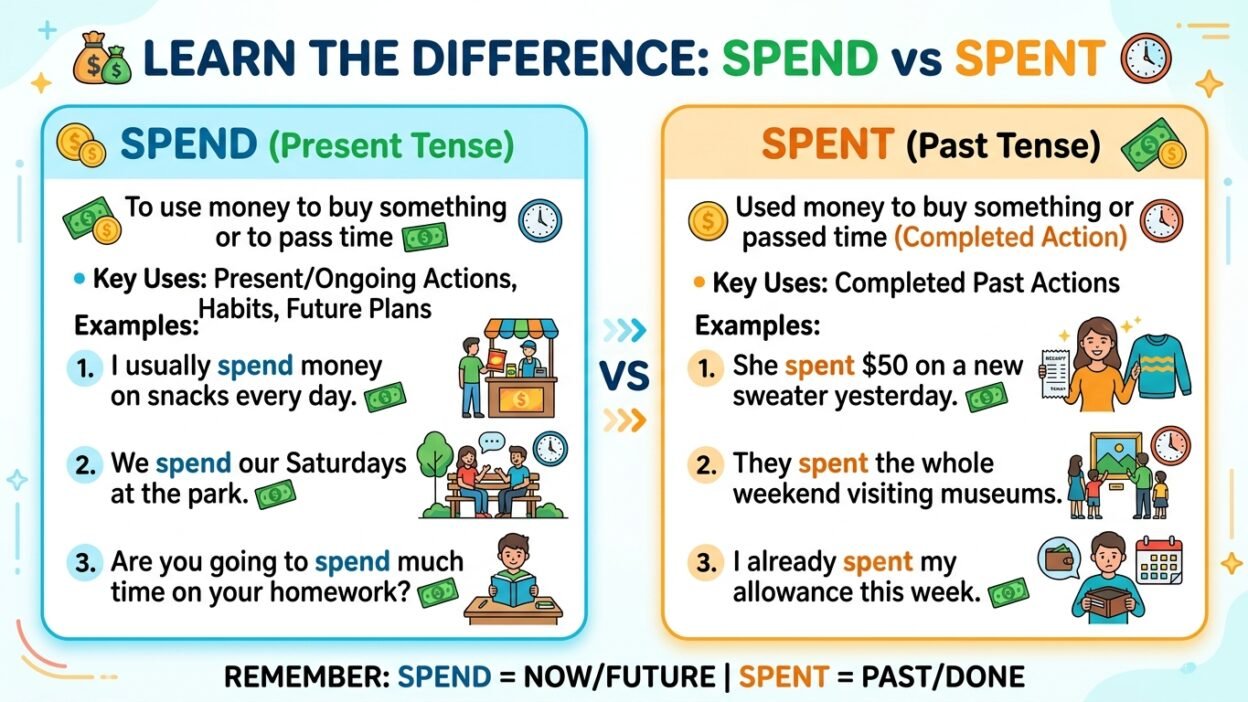
Quick Answer
- Spend = present tense
- Spent = past tense and past participle
- Use spend for actions happening now or regularly.
- Use spent for actions that happened in the past.
- Both words come from the verb to spend.
Examples:
- I spend a lot of time reading.
- I spent a lot of time reading yesterday.
Simple Background
The verb “spend” has been part of English for many centuries. It usually means:
- To use money
- To use time
- To use energy or effort
Like many common English verbs, spend is irregular. Instead of adding -ed to form the past tense, it changes to spent.
For example:
- Spend → Spent
- Send → Sent
- Bend → Bent
Because English has many irregular verbs, learners often need to memorize them.
Clear Explanation of the Difference
The difference between spend and spent is mainly about time.
Spend
Spend is the present tense form.
Use it when talking about:
- Habits
- Daily routines
- Things happening now
- General facts
Examples:
- I spend too much time on my phone.
- They spend their weekends at home.
- We spend money carefully.
Spent
Spent is the past tense and past participle form.
Use it when talking about:
- Completed actions
- Things that happened before now
Examples:
- I spent all my money yesterday.
- She spent three hours studying.
- They spent the weekend at the beach.
Comparison Table
| Feature | Spend | Spent |
|---|---|---|
| Word Type | Verb | Verb |
| Tense | Present | Past |
| Meaning | Use money, time, or effort | Used money, time, or effort |
| Correct Example | I spend money wisely. | I spent money yesterday. |
| Common Usage | Habits and routines | Completed actions |
Which One to Use and When
The rule is very easy.
Use “spend” when talking about the present
Examples:
- I spend an hour exercising every day.
- She spends a lot of money on books.
- We spend time with our family.
These actions happen regularly.
Use “spent” when talking about the past
Examples:
- I spent an hour exercising yesterday.
- She spent a lot of money last month.
- We spent the afternoon together.
These actions are finished.
Use “spent” with helping verbs
Examples:
- I have spent enough money.
- She has spent all her savings.
- They had spent the entire day working.
Common Mistakes People Make
Mistake 1: Using “spend” for the past
Incorrect:
- ❌ I spend all my money yesterday.
Correct:
- ✅ I spent all my money yesterday.
Mistake 2: Using “spent” for the present
Incorrect:
- ❌ I spent a lot of time reading every day.
Correct:
- ✅ I spend a lot of time reading every day.
Mistake 3: Forgetting the irregular form
Some learners write:
- ❌ Spended
Correct form:
- ✅ Spent
Mistake 4: Mixing tenses
Incorrect:
- ❌ Last weekend I spend time with friends.
Correct:
- ✅ Last weekend I spent time with friends.
Everyday Real-Life Examples
In Emails
- I spent the morning reviewing the report.
- I spend most of my workday answering emails.
In News
- The government spent millions on the project.
- Families spend more during holiday seasons.
On Social Media
- I spent all weekend watching movies.
- I spend too much time scrolling online.
In School
- Students spend hours preparing for exams.
- We spent the afternoon working on our project.
In Daily Conversations
- How much do you spend on groceries?
- I spent more than I planned.
Short Learning Section for Students and Beginners
A simple way to remember these words is:
Think About Time
Ask yourself:
Is the action happening now or regularly?
Use spend.
Did the action already happen?
Use spent.
Easy Formula
- Today = Spend
- Yesterday = Spent
Examples:
- Today I spend time reading.
- Yesterday I spent time reading.
Practice Exercise
Choose the correct word.
- I _____ a lot of time studying every day.
- She _____ all her money last week.
- We _____ the afternoon at the park yesterday.
- They _____ too much time online.
Answers:
- spend
- spent
- spent
- spend
FAQ Section
Is “spend” correct?
Yes. It is the present tense form of the verb.
Is “spent” correct?
Yes. It is the past tense and past participle form.
What is the past tense of spend?
The past tense of spend is spent.
Is “spended” a word?
No. The correct past tense is spent.
When should I use spend?
Use spend for present actions, habits, and routines.
When should I use spent?
Use spent for actions that happened in the past.
Can spent be an adjective?
Yes.
Example:
- I feel spent after a long day.
Here, spent means tired or exhausted.
How can I remember the difference?
Remember:
- Present = spend
- Past = spent
Conclusion
The difference between spend and spent is simple once you understand tenses.
- Spend is the present tense.
- Spent is the past tense and past participle.
- Use spend for habits, routines, and present situations.
- Use spent for completed actions in the past.
A quick rule to remember is:
👉 Today = spend
👉 Yesterday = spent
With a little practice, choosing between spend and spent will become easy and natural.