Many learners feel unsure about “passed away” and “past away.” These two phrases look almost the same, and they sound similar when spoken. Because of this, people often mix them up, especially in writing.
This topic is important because it is used in serious situations. So, using the correct words shows care and respect.
The good news is that the difference is very simple. Once you understand it, you will not make this mistake again.
Quick Answer
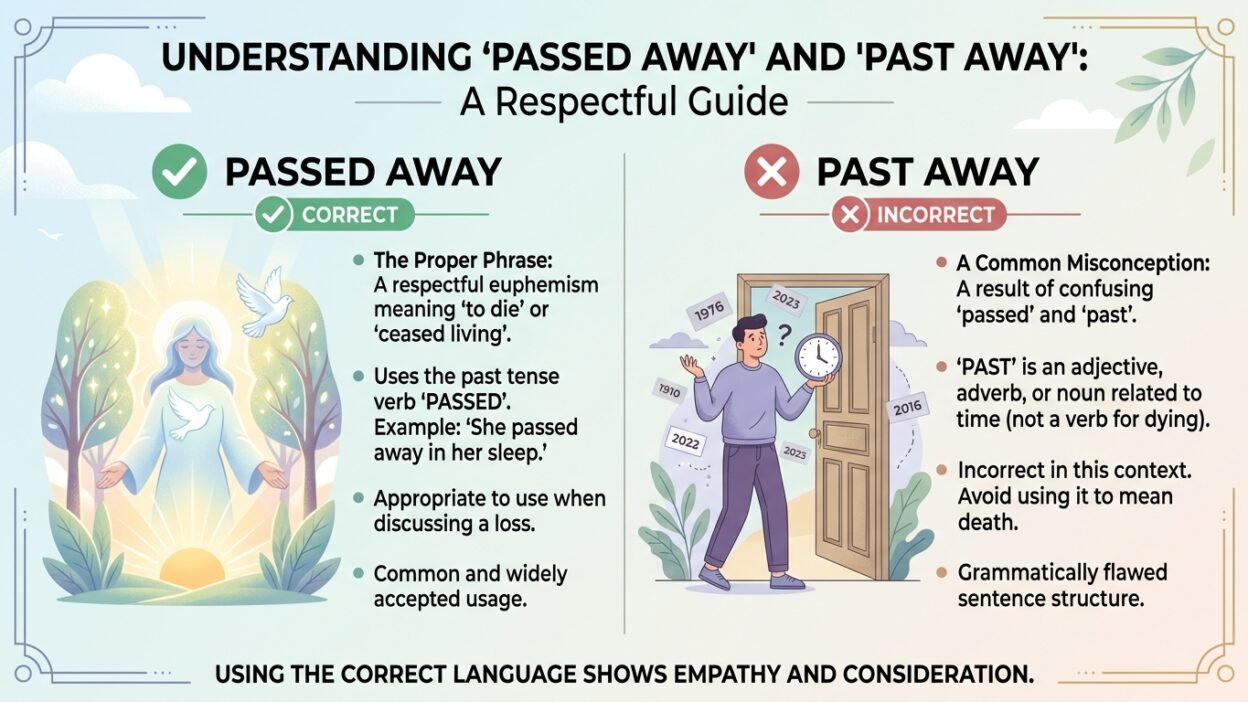
- ✅ Passed away = correct phrase
- ❌ Past away = incorrect
- “Passed” comes from the verb pass (an action)
- “Past” is usually about time or position, not action
Example:
- His grandfather passed away last year. ✅
- His grandfather past away last year. ❌
Simple Origin or Background Explanation
To understand the difference, let’s look at the words “passed” and “past.”
Passed
- Comes from the verb pass
- It shows an action
- “Passed” is the past tense of “pass”
Examples:
- She passed the exam.
- Time passed quickly.
Past
- Not a verb
- Used as a noun, adjective, or preposition
- Talks about time before now or position
Examples:
- In the past, life was different.
- Walk past the door.
Key Idea
👉 Passed = action
👉 Past = time or place
This is the main reason why only one of them works in the phrase.
Clear Explanation of the Difference
What does “passed away” mean?
“Passed away” is a gentle and respectful way to say that someone has died.
People use it to sound polite and kind, especially in serious or emotional situations.
Examples:
- Her father passed away peacefully.
- The old man passed away in his sleep.
Here, “passed” is an action (a verb), so it is correct.
What does “past away” mean?
“Past away” is incorrect.
Why? Because “past” is not a verb, so it cannot describe an action like dying.
The phrase does not make sense in English.
❌ He past away yesterday.
This sentence is wrong.
Key Point
👉 Death (in this phrase) is treated as an action, so we need a verb
👉 Only “passed” works as a verb
Comparison Table
| Feature | Passed Away ✅ | Past Away ❌ |
|---|---|---|
| Meaning | Someone died | No correct meaning |
| Grammar | Correct | Incorrect |
| Word type | Verb (action) | Not a verb |
| Usage | Formal and respectful | Never used |
| Example | He passed away peacefully | He past away ❌ |
Which One to Use and When
Use “passed away” when:
- Talking about someone’s death politely
- Writing messages of sympathy
- Speaking in respectful situations
Examples:
- My neighbor passed away last week.
- She passed away after a long illness.
Do NOT use “past away”
There is no situation where “past away” is correct.
👉 Always replace it with “passed away”
Simple Rule
If you are talking about death:
👉 Always use passed away
Common Mistakes People Make
1. Spelling confusion
❌ He past away last night.
✅ He passed away last night.
This happens because “past” and “passed” sound similar.
2. Not knowing verb vs non verb
People forget that “passed” is a verb, but “past” is not.
3. Typing quickly
Sometimes this mistake happens during fast typing or texting.
4. Not checking meaning
If you stop and think about the sentence, the mistake becomes clear.
Ask yourself:
👉 Is this an action?
If yes → use passed
Everyday Real Life Examples
In Emails
- I am sorry to hear that your uncle passed away.
- Her grandmother passed away peacefully.
In News
- The famous actor passed away at the age of 80.
- The leader passed away after illness.
On Social Media
- RIP. He passed away today.
- Sad news… my pet passed away 💔
In Daily Conversation
- Did you hear? Their teacher passed away.
- His grandfather passed away last year.
Incorrect Examples (for learning)
- ❌ She past away yesterday.
- ❌ My dog past away last night.
Always correct them to:
✔️ passed away
Short Learning Section for Students and Beginners
Here are easy ways to remember:
Trick 1: The Verb Rule
👉 If it is an action, use passed
Death is an action in this phrase → so use passed
Trick 2: Add “by” Test
Try adding “by” after the word:
- He passed (by) → makes sense
- He past (by) → incorrect
So:
👉 “Passed” is the correct form
Trick 3: Think of “Pass”
“Passed” comes from “pass”
Example:
- He passed the ball
- He passed away
Same base word → same verb
Practice Sentences
Fill in the blank:
- Her uncle ______ away last year.
- The dog ______ away peacefully.
- My neighbor ______ away yesterday.
Answers:
- passed
- passed
- passed
FAQ
1. Is “past away” ever correct?
No, it is always incorrect.
2. What does “passed away” mean?
It means someone died in a polite and gentle way.
3. Why do people say “passed away” instead of “died”?
Because it sounds softer and more respectful.
4. Is “passed away” formal or informal?
It can be used in both, but it is especially common in respectful situations.
5. Can I use “past” instead of “passed”?
No. “Past” does not work as a verb here.
6. How can I remember the difference?
Remember:
👉 “Passed” = action
👉 “Past” = time
7. Is this correct: “He has passed away”?
Yes, it is correct.
8. What is the safest option?
👉 Always use passed away
Conclusion
The difference between “passed away” and “past away” is very clear once you understand it.
- Passed away is correct and respectful
- Past away is incorrect
The key idea is simple:
👉 Passed = action (verb)
👉 Past = time or place (not a verb)
Whenever you talk about someone’s death, always use “passed away.” It is the correct, polite, and widely accepted form.
With this simple rule, you can write with confidence and avoid this common mistake.

Austin Brandon serves as both an author and administrator at GrammerPeak. He manages site operations while creating clear, accurate grammar content that helps readers correct mistakes, understand language rules, and write with confidence, precision, and clarity across academic, professional, and everyday English communication.