
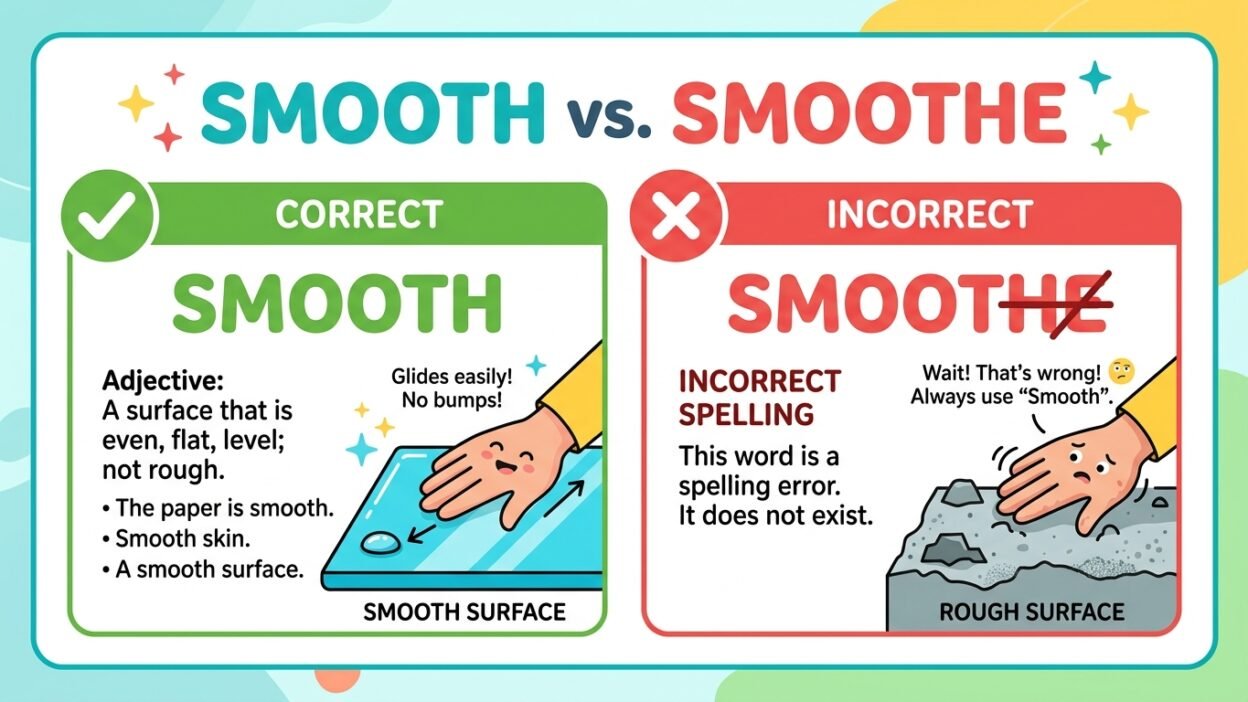
Many learners feel confused about “smooth” and “smoothe.” These two words look very similar, and the extra “e” at the end makes people unsure about which one is correct.
The confusion usually happens because both words come from the same base word. But here is the key point: they are used in different ways.
Let’s make this clear in very simple English so you can understand it easily and use both words correctly.
Quick Answer
- ✅ Smooth = correct and most common (adjective or verb)
- ⚠️ Smoothe = rare and mostly used as a verb (not common)
- Use smooth in almost all situations
Examples:
- The surface is smooth. ✅
- She tried to smooth the paper. ✅
- He tried to smoothe the fabric. ⚠️ (rare)
👉 Best choice: smooth
Simple Origin or Background Explanation
The word “smooth” comes from old English and has been used for a very long time.
It means:
- Even
- Flat
- Not rough
Over time, English also created a verb form from it, meaning:
👉 to make something smooth
Some older forms added an extra “e,” which gave us “smoothe.” But today, this form is very rare and not commonly used.
Modern English prefers the simpler form:
👉 smooth for both meanings
Clear Explanation of the Difference
What does “smooth” mean?
“Smooth” is the main and correct word.
It can be used in two ways:
As an adjective
It describes something that is:
- Not rough
- Even
- Soft to touch
Examples:
- The table is smooth.
- Her skin feels smooth.
- The road is very smooth.
As a verb
It means:
👉 to make something even or flat
Examples:
- He smoothed the paper.
- She smoothed her hair.
- Try to smooth the surface.
What does “smoothe” mean?
“Smoothe” is a very rare verb form.
It also means:
👉 to make something smooth
But:
- It is not commonly used today
- It may look strange or incorrect to many readers
Example:
- He tried to smoothe the cloth.
👉 Most people would say:
- He tried to smooth the cloth
Key Idea
- Smooth = correct and common
- Smoothe = rare and not needed
Comparison Table
| Feature | Smooth ✅ | Smoothe ⚠️ |
|---|---|---|
| Meaning | Even, flat, make smooth | Same meaning (verb) |
| Usage | Very common | Very rare |
| Part of speech | Adjective + verb | Verb only |
| Recommended | Yes | No |
| Example | Smooth surface | Smoothe cloth (rare) |
Which One to Use and When
Use “smooth” when:
- You describe something
- You talk about making something even
- You write in school or daily life
Examples:
- This fabric is very smooth.
- He smoothed the surface.
- The road feels smooth.
Avoid “smoothe” in most cases
Even though it exists, it is:
- Not common
- Not needed
- Often avoided
👉 Always replace it with smooth
Simple Rule
👉 Always choose smooth
Common Mistakes People Make
1. Adding extra “e”
❌ Smoothe
✅ Smooth
People think the extra “e” is needed—but it is not.
2. Thinking both are equal
Some learners think both words are used the same way.
👉 In modern English, smooth is preferred
3. Using “smoothe” in formal writing
It may look incorrect or unusual.
4. Confusing verb forms
Correct verb forms:
- smooth
- smoothed
- smoothing
❌ Not needed:
- smoothe
Everyday Real Life Examples
In Emails
- Please make the surface smooth.
- The design looks clean and smooth.
In News
- The road has a smooth finish.
- Workers smoothed the area.
On Social Media
- This phone runs so smooth 😄
- Love the smooth texture
In Daily Conversation
- This table is very smooth.
- He smoothed his hair before leaving.
Incorrect Examples (for learning)
- ❌ The surface is smoothe.
- ❌ She tried to smoothe the paper.
Correct forms:
✔️ smooth
✔️ smoothed
Short Learning Section for Students and Beginners
Trick 1: No Extra “E”
👉 Smooth = correct
Trick 2: Keep It Simple
English often prefers shorter words
Trick 3: One Safe Choice
👉 Always use smooth
Practice Sentences
Fill in the blank:
- The surface is very ______.
- He ______ the paper.
- The road feels ______.
Answers:
- smooth
- smoothed
- smooth
FAQ
1. Is “smoothe” a real word?
Yes, but it is very rare and not commonly used.
2. Which one is correct: smooth or smoothe?
“Smooth” is the correct and preferred word.
3. Can I use “smoothe” in writing?
It is better to avoid it.
4. What does “smooth” mean?
It means even, flat, or not rough.
5. Can “smooth” be a verb?
Yes. Example: He smoothed the paper.
6. Why do people write “smoothe”?
Because they think the extra “e” is needed.
7. What is the safest option?
👉 Always use smooth
8. Is “smooth” used in formal writing?
Yes, it is correct in all types of writing.
Conclusion
The difference between “smooth” and “smoothe” is very simple.
- Smooth is correct, common, and widely used
- Smoothe is rare and not needed in modern English
👉 Best rule: always use smooth
By following this simple tip, you can avoid mistakes and write clearly and confidently every time.

Austin Brandon serves as both an author and administrator at GrammerPeak. He manages site operations while creating clear, accurate grammar content that helps readers correct mistakes, understand language rules, and write with confidence, precision, and clarity across academic, professional, and everyday English communication.