
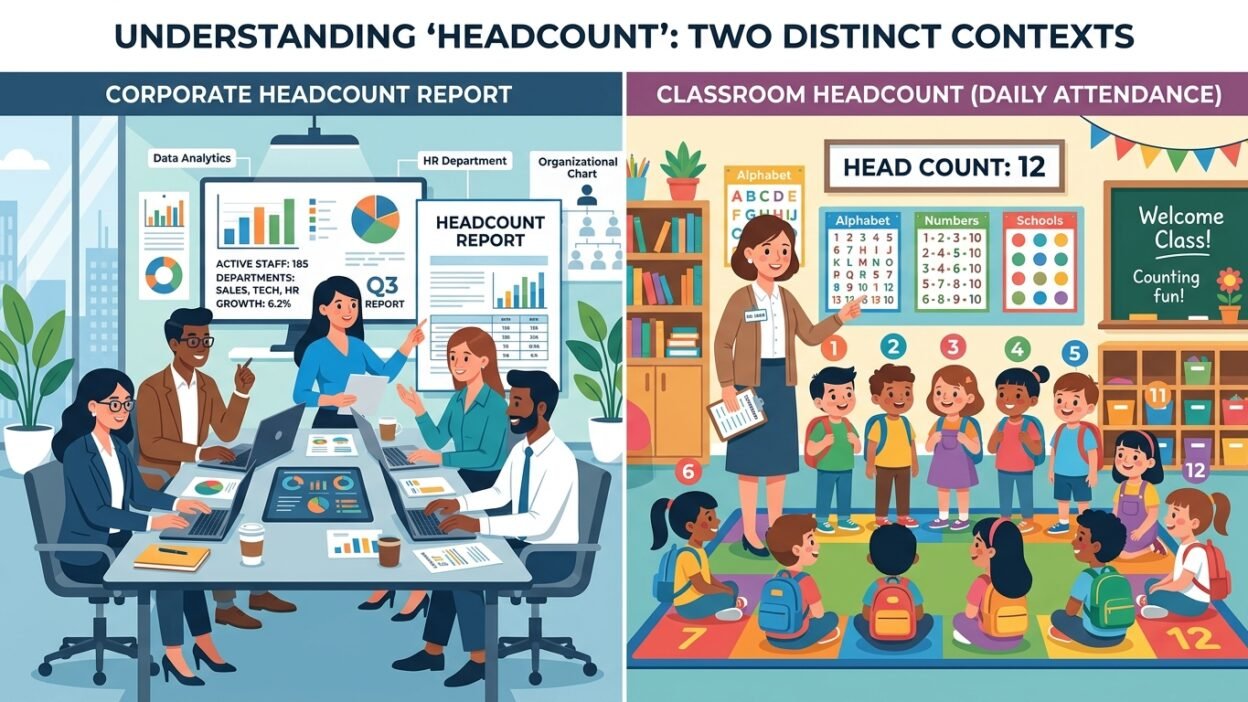
Many English learners feel confused when they see “headcount” and “head count.” These two forms look almost the same. The only difference is a space between the words. Because of this, it is easy to think they mean exactly the same thing and can be used in any situation.
But in real English use, there is a small but important difference.
Sometimes the words are written together as one word (headcount), and sometimes they are written as two words (head count). The meaning is similar, but the way we use them in sentences can change.
This can be confusing for students, beginners, and even professionals. The good news is that the difference is simple and easy to understand once you see clear examples.
In this article, you will learn the exact meaning, usage, differences, and common mistakes so you can use both forms correctly with confidence.
Quick Answer
Here is the simple explanation:
- Headcount (one word) is a noun that means the total number of people.
- Head count (two words) is usually a noun phrase or can refer to the act of counting people.
- In modern English, “headcount” (one word) is more common, especially in business and offices.
- Both forms are correct, but “headcount” is preferred in most situations.
Examples:
- The company increased its headcount this year.
- We need to do a quick head count before leaving.
Simple Origin or Background
To understand the difference, let’s look at how the phrase developed.
The word comes from two simple ideas:
- Head = a person
- Count = to calculate or total something
In the past, people used the phrase “head count” to describe the physical act of counting people, especially in groups like:
- classrooms
- armies
- travel groups
For example, a teacher might count students by looking at each “head.”
Over time, as language became simpler and faster, the two words joined together to form “headcount.”
This new form became popular in:
- business
- offices
- reports
- company planning
So today:
- Head count (two words) often keeps the original meaning of counting people
- Headcount (one word) is more modern and used as a standard noun
Clear Explanation of the Difference
Now let’s break it down clearly.
What “headcount” (one word) means
Headcount is a noun. It refers to the total number of people in a group or organization.
It is often used in:
- companies
- offices
- reports
- planning discussions
Examples:
- Our company’s headcount is growing.
- The team has a headcount of 50 employees.
- We need to reduce headcount this year.
In all these examples, headcount = total number of people.
What “head count” (two words) means
Head count is usually used when we talk about the action of counting people.
It can also be used as a noun phrase, but it feels more physical and direct.
Examples:
- Let’s do a quick head count before the trip.
- The teacher did a head count of the class.
- We need a head count to make sure everyone is here.
Here, the focus is on the process of counting, not just the number.
Key idea to remember
- Headcount = number of people
- Head count = act of counting people
Comparison Table
| Form | Type | Meaning | Common Use | Example |
|---|---|---|---|---|
| Headcount | Noun (one word) | Total number of people | Business, offices | The company increased its headcount. |
| Head count | Noun phrase (two words) | Act of counting people | Schools, trips, groups | Let’s take a head count. |
| Headcount | More modern | Widely used | Reports, HR | Our headcount is 200. |
| Head count | More traditional | Less common in business | Daily situations | Do a head count before leaving. |
This table shows that both forms are correct, but their usage is slightly different.
Which One to Use and When
Choosing the right form is easy if you follow a few simple rules.
Use “headcount” (one word) when:
- you are talking about the number of people
- you are writing in a formal or business setting
- you are discussing teams, companies, or staff
Examples:
- The company plans to increase its headcount next year.
- Our department has a small headcount.
- The project requires a larger headcount.
Use “head count” (two words) when:
- you are talking about the action of counting people
- you are speaking in everyday situations
- you are dealing with groups, trips, or classes
Examples:
- Let’s do a head count before we leave.
- The guide did a head count of the tourists.
- We need a quick head count.
Simple rule
- If you mean number → headcount
- If you mean action → head count
Common Mistakes People Make
Let’s look at some common errors and how to fix them.
Mistake 1: Using two words in business writing
Incorrect:
- The company increased its head count this year.
Better:
- The company increased its headcount this year.
In business English, headcount is preferred.
Mistake 2: Using one word for the action
Incorrect:
- Let’s take a headcount before the trip.
Better:
- Let’s take a head count before the trip.
When talking about the action, two words sound more natural.
Mistake 3: Thinking both forms are always the same
Many learners believe they can always switch between them.
While both forms are correct, they are not always natural in every situation.
Mistake 4: Overthinking the difference
Some learners worry too much about using the wrong form.
The truth is:
- Most people will still understand you
- But using the correct form makes your English clearer and more natural
Everyday Real-Life Examples
Let’s see how these words appear in real situations.
In emails
Example:
- Please confirm your attendance so we can finalize the headcount.
Another example:
- We need a final head count before booking the bus.
In workplace conversations
Example:
- Our headcount has increased this quarter.
- We need to manage our headcount carefully.
In schools
Example:
- The teacher did a head count before starting the trip.
- We need a head count for the school event.
In travel situations
Example:
- The guide checked the head count before leaving.
- The tour group has a total headcount of 25 people.
On social media
Example:
- “Our team’s headcount just reached 100!”
- “Quick head count before we enter the stadium.”
These examples show how both forms are used in daily life.
Learning Tips for Students and Beginners
Here are some simple tips to remember the difference easily.
Tip 1: Think of one word = one number
When you see headcount, think:
one word → one total number
Tip 2: Think of two words = action
When you see head count, think:
two words → counting action
Tip 3: Practice with simple sentences
Try these:
- Our headcount is 30.
- Let’s do a head count.
Practice helps you remember faster.
Tip 4: Notice real usage
Pay attention when you read or listen:
- News → often uses headcount
- Daily speech → often uses head count
(FAQ)
1. Are “headcount” and “head count” the same?
They have similar meanings, but not exactly the same use. One focuses on the number, the other on the action.
2. Which form is more common today?
Headcount (one word) is more common, especially in business and professional writing.
3. Can I always use “headcount”?
In most cases, yes. But for the action of counting, “head count” sounds more natural.
4. Is “head count” wrong?
No, it is correct. It is just used more in everyday situations than in formal writing.
5. What does “headcount” mean in a company?
It means the total number of employees.
6. Can “headcount” be a verb?
No. It is used as a noun.
7. Is this difference important?
Yes. It helps your English sound more natural and correct, especially in writing.
8. How can I remember the difference easily?
Remember:
- Headcount = number
- Head count = counting action
Conclusion
The difference between headcount and head count is small but important.
Headcount (one word) is a modern noun that refers to the total number of people, especially in workplaces and organizations.
Head count (two words) usually refers to the act of counting people, often in everyday situations like classrooms, trips, or events.
By remembering this simple idea number vs action you can easily choose the correct form in any situation.
With a little practice, these two terms will become clear, natural, and easy to use in your daily English.

Austin Brandon serves as both an author and administrator at GrammerPeak. He manages site operations while creating clear, accurate grammar content that helps readers correct mistakes, understand language rules, and write with confidence, precision, and clarity across academic, professional, and everyday English communication.