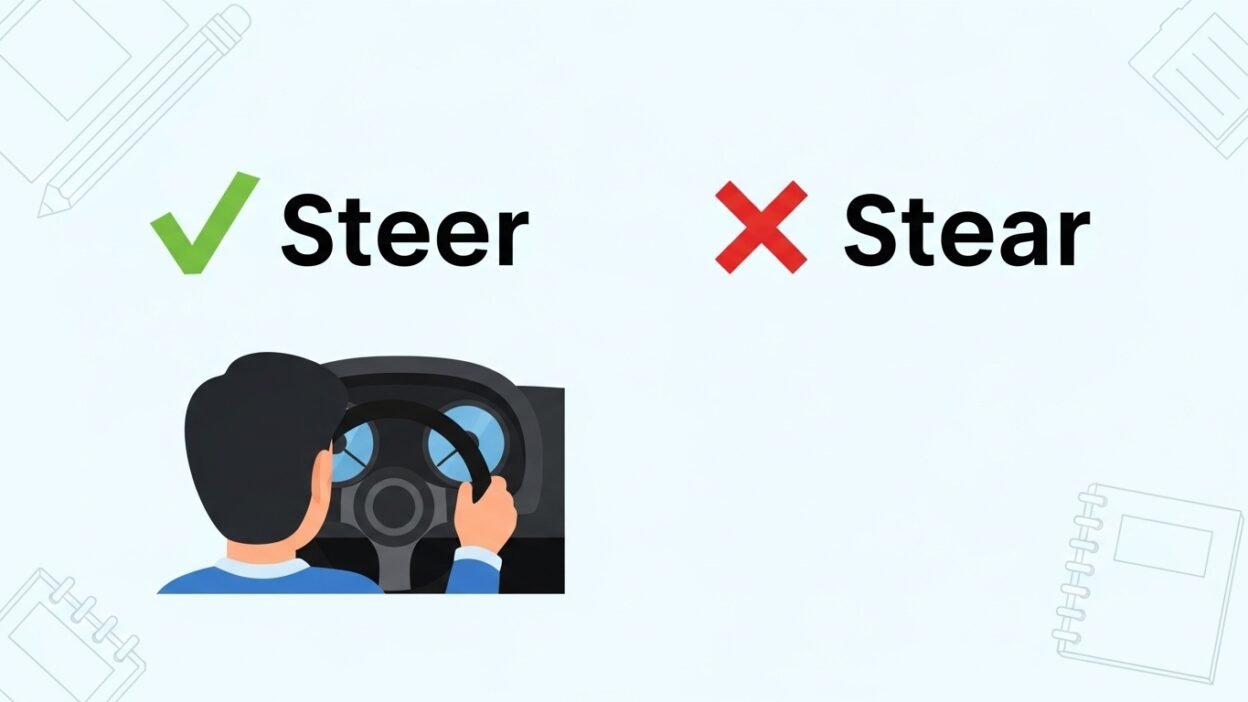
Many students and English learners feel confused between steer and stear. These two words look almost the same, but only one of them is correct in standard English.
The confusion happens because English spelling can be tricky. Sometimes, people hear a word and try to spell it based on sound. The words “steer” and “stear” sound similar, so learners may think both spellings are correct.
The truth is simple: “steer” is correct, and “stear” is not a real English word.
This guide will explain everything clearly in very easy English so you can understand and use the correct spelling with confidence.
Quick Answer: Steer vs Stear
Here is the simple answer:
- Steer ✅ Correct spelling
- Stear ❌ Incorrect spelling
- Steer means to control direction (like driving a car or guiding something)
- Steer can also mean a young male cow
- Stear is a spelling mistake and should not be used
Always use steer, never stear.
Simple Origin and Background
The word steer has been in English for hundreds of years. It comes from old English words that mean “to guide” or “to direct.”
In the past, people used this word when talking about guiding animals, boats, or carts. Today, we still use the same word when talking about driving cars, riding bikes, or controlling anything that moves.
The spelling stear did not develop as a real English word. It is usually just a mistake made by learners or writers.
Clear Explanation of the Difference
The difference between steer and stear is very simple:
1. Steer (Correct Word)
Steer is a real English word with real meanings.
It has two main meanings:
Meaning 1: To control direction
- To guide a car, bike, or vehicle
- To move something in a certain direction
Example:
- She steered the car carefully.
- He steered the boat toward the shore.
Meaning 2: A young male cow
- Used in farming and agriculture
Example:
- The farmer bought a healthy steer.
2. Stear (Incorrect Word)
Stear is not a real English word.
It is:
- A spelling mistake
- Not used in correct English
- Not found in standard dictionaries
If you write “stear,” readers may think it is an error.
Comparison Table: Steer vs Stear
| Feature | Steer | Stear |
|---|---|---|
| Is it a real English word? | Yes | No |
| Correct spelling? | Yes | No |
| Meaning exists? | Yes | No |
| Used in sentences? | Yes | No |
| Found in dictionaries? | Yes | No |
| Should you use it? | Yes | No |
Which One to Use and When
You should always use steer when you want to talk about direction or control.
Use steer when talking about driving
- He steers the car every day.
- She steered the bus safely.
Use steer when talking about guiding something
- The teacher steered students toward the right answer.
Use steer when talking about animals (farming)
- The steer is eating grass.
Never use stear
- It is always incorrect.
Common Mistakes People Make
Many learners make simple spelling mistakes. Here are common errors:
Mistake 1: Writing stear instead of steer
❌ Wrong: He stear the car.
✅ Correct: He steer the car.
✅ Correct: He steers the car.
Mistake 2: Guessing spelling based on sound
People hear “steer” and think it may be spelled “stear.”
But English spelling does not always match sound.
Always remember:
Steer = correct spelling
Mistake 3: Not checking spelling
Sometimes people type fast and make errors.
Always check your writing before sending messages or submitting homework.
Everyday Real Life Examples
Here are examples from daily life so you can see how “steer” is used.
Example 1: Text message
“Can you steer the car while I check the map?”
Example 2: Email
“Please steer the project in the right direction.”
Example 3: Social media
“He learned how to steer a bike today!”
Example 4: News
“The driver lost control and could not steer properly.”
Example 5: Classroom
“The teacher helped steer students toward the solution.”
Short Learning Section for Students and Beginners
Here is an easy way to remember:
Simple rule:
- Steer = correct
- Stear = wrong
Memory tip:
Think of steer and wheel
Both have “ee”
Steer wheel direction
This helps you remember the correct spelling.
Practice sentences
Fill in the blank:
- He learned to ______ the car.
Answer: steer - The driver must ______ carefully.
Answer: steer - The farmer owns a ______.
Answer: steer
Never write stear.
FAQ
Question 1: Is stear a real word?
No. Stear is not a real English word. It is a spelling mistake.
Question 2: What does steer mean?
Steer means to control direction, like driving a car or guiding something.
It can also mean a young male cow.
Question 3: Why do people write stear?
People write stear by mistake because it sounds similar to steer.
Question 4: Which spelling is correct, steer or stear?
Steer is correct. Stear is incorrect.
Question 5: Is steer used in daily life?
Yes. It is used when talking about driving, guiding, or farming.
Example:
She steered the car safely.
Question 6: Is steer used in American and British English?
Yes. Steer is correct in both American and British English.
Question 7: Can steer be used for things other than cars?
Yes. It can be used for boats, bikes, projects, and decisions.
Example:
He steered the conversation.
Conclusion
The difference between steer and stear is very simple.
Steer is the correct spelling and a real English word.
It means to control direction or guide something. It can also mean a young male cow.
Stear is not a real word. It is just a spelling mistake.
Always remember:
- Use steer when writing or speaking
- Never use stear
- Check spelling when unsure
With this simple rule, you can use the correct word confidently in school, messages, and daily life.