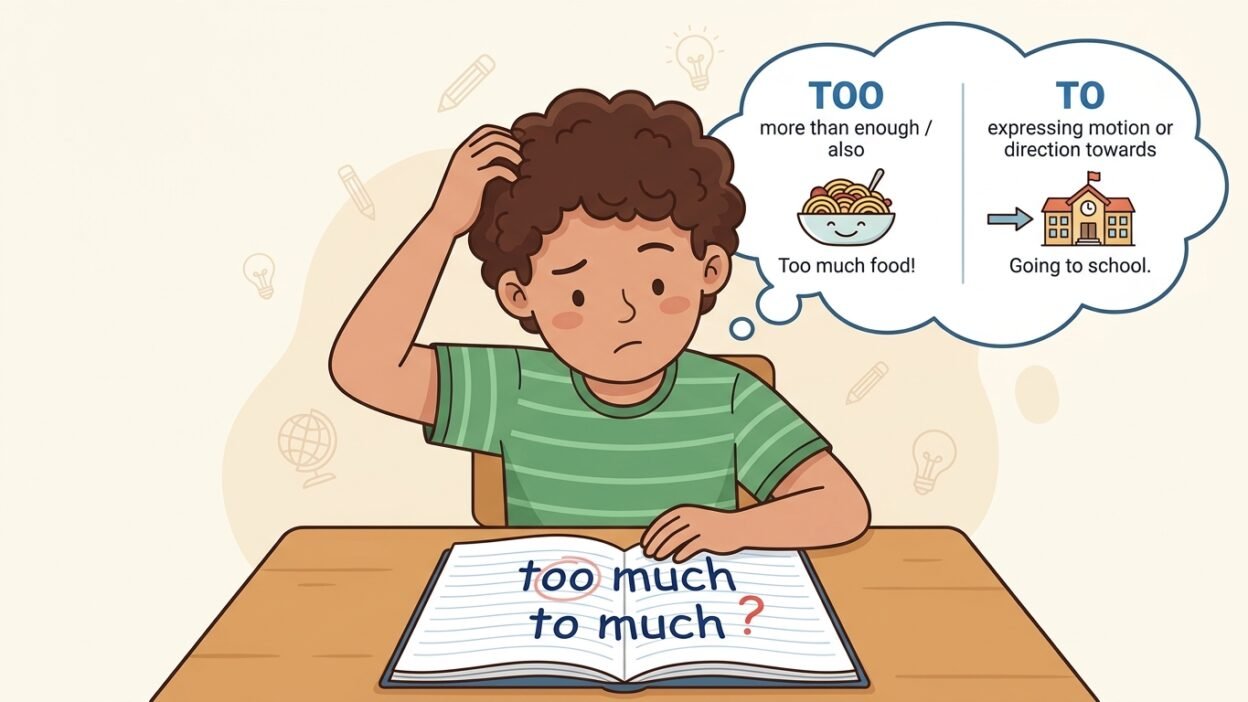
Many students and English learners feel confused when they see the phrases “too much” and “to much.” At first glance, both look similar, and the difference seems very small. Because the words “too” and “to” sound the same when we speak, people often mix them up when writing.
However, in correct English, these two forms are not used in the same way. In fact, “too much” is correct, while “to much” is usually a mistake.
Understanding this difference is important because the wrong form can make a sentence look incorrect or confusing.
The good news is that the rule is simple. Once you understand how the word “too” works, you will almost never make this mistake again.
In this article, you will learn the difference step by step using very simple explanations and clear examples.
Quick Answer
Here is the short and simple answer:
- Too much is the correct phrase in most situations.
- Too means more than needed or more than wanted.
- Much refers to a large amount of something.
- “To much” is usually a spelling mistake.
Examples:
- I ate too much food. ✔
- She talks too much in class. ✔
- I ate to much food. ✘
If you want to say more than necessary, always use too much.
Simple Background Explanation
To understand the difference, we must first look at the words “too” and “to.”
The word “too”
The word too has two main meanings:
- More than necessary
- Also or as well
Examples:
- The coffee is too hot.
- He works too much.
- I want to come too.
In the phrase “too much,” the word too means more than needed.
The word “to”
The word to is one of the most common words in English. It is used for many things, such as:
- showing direction
- connecting verbs
- showing relationships
Examples:
- I am going to the store.
- She wants to study.
- Give the book to him.
Because to has these uses, it normally does not combine with “much” to create the meaning “more than necessary.”
That is why “to much” usually does not work in English sentences.
Clear Explanation of the Difference
The difference is actually very simple.
Too much
Too much means more than needed, more than wanted, or more than acceptable.
It describes an excessive amount of something.
Examples:
- There is too much noise in this room.
- I spent too much money yesterday.
- She drinks too much coffee.
In each sentence, the amount is greater than what is good or comfortable.
To much
To much is usually not correct English.
It appears when someone accidentally writes “to” instead of “too.”
Example of the mistake:
- I ate to much cake. ✘
Correct sentence:
- I ate too much cake. ✔
So in most situations, “to much” should be corrected to “too much.”
Comparison Table
| Feature | Too Much | To Much |
|---|---|---|
| Correct spelling | Yes | Usually no |
| Meaning | More than necessary | No clear meaning |
| Used in sentences | Yes | Usually a mistake |
| Example | I talk too much | I talk to much (incorrect) |
| Common use | Describing excess | Typing or spelling error |
This table shows that “too much” is the form you should use.
Which One Should You Use and When
You should use too much whenever you want to talk about excess.
Common situations include:
Talking about food
- I ate too much pizza.
- He drinks too much soda.
Talking about work or activity
- She works too much.
- I study too much before exams.
Talking about problems
- There is too much traffic today.
- We have too much homework.
A simple rule to remember:
If the meaning is “more than necessary,” use “too much.”
Common Mistakes People Make
Many learners make the same mistakes when using these words.
Mistake 1: Writing “to” instead of “too”
This happens because both words sound the same.
Incorrect:
- I talk to much.
Correct:
- I talk too much.
Mistake 2: Forgetting the meaning of “too”
Some learners think too simply means very.
But too actually means more than needed.
Example:
- This bag is too heavy.
- The room is too cold.
Mistake 3: Typing quickly
Sometimes people know the rule but still write to much by accident when typing fast.
This mistake often happens in:
- text messages
- social media
- online comments
Everyday Real Life Examples
Let’s see how too much appears in real daily communication.
Emails
- I think we have too much information in this report.
- The meeting took too much time.
Social Media
- I spend too much time on my phone.
- There is too much drama online today.
Daily Conversation
- You watch too much TV.
- We have too much work today.
News Style Sentences
- The city has too much traffic during rush hour.
- Experts say people eat too much sugar.
These examples show that too much is very common in everyday English.
Learning Section for Students and Beginners
Here is a simple way to remember the rule.
Easy Memory Trick
Think about the word extra.
If the meaning is extra or more than needed, use too much.
Example:
- I bought too much food.
- She talks too much in class.
Practice Sentences
Try to choose the correct form.
- I ate ___ chocolate.
- There is ___ noise here.
- He spends ___ money.
Correct answers:
- too much
- too much
- too much
You can see that too much works in all these sentences.
(FAQ)
1. Is “to much” ever correct?
In normal sentences, no. It is usually a spelling mistake.
2. What does “too much” mean?
It means more than necessary or more than comfortable.
Example:
There is too much noise.
3. Why do people confuse these words?
Because too and to sound the same when we speak.
4. Can “too much” describe feelings?
Yes.
Example:
- The stress is too much for me.
5. Is “too much” formal or informal?
It works in both formal and informal English.
Example:
- This report contains too much data.
6. Can we use “too much” with verbs?
Yes.
Examples:
- He talks too much.
- She worries too much.
7. What is the opposite of “too much”?
Often people say:
- not much
- just enough
Example:
- I didn’t eat too much today.
8. Is “too much” common in daily English?
Yes, it is very common in speaking and writing.
Conclusion
The difference between too much and to much is simple once you understand the meaning of too.
Too much is the correct phrase and it means more than necessary or more than wanted. It is used to talk about excess amounts of things such as food, work, noise, or time.
On the other hand, to much is usually just a spelling mistake. It happens because the words too and to sound the same, but they have different meanings.
To avoid confusion, remember this easy rule:
If you mean “more than needed,” always write “too much.”
With practice and careful writing, this small mistake will become very easy to avoid.