
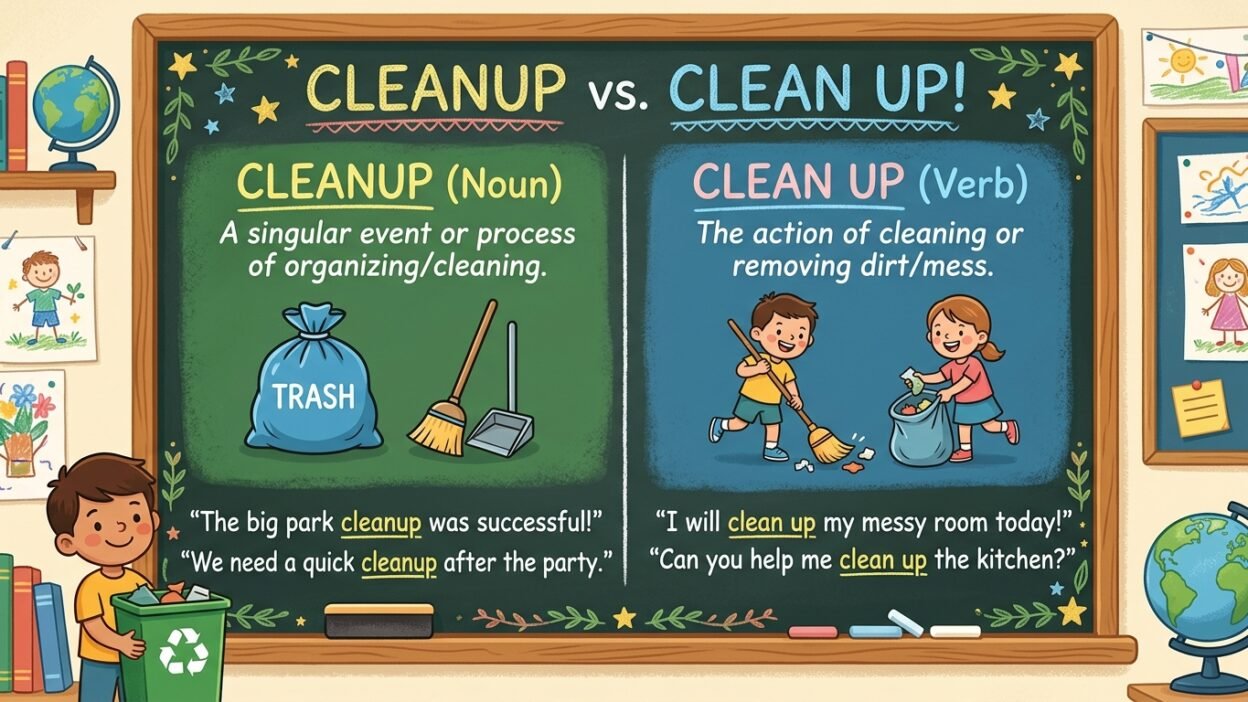
Many English learners feel confused when they see “cleanup” and “clean up.” At first look, these two forms seem almost the same. They use the same words and have the same meaning idea making something clean. Because of this, people often mix them up in writing.
The confusion usually happens because one form is a noun or adjective, and the other form is a verb. In simple words, one describes a thing or event, and the other describes an action.
This small space between the words changes how they work in a sentence. If you understand this simple rule, you will never feel confused again.
This guide explains everything in very simple English so students, beginners, and general readers can understand it easily.
Quick Answer
Here is the short and simple answer:
- Clean up → a verb phrase (an action)
- Cleanup → a noun or sometimes an adjective
Easy way to remember:
- Use clean up when you talk about doing the action of cleaning.
- Use cleanup when you talk about the event, process, or result of cleaning.
Examples:
- We need to clean up the room.
- The beach cleanup starts tomorrow.
Simple Background of the Words
The phrase “clean up” started as a normal verb phrase in English.
- Clean = make something not dirty
- Up = completely or fully
When people say clean up, they mean to make something completely clean.
Over time, English speakers started using the action name as a single word. That is how “cleanup” was created.
English often forms nouns this way. A verb phrase slowly becomes one word that names an activity.
For example:
- setup
- breakdown
- login
In the same way:
- clean up (verb) became
- cleanup (noun)
This change is very common in English.
Clear Explanation of the Difference
The difference between cleanup and clean up is mostly about grammar and sentence role.
Clean Up (Verb Phrase)
Clean up is an action. It means to remove dirt, mess, trash, or unwanted things.
It describes something that someone does.
Examples:
- Please clean up your desk.
- We need to clean up the kitchen.
- Volunteers will clean up the park.
In all these examples, someone is doing the action.
Cleanup (Noun or Adjective)
Cleanup is a thing or event, not an action word.
It often describes:
- a cleaning activity
- a cleaning effort
- a cleaning event
Examples:
- The city organized a beach cleanup.
- The cleanup took three hours.
- The school cleanup day is Friday.
Here, the word is naming the event or activity, not the action itself.
Comparison Table
| Feature | Clean Up | Cleanup |
|---|---|---|
| Word type | Verb phrase | Noun / adjective |
| Meaning | The action of making something clean | The event or process of cleaning |
| Written form | Two words | One word |
| Example | Please clean up your room | The cleanup begins at 9 AM |
| Sentence role | Action in the sentence | Name of activity or event |
This table shows the key difference very quickly.
Which One to Use and When
A simple trick can help you choose the correct form.
Use “Clean Up” When Talking About Action
Ask yourself: Is someone doing the cleaning?
If yes, use clean up.
Examples:
- We must clean up after the party.
- She will clean up the classroom.
- They stayed late to clean up the office.
The focus is on the action of cleaning.
Use “Cleanup” When Naming the Activity
Ask yourself: Am I talking about the event or the process?
If yes, use cleanup.
Examples:
- The river cleanup starts this weekend.
- The cleanup was successful.
- Volunteers joined the park cleanup.
Here, the word works like a thing or event name.
Common Mistakes People Make
Many learners make small mistakes with these two forms. Here are the most common ones.
Writing the Verb as One Word
Incorrect:
- We need to cleanup the room.
Correct:
- We need to clean up the room.
Remember: actions usually stay two words.
Writing the Noun as Two Words
Incorrect:
- The beach clean up was successful.
Correct:
- The beach cleanup was successful.
Because here the word is the name of the event.
Mixing Both Forms in the Same Sentence
Incorrect:
- We will cleanup the park during the community clean up.
Correct:
- We will clean up the park during the community cleanup.
Understanding the role of the word helps avoid these mistakes.
Everyday Real-Life Examples
Seeing these words in daily situations helps make the difference clearer.
Emails
- Please clean up the meeting room before leaving.
- The office cleanup will happen on Saturday.
News
- Volunteers helped clean up the beach after the storm.
- The city organized a large cleanup project.
Social Media
- Let’s clean up our neighborhood today!
- Join our weekend park cleanup.
At Home
- Kids must clean up their toys.
- The kitchen cleanup took an hour.
At School
- Students stayed after class to clean up.
- The school announced a campus cleanup.
In real life, both forms appear often, but they serve different roles.
Learning Tip for Students and Beginners
A very easy memory trick can help you remember the difference.
The Action Test
Ask yourself:
Is someone doing the cleaning?
- Yes → clean up
Example:
- Please clean up your desk.
The Event Test
Ask yourself:
Is it the name of the cleaning activity?
- Yes → cleanup
Example:
- The beach cleanup starts at 8 AM.
Another Easy Rule
You can also remember this:
Two words = action
One word = thing
- clean up → action
- cleanup → event
This rule works in most situations.
FAQ
1. Is “cleanup” one word or two?
It can be both, depending on how it is used.
- cleanup → noun or adjective
- clean up → verb phrase
2. Which form is more common?
Both are common. The correct choice depends on the sentence role.
3. Can “cleanup” be used as an adjective?
Yes.
Example:
- The cleanup team arrived early.
Here it describes the team.
4. Is “clean up” always two words?
Yes, when it works as a verb phrase, it is always written as two words.
Example:
- Please clean up the room.
5. Do British and American English use different forms?
No. Both forms are used in both varieties of English.
6. Can “cleanup” describe a large project?
Yes.
Example:
- The oil spill cleanup lasted several months.
7. Why do people mix these words?
People mix them because they sound the same and use the same root words.
8. Is “clean-up” with a hyphen correct?
Sometimes you may see clean-up with a hyphen, but modern writing usually prefers cleanup as one word.
Conclusion
The difference between cleanup and clean up is simple once you know the rule.
- Clean up is a verb phrase that describes the action of making something clean.
- Cleanup is a noun or adjective that describes the event, process, or result of cleaning.
A quick memory trick can help:
- Two words → action
- One word → event
Examples:
- Please clean up your room.
- The beach cleanup starts tomorrow.
With this understanding, students and learners can easily choose the correct form and avoid common mistakes in writing.