Many students and English learners get confused between truly and truely. When people try to write this word, they often stop and think:
- Should I write truly?
- Or should it be truely?
The confusion happens because the word true ends with the letter “e.” In English, we usually keep the “e” when we add letters to a word. So many people naturally think the spelling should be truely.
However, English sometimes breaks its own patterns. In this case, the correct spelling is different from what many learners expect.
The good news is that the rule behind this word is simple. Once you understand it, you will never make this mistake again.
Quick Answer
Here is the simple answer:
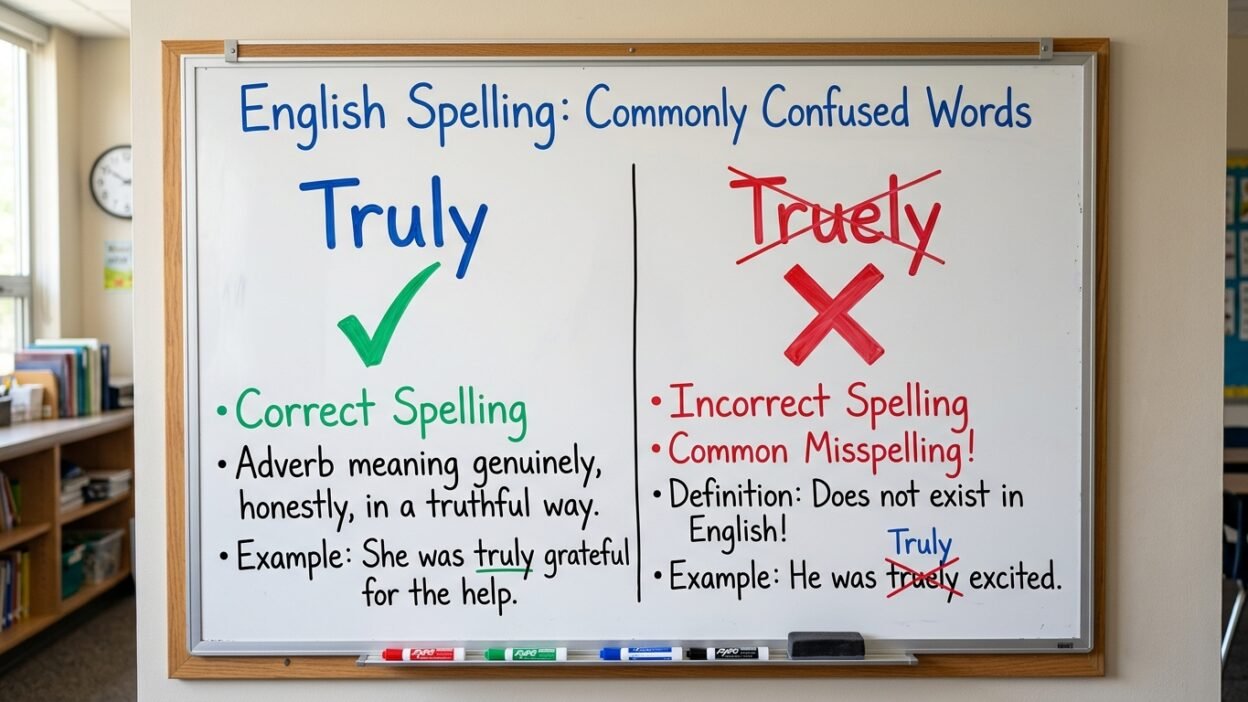
- ✅ Truly is the correct spelling.
- ❌ Truely is incorrect.
- “Truly” means in a real, honest, or sincere way.
- The “e” in the word true is removed before adding -ly.
So remember this rule:
True → Truly (drop the “e”).
Simple Origin and Background
The word truly comes from the adjective true.
The word true means:
- real
- honest
- correct
- sincere
When we want to describe an action in an honest or real way, we add -ly to make an adverb.
For example:
- quick → quickly
- happy → happily
- honest → honestly
However, the word true follows a small spelling change.
Instead of writing:
- true + ly = truely
English removes the “e.”
So the correct form becomes:
- true → truly
This spelling has been used for many centuries in English writing.
Clear Explanation of the Difference
Let’s clearly understand the difference between these two spellings.
Truly (Correct Form)
Truly is an adverb. It describes how something is done.
It means:
- honestly
- sincerely
- really
- in a genuine way
Examples:
- I truly appreciate your help.
- She truly cares about her students.
- This was a truly amazing experience.
In all correct English writing, the spelling is truly.
Truely (Incorrect Form)
Truely is not a correct English spelling.
It usually appears because people think the word should keep the “e” from true.
Example mistake:
- I truely enjoyed the movie.
Correct sentence:
- I truly enjoyed the movie.
So whenever you see truely, it is simply a spelling mistake.
Comparison Table
Here is a simple table to make the difference easy to see.
| Feature | Truly | Truely |
|---|---|---|
| Correct spelling | Yes | No |
| Used in formal writing | Yes | No |
| Dictionary word | Yes | No |
| Meaning | Honestly or sincerely | Spelling error |
| Based on word “true” | Yes | Incorrect formation |
The table clearly shows that truly is the only correct spelling.
Which One to Use and When
The answer is very simple.
Always Use “Truly”
Use truly in every type of writing:
- school assignments
- essays
- emails
- professional messages
- books and articles
Example sentences:
- I am truly grateful for your support.
- This is truly the best solution.
- She truly believes in her work.
Never Use “Truely”
The spelling truely should never appear in correct English writing.
If you see it, it is simply an error.
Common Mistakes People Make
Let’s look at some mistakes learners often make with this word.
1. Keeping the “e” from “true”
Many people think the spelling should be:
- truely
But English removes the “e” when adding -ly in this word.
Correct form:
- truly
2. Mixing it with other “-ly” words
Some words keep the original spelling when adding -ly.
For example:
- nice → nicely
- brave → bravely
Because of this pattern, learners expect:
- true → truely
But this word is an exception.
3. Typing mistakes
Sometimes people simply type too fast and add an extra letter.
Example mistake:
- truely
Always double-check your spelling.
4. Copying incorrect spelling online
On social media, people sometimes write quickly without checking spelling. That is why incorrect forms like truely appear online.
Always rely on correct standard spelling.
Everyday Real-Life Examples
Let’s see how the word truly appears in daily communication.
In Emails
- I truly appreciate your quick reply.
- We are truly thankful for your help.
In News Writing
- The athlete gave a truly impressive performance.
- The city experienced a truly historic event.
On Social Media
- This is truly my favorite place to visit.
- I truly love this song.
In Daily Conversation
- I truly enjoyed our conversation.
- She truly understands the problem.
- That was truly surprising.
In all these examples, the spelling remains truly.
Short Learning Section for Students and Beginners
Here is a simple trick to remember the correct spelling.
Memory Trick
Think of the word in two parts:
Tru + ly
The letter “e” disappears.
So remember:
True → Truly (drop the e).
Quick Practice
Choose the correct spelling.
- I ______ appreciate your support.
- This was a ______ wonderful experience.
- She ______ cares about her work.
Correct answers:
- truly
- truly
- truly
Simple Reminder
If you ever feel unsure, just remember:
Truely = extra letter = wrong
Truly = simple spelling = correct
FAQ
1. Is “truely” ever correct?
No. It is always considered a spelling mistake.
2. What is the correct spelling?
The correct spelling is truly.
3. Why does “true” lose the “e”?
English drops the “e” before adding -ly in this word.
4. Is “truly” an adjective or an adverb?
It is an adverb, because it describes how something happens.
5. Can “truly” start a sentence?
Yes.
Example:
- Truly, this was an unforgettable moment.
6. Is this mistake common for learners?
Yes. Many learners write truely because it seems logical.
7. Are there other words like this?
Yes. Some words change spelling slightly when adding -ly.
8. What is the easiest way to remember the spelling?
Remember: the “e” disappears when “true” becomes “truly.”
Conclusion
The confusion between truly and truely is very common, but the answer is simple.
Only one spelling is correct:
Truly
The spelling truely is incorrect because English removes the “e” from the word true before adding -ly.
If you remember this small rule, you will never make this mistake again.
Just think:
True → Truly (drop the e).
Now you can write this word confidently in emails, school work, and everyday writing.

Austin Brandon serves as both an author and administrator at GrammerPeak. He manages site operations while creating clear, accurate grammar content that helps readers correct mistakes, understand language rules, and write with confidence, precision, and clarity across academic, professional, and everyday English communication.