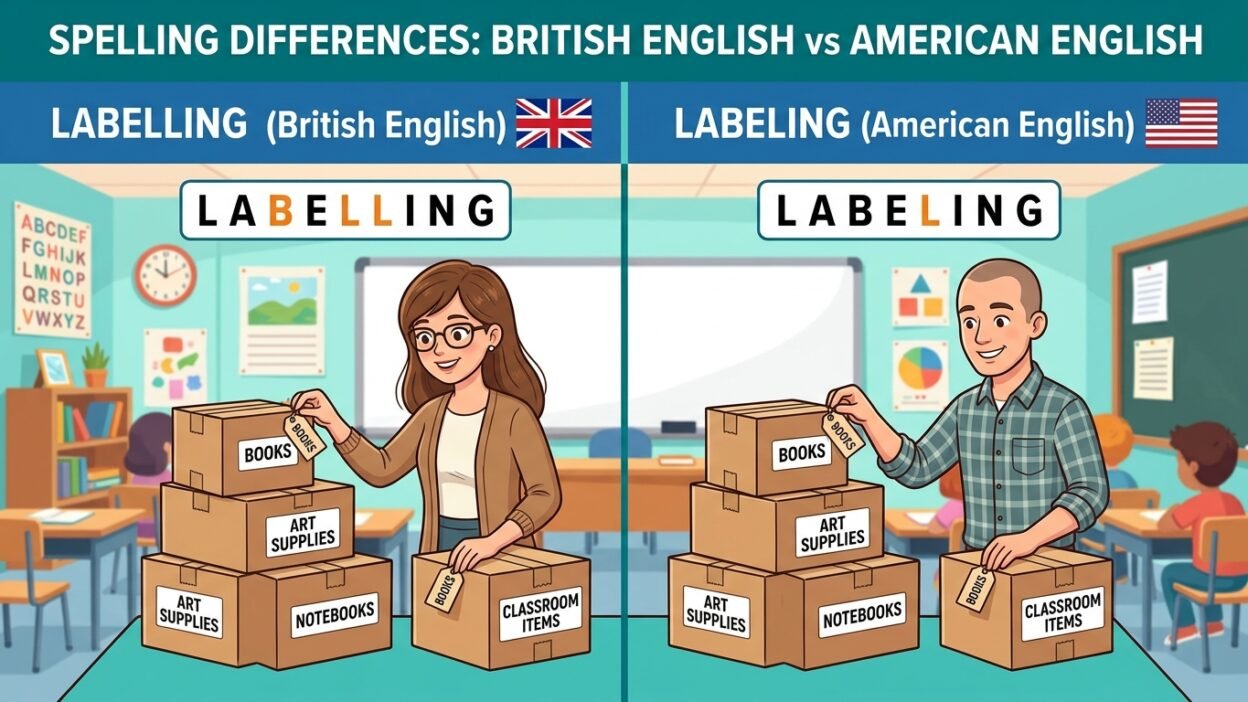
Many students and English learners feel confused when they see the words labelling and labeling. Both look almost the same. The only difference is one extra letter “l.”
Because of this small difference, people often ask questions like:
- Is labelling correct?
- Is labeling the right spelling?
- Why do some books use two “l” letters while others use one?
This confusion happens because English has different spelling styles in different parts of the world. Some countries prefer one spelling, while others prefer another.
The good news is that the explanation is simple. Once you understand the rule, the difference between labelling and labeling becomes very easy to remember.
Let’s go step by step and clear up the confusion.
Quick Answer
Here is the simple truth:
- ✅ Labelling is the preferred spelling in British English.
- ✅ Labeling is the preferred spelling in American English.
- Both spellings are correct.
- The meaning of the word is exactly the same.
- The difference is only about spelling style.
So if you remember just one thing, remember this:
British English → labelling
American English → labeling
Simple Origin and Background
To understand these spellings, we first need to look at the base word label.
A label is a small piece of information that identifies something. It can be:
- A tag on clothing
- A name on a container
- A description attached to something
For example:
- A label on a bottle
- A label on a product
- A label in a school project
When we turn label into a verb, it means to attach a label or name to something.
Examples:
- She labeled the boxes.
- The teacher labeled the diagram.
Now when we add -ing to make the present form, we get:
- labeling
or - labelling
This is where the spelling difference appears.
Clear Explanation of the Difference
The difference between labelling and labeling comes from two spelling systems: British English and American English.
Labelling (British English)
In British English, when a word ends with “l”, writers often double the “l” before adding -ing.
So:
label → labelling
This spelling is common in:
- The United Kingdom
- Australia
- New Zealand
- Canada (often)
Example sentences:
- The company is labelling the products.
- She is labelling the jars in the kitchen.
- The teacher is labelling the parts of the diagram.
Labeling (American English)
In American English, the final “l” is usually not doubled when adding -ing.
So:
label → labeling
This spelling is common in:
- The United States
- Many American publications
Example sentences:
- The factory is labeling the packages.
- He is labeling the files.
- The diagram is labeling each part clearly.
The meaning stays exactly the same.
Comparison Table
Here is a simple table to make the difference easy to see.
| Feature | Labelling | Labeling |
|---|---|---|
| Spelling style | British English | American English |
| Number of “l” letters | Two | One |
| Meaning | Adding a label | Adding a label |
| Pronunciation | Same | Same |
| Correct spelling | Yes | Yes |
As you can see, the meaning does not change. Only the spelling style changes.
Which One to Use and When
Now you may wonder:
Which spelling should I choose?
The answer depends on the type of English you are using.
Use “labelling” when writing in British English
This is common in:
- British schools
- UK newspapers
- UK academic writing
Example:
- The workers are labelling new products.
Use “labeling” when writing in American English
This spelling is common in:
- American schools
- US books and articles
- American businesses
Example:
- The staff is labeling each box carefully.
If you are unsure
If you do not know which style to use, the most important thing is consistency.
Choose one spelling and use it throughout your writing.
Do not mix both styles in the same text.
Common Mistakes People Make
Let’s look at some mistakes learners often make.
1. Mixing both spellings
Incorrect example:
- The company is labeling products and labelling packages.
This mixes two spelling styles.
Better example:
- The company is labeling products and labeling packages.
or - The company is labelling products and labelling packages.
2. Thinking one spelling is wrong
Some students believe only one spelling is correct.
That is not true.
Both spellings are correct. They just belong to different English styles.
3. Adding too many letters
Sometimes people write:
- ❌ labellling
- ❌ labelinng
These are spelling errors.
Correct forms are only:
- labelling
- labeling
4. Forgetting the base word
The base word is label.
If you remember the base word, it becomes easier to spell the longer forms.
Everyday Real Life Examples
Let’s see how the word appears in daily life.
In Emails
- We are labeling the storage boxes today.
- The team is labelling the files for easy access.
In News Articles
- New rules require clear labeling on food products.
- The company started labelling its goods more carefully.
On Social Media
- I’m labeling all my study notes tonight.
- Spent the afternoon labelling my spice jars.
In Daily Conversations
- She is labeling the folders.
- The teacher is labelling the map.
- They are labeling the packages before shipping.
In speech, there is no difference. Both words sound the same.
Short Learning Section for Students and Beginners
Here is a simple way to remember the difference.
Memory Trick
Think about location.
British English → Double L
labelling
American English → Single L
labeling
Quick Practice
Choose the correct spelling for each style.
British English:
- She is ______ the jars.
Answer:
labelling
American English:
- The worker is ______ the boxes.
Answer:
labeling
Simple Tip
If you see words like:
- travelling
- cancelling
- modelling
These also follow the British double “l” pattern, similar to labelling.
FAQ
1. Are labelling and labeling pronounced differently?
No. Both words sound exactly the same.
2. Is one spelling better than the other?
No. Both are correct. The difference depends on the English style you use.
3. Which spelling should students use in exams?
Use the spelling style taught by your school or teacher.
4. Is “labelling” used in American English?
It can appear sometimes, but labeling is more common in the United States.
5. Is “labeling” wrong in British English?
It is not completely wrong, but labelling is preferred in British writing.
6. Does the meaning change with spelling?
No. Both words mean the same thing: adding labels.
7. Can “label” be a noun and a verb?
Yes.
Noun:
- The bottle has a label.
Verb:
- She labeled the bottle.
8. Is the spelling difference common in English?
Yes. Many words have British and American spelling differences.
Examples include:
- travelling / traveling
- cancelling / canceling
- modelling / modeling
Conclusion
The confusion between labelling and labeling is easy to understand once you know the reason behind it.
Both spellings are correct. Both mean adding a label or name to something.
The only difference is the style of English:
- Labelling is used in British English.
- Labeling is used in American English.
If you choose one spelling and use it consistently, your writing will be clear and correct.
Now you can confidently write the word without worrying about the extra “l.”