
Many students and English learners feel confused when they see the words indexes and indices. Both words appear in books, articles, and school materials. Because they look similar and seem to mean the same thing, people often wonder:
- Which word is correct?
- When should I use indexes?
- When should I use indices?
The confusion happens because both words are plural forms of the word index. However, they are often used in different situations.
The good news is that the difference is easy to understand. Once you learn when each word is used, choosing the correct one becomes very simple.
In this guide, we will explain everything in clear and easy English so you can understand it quickly.
Quick Answer
Here is the simple truth:
- Indexes and indices are both plural forms of the word index.
- Indexes is commonly used in everyday English.
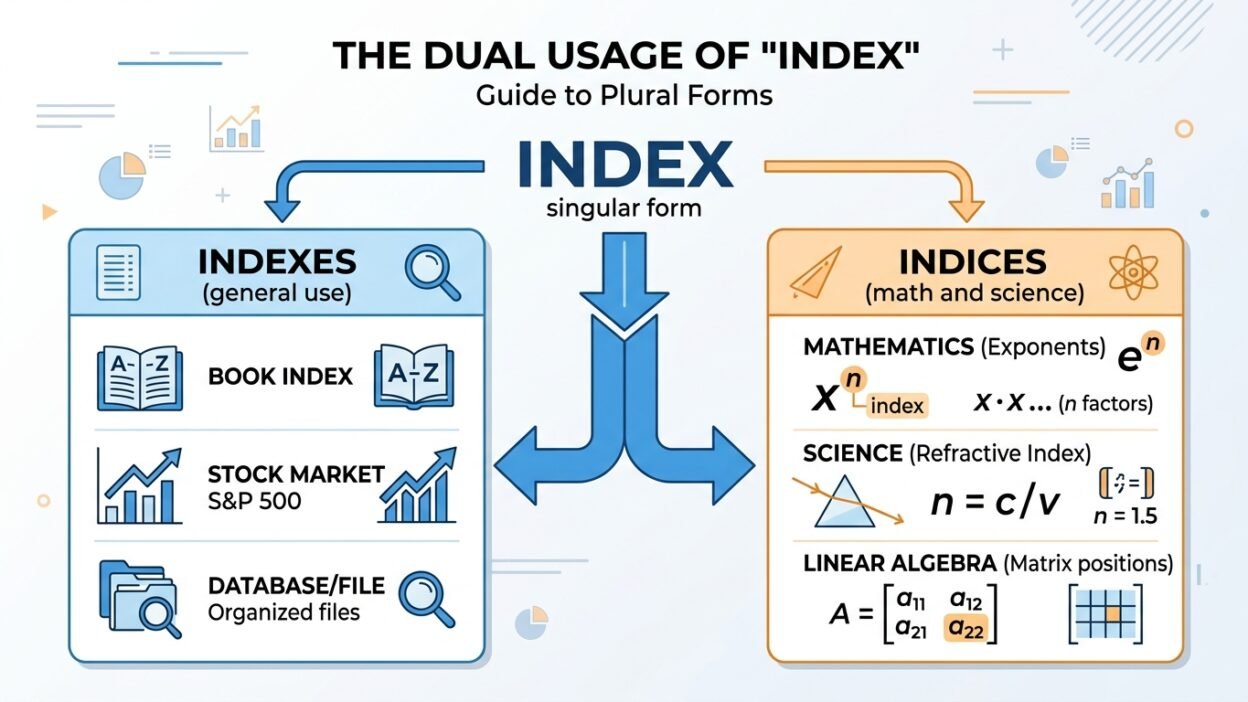
- Indices is often used in mathematics, science, and technical subjects.
- Both words are correct, but they are used in different contexts.
Simple rule to remember:
- General use → indexes
- Math and science → indices
Simple Origin and Background
The word index originally came from Latin. In Latin, the plural form of index was indices.
When English borrowed the word, both plural forms started to appear.
Over time, English created its own plural form by adding -es, which produced indexes.
So today English has two accepted plural forms:
- Indexes (English-style plural)
- Indices (Latin-style plural)
Both forms stayed in the language, but they developed different uses.
Clear Explanation of the Difference
Let’s understand how each word is used.
Indexes
Indexes is the more common plural form in everyday English.
It usually refers to:
- Lists of topics at the end of books
- Database lists
- Business or economic lists
- General references
Example:
- The book has two indexes at the back.
- The library created indexes for all the documents.
- The company tracks several market indexes.
This spelling feels natural in normal English writing.
Indices
Indices is mostly used in academic subjects.
It often appears in:
- Mathematics
- Science
- Statistics
- Finance
- Technical writing
Example:
- Students learn about indices in math class.
- The scientist studied climate indices.
- Several economic indices show growth this year.
In these subjects, indices is often preferred because it matches traditional academic language.
Comparison Table
Here is a simple table to make the difference easy to see.
| Feature | Indexes | Indices |
|---|---|---|
| Plural of index | Yes | Yes |
| Style | Modern English plural | Latin plural |
| Used in everyday writing | Yes | Sometimes |
| Used in math and science | Rare | Very common |
| Easy for beginners | Yes | Slightly more formal |
Both forms are correct, but their usage depends on the situation.
Which One to Use and When
Choosing the correct word becomes easy if you remember these simple rules.
Use “indexes” when writing about:
- Books
- Lists of topics
- Databases
- General English writing
- School essays that are not about math
Examples:
- The textbook includes several helpful indexes.
- The database contains indexes for quick searching.
- The librarian updated the indexes.
Use “indices” when writing about:
- Mathematics
- Scientific research
- Statistics
- Technical reports
Examples:
- Students studied powers and indices in math class.
- The report compares economic indices.
- Scientists measure environmental indices.
If you are unsure
If you are writing general English, indexes is usually the safer choice.
Common Mistakes People Make
Let’s look at mistakes learners often make.
1. Thinking one word is wrong
Some people believe only one plural form is correct.
That is not true.
Both indexes and indices are correct.
2. Using “indices” in very simple writing
Sometimes learners try to sound more formal and use indices in normal sentences.
Example:
- The book has three indices.
This is not wrong, but indexes sounds more natural in everyday writing.
3. Mixing the two forms in the same sentence
Example:
- The report includes indexes and indices.
This can confuse readers. Choose one form based on the topic.
4. Forgetting the meaning of “index”
Some students confuse index with words like:
- list
- chapter
- summary
But an index is a special list that helps readers find topics quickly in a book or document.
Everyday Real Life Examples
Let’s see how these words appear in daily life.
In Emails
- Please check the indexes at the end of the manual.
- The report compares several financial indices.
In News Writing
- Global stock indexes rose today.
- New economic indices show improvement in the market.
On Social Media
- These study guides have great indexes!
- Learning about algebraic indices today.
In Daily Conversations
- The textbook has helpful indexes.
- We studied indices in math class.
- The report shows several health indices.
These examples show how context decides the correct word.
Short Learning Section for Students and Beginners
Here is an easy trick to remember the difference.
Think About the Subject
If the topic is math or science, think of the word indices.
If the topic is books or general lists, think of the word indexes.
Simple Memory Trick
Indexes → books and lists
Indices → math and science
Quick Practice
Choose the correct word.
- The math teacher explained powers and ______.
- The book has helpful ______ at the end.
- The report studies climate ______.
Answers:
- indices
- indexes
- indices
Practicing these examples helps the difference become clear.
FAQ
1. Are indexes and indices both correct?
Yes. Both are accepted plural forms of the word index.
2. Which one is more common?
Indexes is more common in everyday English.
3. Which one is used in mathematics?
Indices is usually used in mathematics.
4. Can I use indexes in math?
Sometimes, but indices is usually preferred in academic math writing.
5. What does an index in a book mean?
It is a list of topics at the back of a book that helps readers find information quickly.
6. Why does English have two plural forms?
Because the word came from Latin, and English kept both the Latin and English plural styles.
7. Which word should students use in school essays?
If the topic is not math or science, indexes is usually better.
8. Are the words pronounced differently?
Yes, slightly.
Indexes → IN-deks-iz
Indices → IN-di-seez
Conclusion
The difference between indexes and indices is easier than it first appears.
Both words are correct plural forms of index, but they are usually used in different situations.
- Indexes is common in everyday English, books, and general writing.
- Indices is often used in mathematics, science, and technical subjects.
If you remember this simple rule, you will not feel confused again:
Indexes for general use.
Indices for math and science.
Now you can choose the right word confidently in your writing.