
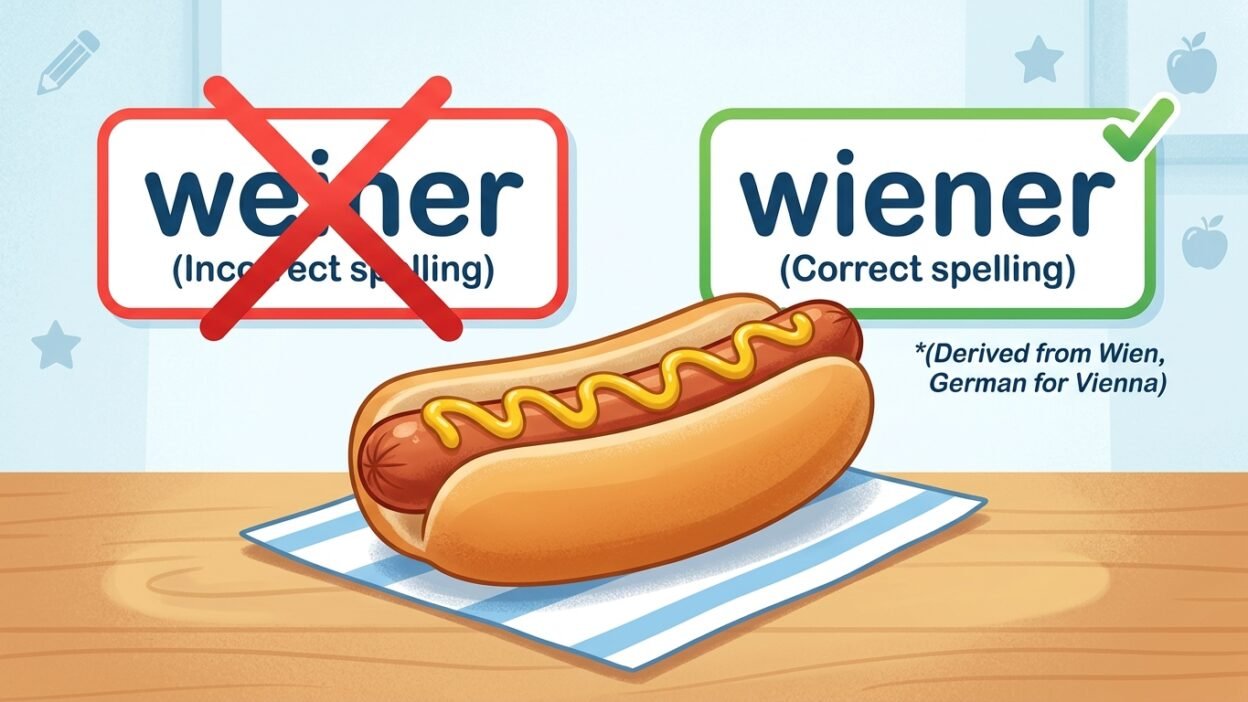
Many people feel confused when they see the words “weiner” and “wiener.” They look almost the same, sound the same, and are often used in similar situations. So which one is correct? And does the spelling really matter?
The confusion usually happens because one spelling is correct in standard English, while the other is a common mistake. Also, both words are linked to food and sometimes used in informal language, which makes things even more confusing for learners.
This simple guide will help you understand the difference clearly, so you can use the right word with confidence.
Quick Answer
- Wiener is the correct and standard spelling
- Weiner is usually a misspelling of “wiener”
- “Wiener” refers to a type of sausage (like a hot dog)
- “Weiner” may appear in names, but not as the correct word for the food
- Use “wiener” in writing and speaking when talking about food
Origin and Background
To understand the difference, it helps to look at where the word comes from.
The word “wiener” comes from the German word “Wien,” which is the name of the city Vienna. In German, something that comes from Vienna is called “Wiener.”
A “Wiener sausage” means a sausage from Vienna. Over time, English speakers shortened it to just “wiener.” This word became popular, especially in American English, where it is often used to mean a hot dog.
On the other hand, “weiner” does not come from this origin. It is simply a spelling mistake that became common because people write the word the way it sounds.
Clear Explanation of the Difference
The main difference is very simple:
- Wiener is the correct word
- Weiner is incorrect in most cases
What does “wiener” mean?
“Wiener” is a noun. It usually refers to:
- A type of sausage
- A hot dog
- Sometimes used in informal or humorous language
Example:
- I ate a wiener at the picnic.
What about “weiner”?
“Weiner” is not the correct spelling for the food. However, it may appear in:
- Personal names (like a family name)
- Misspellings in casual writing
Example:
- That is Mr. Weiner’s book. (Here, it is a name, so it is correct)
So, if you are talking about food, always use “wiener.”
Comparison Table
| Feature | Wiener | Weiner |
|---|---|---|
| Correct spelling | Yes | No (usually incorrect) |
| Meaning | Sausage or hot dog | No standard meaning |
| Origin | From Vienna (German “Wien”) | No real origin as a word |
| Usage | Food, informal language | Names or spelling mistakes |
| Example | I ate a wiener. | That is her last name: Weiner. |
Which One to Use and When
Here is an easy rule to remember:
Use “wiener” when:
- You are talking about food
- You mean a sausage or hot dog
- You are writing in school, exams, or formal work
Use “weiner” when:
- It is part of a person’s name
If you are ever unsure, choose “wiener.” It is the safe and correct option in almost all situations.
Common Mistakes People Make
Many learners and even native speakers make small mistakes with this word. Here are the most common ones:
1. Writing “weiner” instead of “wiener”
This is the biggest mistake. People often spell it the way it sounds.
Wrong:
- I want a weiner.
Correct:
- I want a wiener.
2. Mixing up spelling in formal writing
In exams or school work, using “weiner” instead of “wiener” can be marked as incorrect.
3. Not knowing the origin
Some people do not know the word comes from Vienna, so they do not understand why the spelling is different.
4. Using spell check without thinking
Sometimes, spell-check tools may not catch the mistake if “Weiner” is used as a name.
Everyday Real Life Examples
In emails
- Correct:
“We will serve hot dogs and wieners at the event.” - Incorrect:
“We will serve weiners at the event.”
In social media posts
- Correct:
“Nothing beats a grilled wiener on a sunny day!” - Incorrect:
“Nothing beats a grilled weiner!”
In daily conversation
- “Do you want a wiener or a burger?”
- “He bought wieners for the barbecue.”
In news or writing
- “The festival offered fresh wieners and other snacks.”
These examples show that “wiener” is the correct spelling in all normal uses.
Learning Section for Students and Beginners
If you are learning English, here is a simple way to remember the correct spelling:
Easy memory trick
Think of “Wien” (Vienna) → Wiener
Both words start with “Wien.” This can help you remember that “wiener” is the correct spelling.
Practice tips
- Write the word “wiener” five times
- Use it in simple sentences
- Read it out loud
Example practice:
- I ate a wiener.
- The wiener is hot.
- She cooked a wiener.
The more you use it, the easier it becomes.
FAQ
1. Is “weiner” ever correct?
Only if it is a person’s name. Otherwise, it is usually a mistake.
2. Why do people write “weiner”?
Because they spell it the way it sounds. English spelling is not always easy.
3. What does “wiener” mean?
It means a sausage or hot dog.
4. Is “wiener” British or American English?
It is more common in American English, but people understand it in many places.
5. Can I use “wiener” in formal writing?
Yes, if you are talking about food. It is a correct word.
6. Is there any difference in pronunciation?
No, both “weiner” and “wiener” sound the same.
7. Is “wiener” a slang word?
It can be used informally, but it is also a normal word for a type of sausage.
8. What is the safest choice?
Always use “wiener” unless it is a name.
Conclusion
The difference between “weiner” and “wiener” is simple once you understand it.
“Wiener” is the correct spelling and comes from the city of Vienna. It is used to describe a sausage or hot dog. “Weiner,” on the other hand, is usually just a spelling mistake, except when it is part of a name.
If you remember one thing, let it be this:
👉 Use “wiener” for food. Avoid “weiner.”
With this clear rule, you can write and speak with confidence and avoid a very common mistake.