Many learners feel confused about “leach” and “leech.” These words sound the same, so it’s easy to mix them up in writing. But their meanings are very different.
One is a verb about removing something, and the other is a living creature.
Quick Answer
- Leach = a verb
→ means to remove or drain something (usually slowly) - Leech = a noun
→ a small animal that sucks blood or a person who takes advantage of others
Simple Background
The word leach comes from old English words related to washing or draining.
The word leech comes from a different history. It refers to a type of worm-like animal that attaches to skin and drinks blood.
Even though they sound the same, they are not related in meaning.
Clear Explanation of the Difference
What is “Leach”?
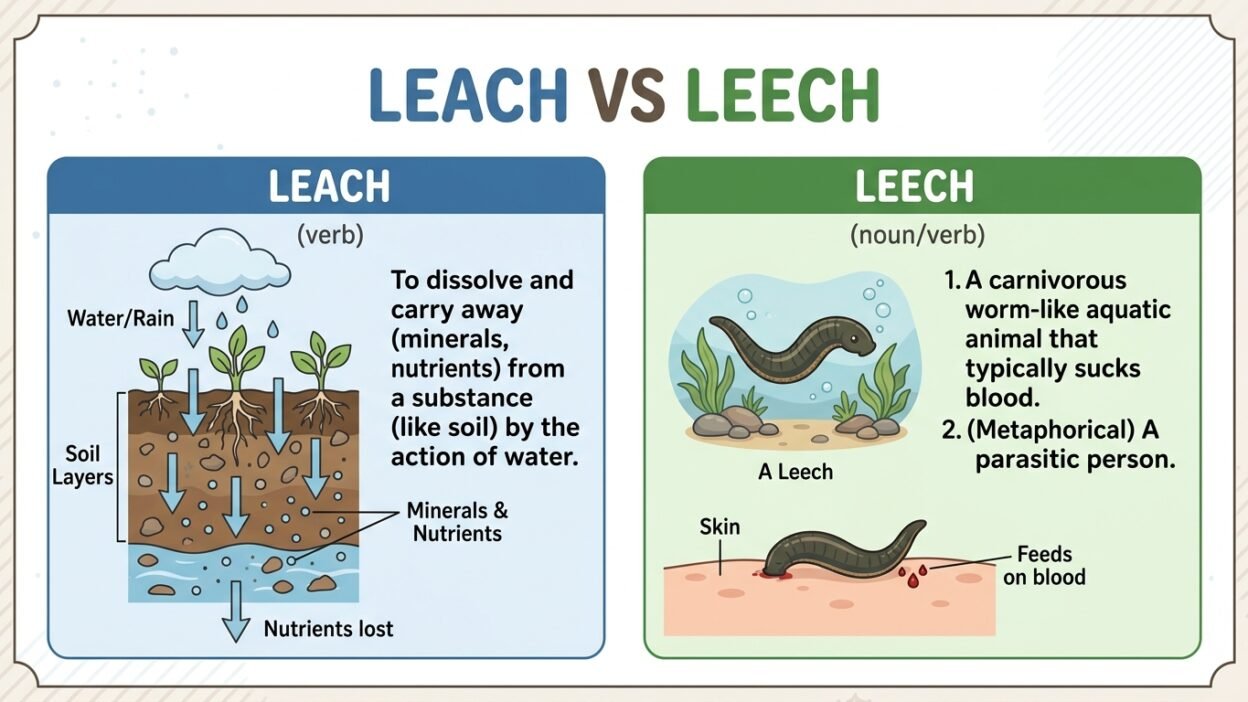
Leach is a verb.
It means:
- To remove a substance slowly (often by water)
- To drain something out
Examples:
- “Rain can leach nutrients from the soil.”
- “Chemicals may leach into the water.”
What is “Leech”?
Leech is a noun.
It can mean:
- A small animal that sucks blood
- A person who depends on others and takes advantage
Examples:
- “A leech attached to his leg.”
- “He is acting like a leech, always asking for money.”
Comparison Table
| Word | Type | Meaning | Example Sentence |
|---|---|---|---|
| Leach | Verb | To drain or remove slowly | “Water can leach minerals.” |
| Leech | Noun | Blood-sucking animal / dependent person | “A leech stuck to his arm.” |
Which One to Use and When
Use leach when:
- You are talking about removing something slowly
- You are describing a process (often with water or chemicals)
Use leech when:
- You are talking about the animal
- You are describing a person who depends too much on others
Simple Tip to Remember
- Leach = liquid action (removing)
- Leech = living thing (animal/person)
Common Mistakes People Make
1. Using “leech” instead of “leach”
❌ “The soil will leech nutrients.”
✔ “The soil will leach nutrients.”
2. Using “leach” for the animal
❌ “A leach was on his arm.”
✔ “A leech was on his arm.”
3. Confusing spelling because of sound
Both words sound the same, so spelling is important.
Everyday Real Life Examples
In Science or News
- “Rain can leach chemicals into rivers.”
In Daily Life
- “The water may leach minerals from the ground.”
Talking About Animals
- “A leech can stick to your skin.”
Talking About People
- “He is a leech, always depending on others.”
Short Learning Section for Students
Here is a simple way to remember:
Step 1: Learn the meanings
- Leach = remove
- Leech = animal/person
Step 2: Practice
- “Chemicals leach into water.”
- “The leech is small.”
Step 3: Use memory trick
Think:
Leech has double “e” → like “eat” (it eats blood)
Step 4: Check spelling
Always double check in writing.
FAQ
Is “leach” a common word?
It is used mainly in science or environmental topics.
What does “leech” mean in slang?
It means a person who depends on others too much.
Why are these words confusing?
Because they sound exactly the same.
Can “leech” be a verb?
Yes, but it’s less common. It means to depend on others.
Which word is more common?
“Leech” is more common in everyday language.
How can I remember easily?
Think: leech (animal) has double “e” → eats blood.
Should I worry about this mistake?
It’s helpful to learn, especially for writing and exams.
Conclusion
The difference between leach and leech is simple once you understand it.
- Leach is a verb meaning to remove or drain something slowly.
- Leech is a noun meaning an animal or a person who depends on others.
Remember this simple rule:
Leach = process, Leech = creature.
With this, you can avoid a common spelling mistake and write with confidence.