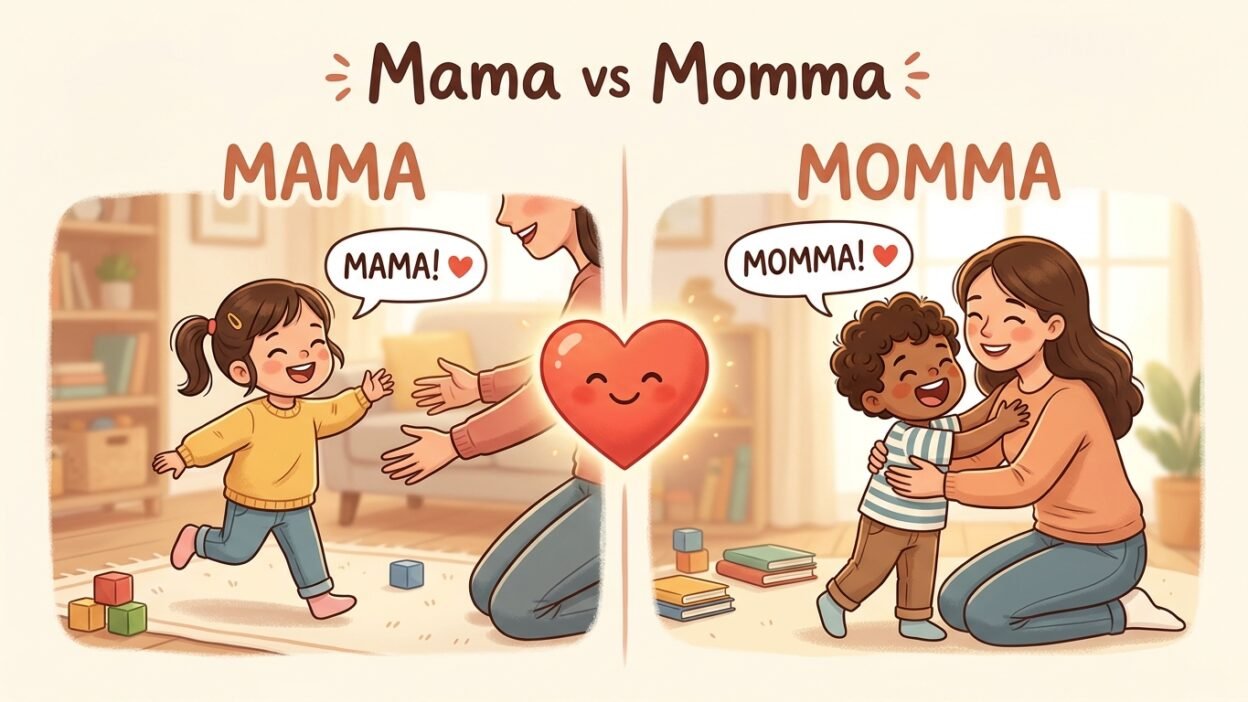
Many learners feel confused about “mama” and “momma.” Both words sound very similar and are used in friendly or emotional ways. Because of this, people often wonder which spelling is correct.
The truth is simple: both are correct, but they are used differently depending on style and situation.
Quick Answer
- Mama = more common and widely accepted
→ used in many cultures and simple speech - Momma = informal spelling
→ used mainly in casual or regional English
Simple Background
The word mama comes from very early human speech. Babies often say “ma” sounds first, so many languages use similar words for mother (mama, amma, etc.).
The word momma developed later in English, especially in American informal speech. It is a variation of “mom.”
Clear Explanation of the Difference
What is “Mama”?
Mama is:
- A common and simple word for “mother”
- Used worldwide
- Often used by children
Examples:
- “Mama, I need help.”
- “She called her mama.”
What is “Momma”?
Momma is:
- Informal
- More common in American English
- Often used in a warm, emotional, or storytelling style
Examples:
- “My momma is the best.”
- “Momma told me to be careful.”
Comparison Table
| Word | Type | Usage Level | Example Sentence |
|---|---|---|---|
| Mama | Informal noun | Common, worldwide | “Mama is cooking.” |
| Momma | Informal noun | Casual/regional | “Momma loves you.” |
Which One to Use and When
Use mama when:
- You want a simple and common word
- You are writing for a general audience
- You are speaking like a child or in a neutral tone
Use momma when:
- You are writing informally
- You want a warm or emotional tone
- You are using American casual style
Simple Tip to Remember
- Mama = more common
- Momma = more casual and expressive
Common Mistakes People Make
1. Thinking one is wrong
Both are correct, but they are used differently.
2. Using “momma” in formal writing
It can sound too informal in essays or professional writing.
3. Mixing styles
Switching between “mama” and “momma” in the same text can look inconsistent.
Everyday Real Life Examples
In Messages
- “I love you, mama.”
- “Thanks, momma ❤️”
On Social Media
- “Miss you, mama!”
- “My momma is my hero 💖”
In Daily Life
- “Mama is calling you.”
- “Momma made dinner.”
In Stories or Songs
- “Mama always knows best.”
- “My momma taught me well.”
Short Learning Section for Students
Here is an easy way to remember:
Step 1: Learn the tone
- Mama = simple
- Momma = emotional/casual
Step 2: Practice
- “Mama is here.”
- “My momma is kind.”
Step 3: Use memory trick
Think:
Momma has extra letters → extra feeling
Step 4: Choose based on situation
Use simpler words in formal writing.
FAQ
Is “mama” correct English?
Yes, it is widely used and understood.
Is “momma” wrong?
No, but it is informal.
Which one is more common?
Mama is more widely used globally.
Can I use “momma” in exams?
It’s better to avoid it in formal writing.
Why do both words exist?
They developed from different speech styles and cultures.
Are they used in the same way?
Yes, both refer to “mother,” but the tone is different.
How can I remember the difference?
Think: momma = more emotional tone.
Conclusion
The difference between mama and momma is simple.
- Both words mean “mother.”
- Mama is more common and neutral.
- Momma is more informal and expressive.
If you remember one simple rule, remember this:
Use “mama” for general use and “momma” for a casual, emotional tone.
With this, you can choose the right word easily in any situation.