Many learners get confused between “to” and “too.” These words sound the same, so it is easy to mix them up in writing. But they have very different meanings and uses.
Once you understand the simple rules, this confusion will disappear.
Quick Answer
- To = shows direction, place, purpose, or part of a verb
- Too = means “also” or “more than enough”
Simple Background
Both words come from old English, but over time they developed different meanings.
- To became a very common word used in many ways
- Too developed meanings like “also” and “excess” (more than needed)
Even though they sound the same, their roles in a sentence are very different.
Clear Explanation of the Difference
What is “To”?
To is one of the most common words in English.
It is used:
- To show direction
- Before a verb (infinitive form)
- To show purpose
Examples:
- “I am going to school.”
- “I want to learn English.”
- “Give this to her.”
What is “Too”?
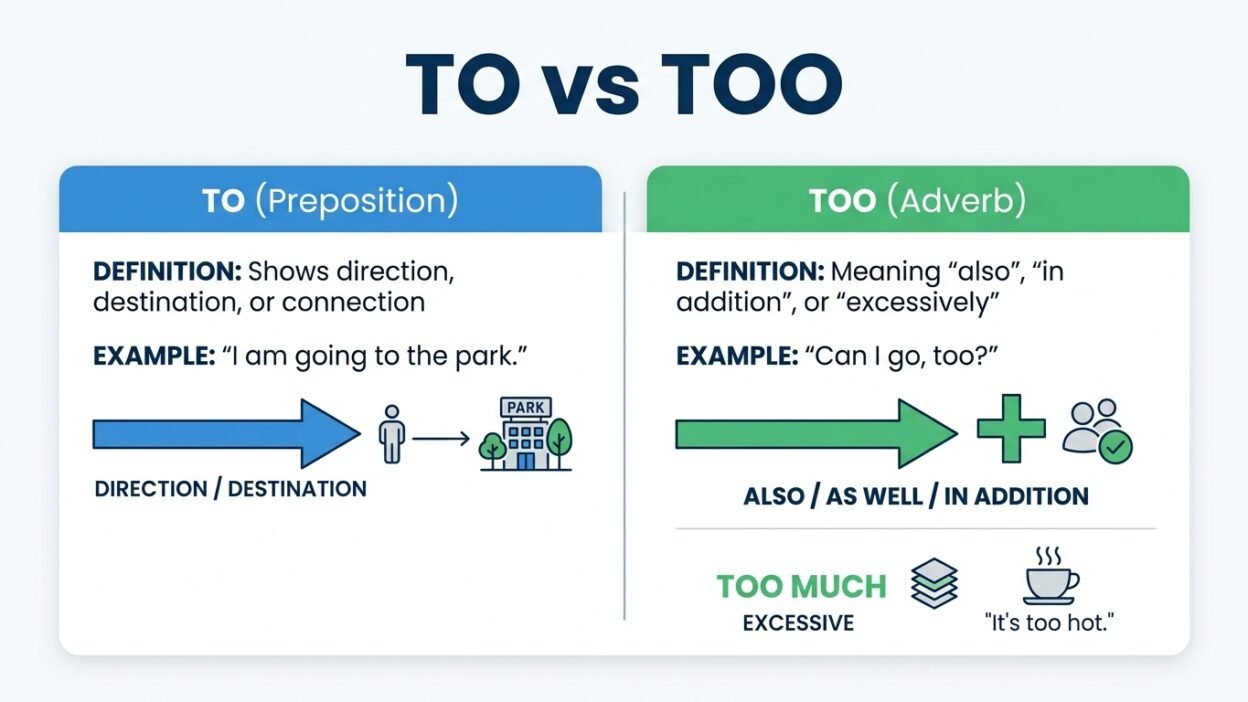
Too has two main meanings:
- Also (in addition)
- More than enough
Examples:
- “I want to come too.” (also)
- “This bag is too heavy.” (more than enough)
Comparison Table
| Word | Type | Meaning | Example Sentence |
|---|---|---|---|
| To | Preposition/Particle | Direction, purpose, verb form | “Go to the store.” |
| Too | Adverb | Also / more than enough | “It’s too cold.” |
Which One to Use and When
Use to when:
- Showing direction → “go to school”
- Before a verb → “want to eat”
- Giving something → “give it to me”
Use too when:
- You mean “also” → “I’m coming too”
- You mean “extra” → “too big,” “too fast”
Simple Tip to Remember
- Too = extra (two o’s = extra letter = extra meaning)
- To = simple and basic use
Common Mistakes People Make
1. Using “to” instead of “too”
❌ “I want to come to.”
✔ “I want to come too.”
2. Using “too” instead of “to”
❌ “I am going too school.”
✔ “I am going to school.”
3. Forgetting the meaning of “too”
Many learners forget that it means “also” or “more than enough.”
Everyday Real Life Examples
In Emails
- “I will send this to you.”
- “I will join the meeting too.”
In Messages
- “Come to my house.”
- “I like it too.”
On Social Media
- “This is too funny 😂”
- “I want to try this!”
In Daily Life
- “Let’s go to the market.”
- “It’s too hot today.”
Short Learning Section for Students
Here is an easy way to learn:
Step 1: Learn the meanings
- To = direction or verb
- Too = also or extra
Step 2: Practice
- “I want to eat.”
- “I want to eat too.”
Step 3: Use memory trick
Think:
Too has two o’s = extra meaning
Step 4: Check your sentence
Ask: Does it mean “also” or “extra”? If yes, use too.
FAQ
Is “to” more common than “too”?
Yes, “to” is used much more often.
Can “too” mean “also”?
Yes, it often means “also.”
Can “too” mean something negative?
Yes, like “too much” or “too difficult.”
Is this mistake common?
Yes, many learners confuse these words.
Can I use both in one sentence?
Yes. Example: “I want to go too.”
How can I remember the difference?
Think: “too” has extra “o,” so it means extra or also.
Which one should I use in exams?
Use them carefully based on meaning.
Conclusion
The difference between to and too is simple once you understand their meanings.
- To is used for direction, purpose, and verbs.
- Too means “also” or “more than enough.”
Remember this simple rule:
Too has an extra “o,” so it means extra.
With practice, you will use both words correctly and confidently.