Many learners feel confused about “affect” and “effect.” These two words look and sound similar, so it’s easy to mix them up. Even native speakers sometimes make mistakes with them.
But don’t worry the difference is simple once you understand the basic rule.
Quick Answer
- Affect = usually a verb (an action)
→ means to influence or change something - Effect = usually a noun (a result)
→ means the result of a change
Simple Background
Both words come from Latin and are related in meaning. They are connected because:
- One causes a change (affect)
- The other is the result of that change (effect)
That’s why they are often used together.
Clear Explanation of the Difference
What is “Affect”?
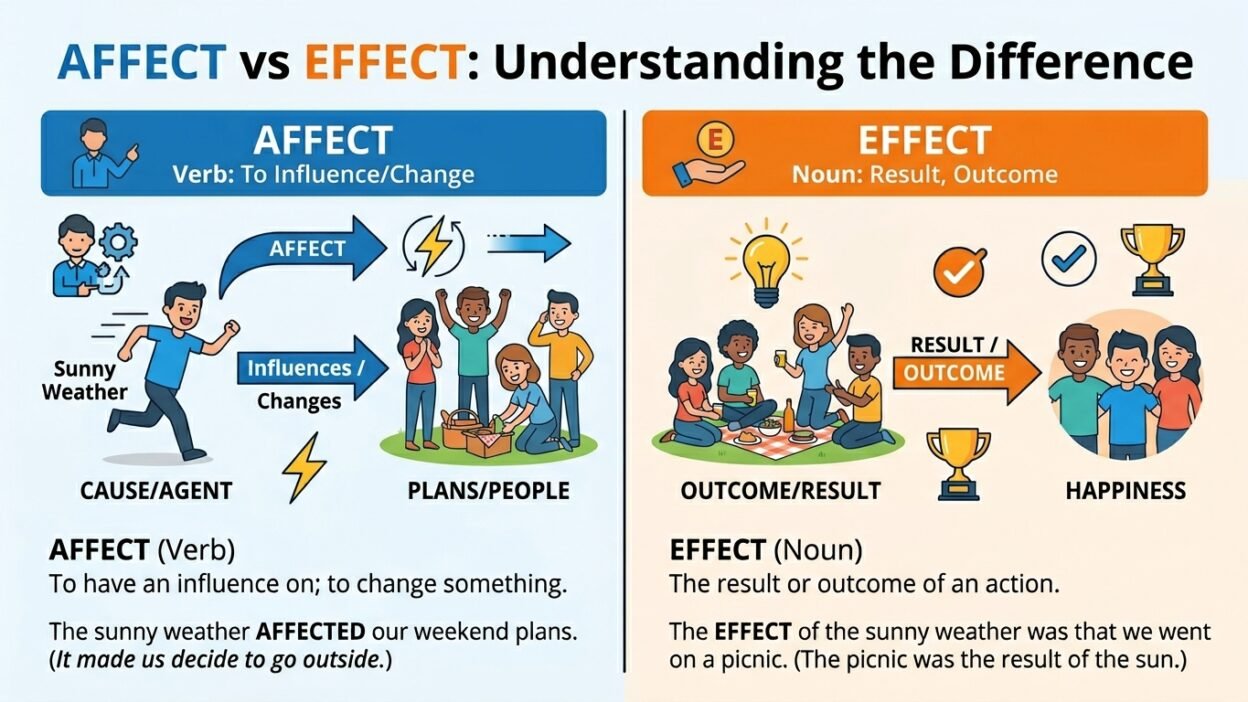
Affect is usually a verb (an action word).
It means:
- To influence something
- To cause a change
Examples:
- “Rain can affect your plans.”
- “Lack of sleep affects your health.”
What is “Effect”?
Effect is usually a noun (a thing or result).
It means:
- The result or outcome of something
Examples:
- “The effect of rain was flooding.”
- “This medicine has a strong effect.”
Comparison Table
| Word | Type | Meaning | Example Sentence |
|---|---|---|---|
| Affect | Verb | To influence or change | “This will affect you.” |
| Effect | Noun | Result or outcome | “The effect was clear.” |
Which One to Use and When
Use affect when:
- You are describing an action
- Something is changing or influencing something else
Use effect when:
- You are talking about a result
- Something has already happened
Simple Tip to Remember
- Affect = Action (both start with A)
- Effect = End result
Common Mistakes People Make
1. Using “effect” as a verb
❌ “This will effect your grade.”
✔ “This will affect your grade.”
2. Using “affect” as a noun
❌ “The affect was strong.”
✔ “The effect was strong.”
3. Forgetting the basic rule
Many learners forget that one is usually a verb and the other is a noun.
Everyday Real Life Examples
In Emails
- “This change may affect your schedule.”
- “The effect of the update is positive.”
In News
- “Weather changes affect crops.”
- “The effect of the storm was severe.”
On Social Media
- “Lack of sleep affects mood 😴”
- “This song has a calming effect 🎵”
In Daily Life
- “Exercise affects your health.”
- “The effect of exercise is better fitness.”
Short Learning Section for Students
Here is an easy way to learn:
Step 1: Learn the rule
- Affect = action
- Effect = result
Step 2: Practice
- “This affects me.”
- “The effect is clear.”
Step 3: Use memory trick
Think:
A = Action (affect)
E = End (effect)
Step 4: Check your sentence
Ask: Is this an action or a result?
FAQ
Is “affect” always a verb?
Usually yes, but in rare cases it can be a noun (advanced use).
Is “effect” always a noun?
Mostly yes, but it can be a verb in formal English (rare).
Which one is more common?
Both are common but used in different ways.
Why are they confusing?
Because they look and sound similar.
Can I use both in one sentence?
Yes. Example: “The weather affects the effect of the event.”
How can I remember easily?
Think: affect = action, effect = end result.
Which should I use in exams?
Use them carefully based on meaning.
Conclusion
The difference between affect and effect becomes easy when you remember one simple idea:
- Affect is an action (to change something).
- Effect is the result (what happens after).
If you remember this rule A for Action, E for End you will use these words correctly every time.