Many English learners feel confused when they see words like parents, parent’s, and parents’. These words look almost the same, but a small mark ( ’ ) changes the meaning completely.
This small mark is called an apostrophe, and it is very important in English. It shows ownership or possession.
Because the difference is very small in writing, students often mix them up. They may write the wrong form in exams, emails, or messages.
The good news is that this topic is actually very simple. Once you understand a few basic rules, you will never feel confused again.
In this article, you will learn the clear difference between parents, parent’s, and parents’, with easy examples and tips.
Quick Answer
Here is the simple difference:
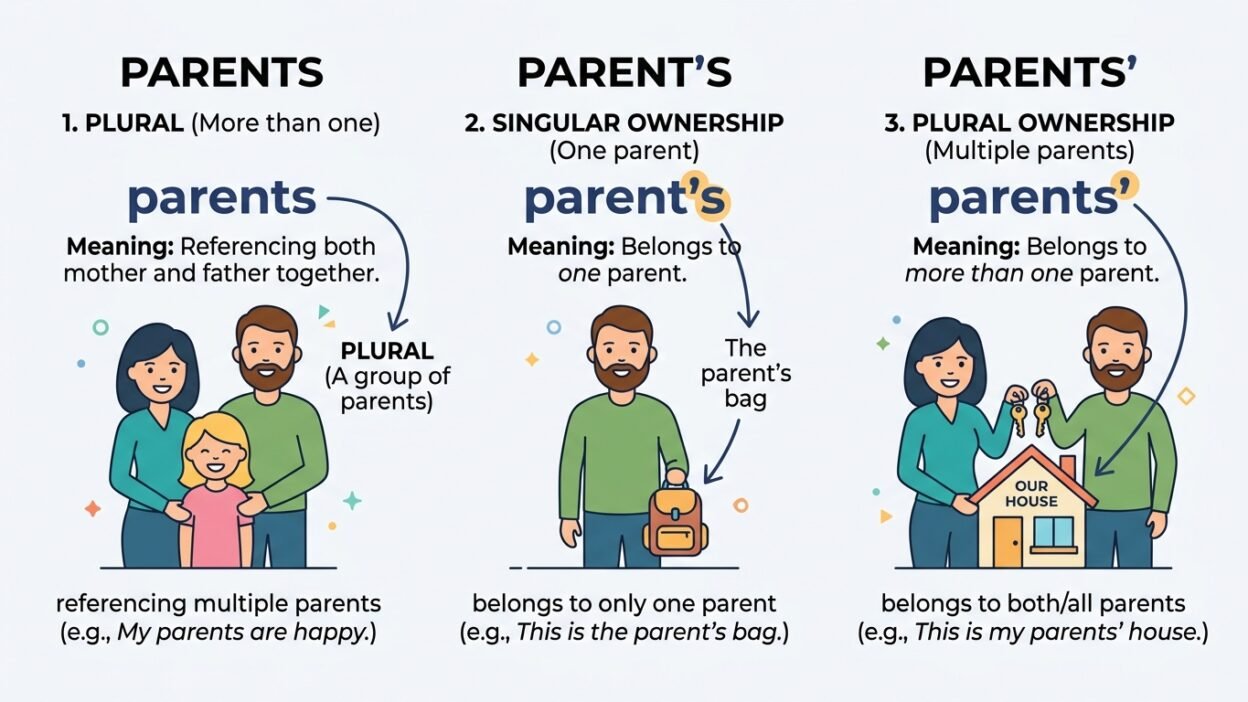
- Parents = more than one parent (no ownership)
- Parent’s = one parent owns something
- Parents’ = more than one parent owns something
Quick examples:
- My parents are kind.
- My parent’s car is outside. (one parent)
- My parents’ house is big. (both parents)
Simple Origin or Background
To understand this topic, you need to know two simple ideas:
1. Plural nouns
A plural noun means more than one.
- parent → parents
- student → students
- teacher → teachers
So, parents simply means mother and father or more than one parent.
2. Apostrophe ( ’ )
An apostrophe shows possession (ownership).
It answers the question:
“Who owns this?”
Examples:
- The boy’s book → book belongs to the boy
- The teacher’s desk → desk belongs to the teacher
Now combine these two ideas, and you will understand everything.
Clear Explanation of the Difference
Let’s explain each form clearly.
What “parents” means
Parents is just a plural noun.
It means:
- more than one parent
- mother and father
It does not show ownership.
Examples:
- My parents live in the city.
- Her parents are teachers.
- Many parents worry about their children.
There is no apostrophe, so there is no ownership.
What “parent’s” means
Parent’s shows ownership by one parent.
It means something belongs to one parent.
Examples:
- My parent’s phone is ringing.
- The parent’s decision was final.
- That is my parent’s advice.
Here, only one parent owns something.
What “parents’” means
Parents’ shows ownership by more than one parent.
It means something belongs to both parents.
Examples:
- My parents’ house is large.
- The parents’ meeting starts at 5 PM.
- The parents’ decision was important.
Here, the ownership is shared by more than one parent.
Comparison Table
| Word | Meaning | Number | Ownership | Example |
|---|---|---|---|---|
| Parents | More than one parent | Plural | No | My parents are happy. |
| Parent’s | One parent owns something | Singular | Yes | My parent’s car is new. |
| Parents’ | More than one parent owns something | Plural | Yes | My parents’ house is big. |
This table helps you quickly see the difference.
Which One to Use and When
Choosing the correct form is easy if you ask two simple questions.
Step 1: Is it singular or plural?
- One parent → parent
- More than one → parents
Step 2: Is there ownership?
- No ownership → no apostrophe
- Ownership → use apostrophe
Now apply the rules:
Use “parents” when:
- you are just talking about mother and father
- there is no ownership
Examples:
- My parents love me.
- All parents want the best for their children.
Use “parent’s” when:
- one parent owns something
Examples:
- My parent’s car is red.
- The parent’s opinion matters.
Use “parents’” when:
- both parents own something
Examples:
- My parents’ home is near the park.
- The parents’ meeting was long.
Common Mistakes People Make
Many learners make similar mistakes with these forms.
Mistake 1: Using “parents” instead of “parents’”
Incorrect:
- My parents house is big.
Correct:
- My parents’ house is big.
Reason: The house belongs to both parents.
Mistake 2: Using “parent’s” for plural
Incorrect:
- My parent’s house is big. (if both parents own it)
Correct:
- My parents’ house is big.
Mistake 3: Adding apostrophe when not needed
Incorrect:
- My parent’s are kind.
Correct:
- My parents are kind.
Reason: There is no ownership here.
Mistake 4: Confusing placement of apostrophe
Remember:
- Singular → ’s
- Plural ending in “s” → s’
Examples:
- boy → boy’s
- boys → boys’
- parent → parent’s
- parents → parents’
Everyday Real-Life Examples
Let’s see how these words are used in real life.
In emails
- Dear Sir,
I am writing with my parents’ permission. - My parents will attend the meeting tomorrow.
In school notices
- The parents’ meeting will be held on Monday.
- All parents are invited.
In social media
- “Love spending time with my parents.”
- “At my parents’ house for dinner.”
In daily conversations
- My parents are very supportive.
- I borrowed my parent’s phone.
- We visited my parents’ hometown.
These examples show how common these forms are in daily life.
Learning Section for Students and Beginners
Here are some easy tips to remember.
Tip 1: Look for ownership
Ask yourself:
Does something belong to someone?
- Yes → use apostrophe
- No → no apostrophe
Tip 2: Check the number
- One parent → parent’s
- Two parents → parents’
Tip 3: Practice simple sentences
Try writing:
- My parents are kind.
- My parent’s bag is here.
- My parents’ car is outside.
Tip 4: Remember the pattern
- Singular → ’s
- Plural (ends in s) → s’
This pattern works for many words, not just “parent”.
(FAQ)
1. What is the difference between parents and parent’s?
Parents means more than one parent.
Parent’s shows something belongs to one parent.
2. What does parents’ mean?
It shows something belongs to more than one parent.
3. Is “parents” always plural?
Yes. It always means two or more parents.
4. When do we use an apostrophe?
We use it to show ownership.
5. Which is correct: parents house or parents’ house?
Correct: parents’ house
Because the house belongs to both parents.
6. Can “parent’s” mean both parents?
No. It only means one parent.
7. Why is this topic important?
Because a small mistake can change the meaning of your sentence.
8. Is this rule the same for other words?
Yes. The same rule applies to many nouns in English.
Conclusion
The difference between parents, parent’s, and parents’ may look small, but it is very important in English.
- Parents means more than one parent, with no ownership.
- Parent’s shows something belongs to one parent.
- Parents’ shows something belongs to more than one parent.
The key idea is simple:
Check number and ownership.
Once you understand this, you will feel more confident in writing and speaking English. With a little practice, these forms will become easy and natural to use in everyday life.

Austin Brandon serves as both an author and administrator at GrammerPeak. He manages site operations while creating clear, accurate grammar content that helps readers correct mistakes, understand language rules, and write with confidence, precision, and clarity across academic, professional, and everyday English communication.