Many learners feel confused about “grey” and “gray.” These two words look different but sound exactly the same. Because of this, people often wonder which spelling is correct.
The good news is simple: both are correct but used in different places.
Quick Answer
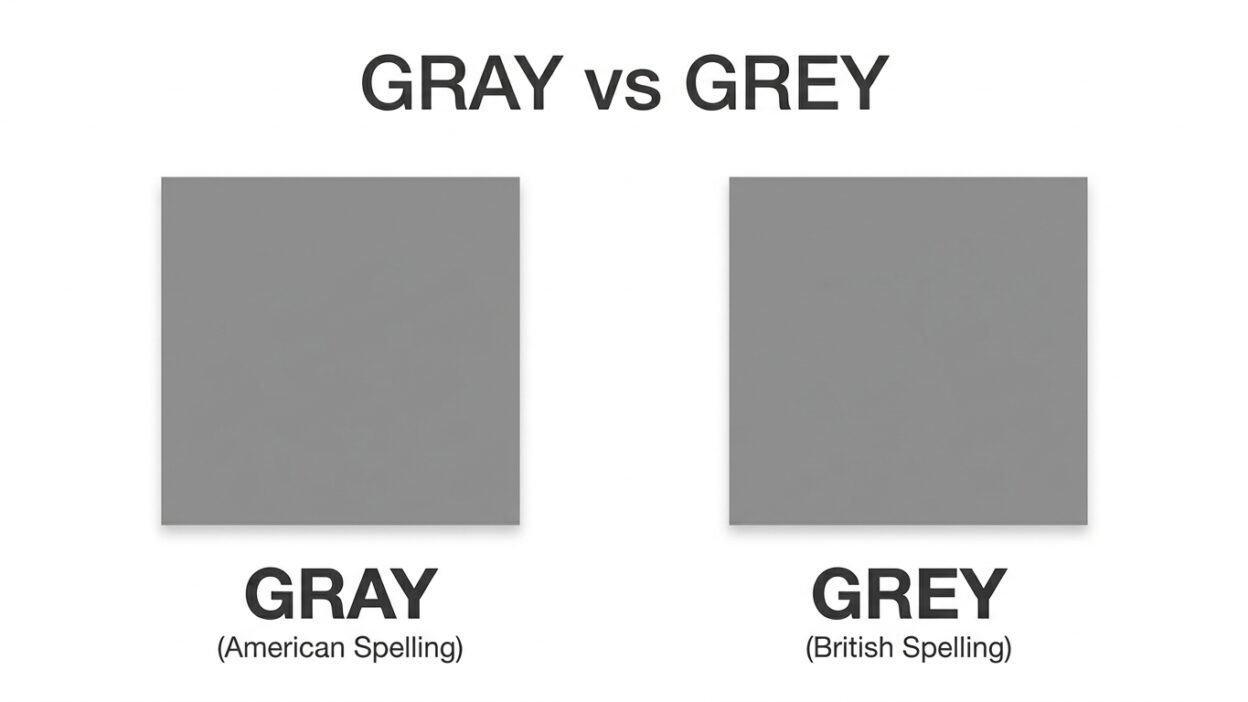
- Gray = used in American English
- Grey = used in British English
Both words mean the same color (between black and white).
Simple Background
The word comes from old English language forms, and over time, two spellings developed:
- Gray became common in the United States
- Grey became common in the United Kingdom and many other countries
So the difference is not about meaning it is about style and region.
Clear Explanation of the Difference
What is “Gray”?
Gray is the preferred spelling in American English.
Examples:
- “He wore a gray shirt.”
- “The sky looks gray today.”
What is “Grey”?
Grey is the preferred spelling in British English and many other regions.
Examples:
- “She has grey hair.”
- “The walls are painted grey.”
Comparison Table
| Word | Region | Meaning | Example Sentence |
|---|---|---|---|
| Gray | American English | Color between black/white | “The cat is gray.” |
| Grey | British English | Same meaning | “The cat is grey.” |
Which One to Use and When
Use gray when:
- You are writing for American English
- You are following U.S. spelling rules
Use grey when:
- You are writing for British English
- You are following UK or international style
Simple Tip to Remember
- Gray = America (A in both words)
- Grey = England (E in both words)
Common Mistakes People Make
1. Thinking one spelling is wrong
Both are correct just used in different places.
2. Mixing both in the same text
Try to stay consistent. Choose one style and use it throughout.
3. Worrying too much about it
This is a small difference. The meaning stays the same.
Everyday Real Life Examples
In Emails
- American style: “The car is gray.”
- British style: “The car is grey.”
In Messages
- “I like that gray jacket.”
- “I like that grey jacket.”
On Social Media
- “Feeling a little grey today ☁️”
- “Gray skies and coffee ☕”
In Daily Life
- “He has gray hair.”
- “She bought a grey dress.”
Short Learning Section for Students
Here is an easy way to remember:
Step 1: Learn the rule
- Gray = American
- Grey = British
Step 2: Practice
- “The sky is gray.”
- “The sky is grey.”
Step 3: Use memory trick
Think:
A = America → Gray
E = England → Grey
Step 4: Be consistent
Pick one style and stick to it in your writing.
FAQ
Is “gray” or “grey” more correct?
Both are correct. It depends on the region.
Which spelling is more common?
“Gray” is common in the U.S., while “grey” is common in the UK and many other countries.
Can I use both in one sentence?
It’s better to choose one style and stay consistent.
Do they have different meanings?
No, both mean the same color.
Which should I use in exams?
Follow your school’s style (American or British English).
Is this difference important?
Not very, but consistency is important in writing.
How can I remember easily?
A = America (gray), E = England (grey).
Conclusion
The difference between grey and gray is simple and easy to remember.
- Both words are correct and mean the same color.
- The only difference is the spelling style based on region.
If you remember one simple rule, you will never be confused again:
Gray for America, Grey for England.
With this, you can use both words correctly and confidently.