Many learners get confused between “checkout” and “check out.” They look almost the same, but the meaning changes depending on whether you write them as one word or two words.
This is a very common mistake in English, especially in emails, online shopping, and daily conversations.
Quick Answer
- Checkout (one word) = a noun or adjective
→ the place or process of paying - Check out (two words) = a verb phrase
→ to look at something, leave a place, or examine
Simple Background
English often combines words over time. That’s how “checkout” became a single word in certain cases.
But the original form “check out” is still used as a verb. That’s why both forms exist today but they are used differently.
Clear Explanation of the Difference
What is “Check Out”?
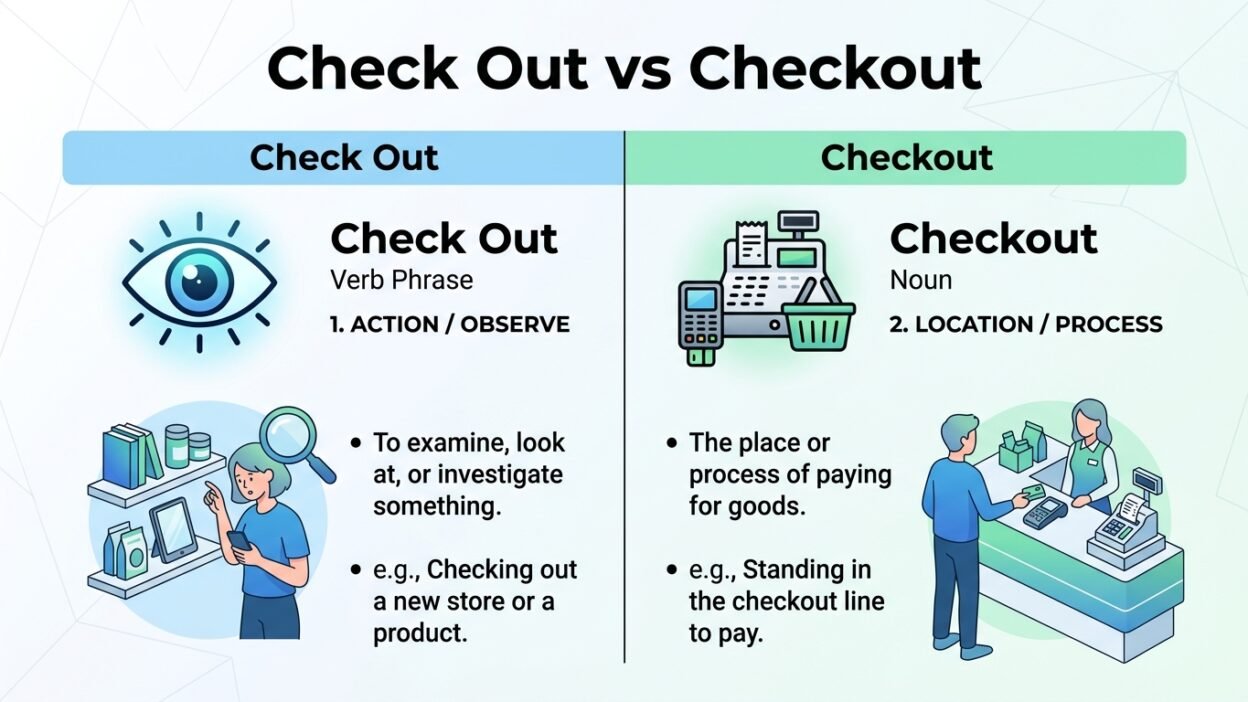
Check out (two words) is a verb phrase.
It can mean:
- To look at something
- To leave a hotel or place
- To examine or try something
Examples:
- “Check out this video!”
- “We need to check out of the hotel.”
- “You should check out this new shop.”
What is “Checkout”?
Checkout (one word) is a noun or adjective.
It refers to:
- The place where you pay in a store
- The process of paying
Examples:
- “Go to the checkout to pay.”
- “The checkout line is long.”
- “Use the self-checkout machine.”
Comparison Table
| Form | Type | Meaning | Example Sentence |
|---|---|---|---|
| Check out | Verb phrase | Look at / leave / examine | “Check out this book.” |
| Checkout | Noun/Adj | Payment place or process | “The checkout is busy.” |
Which One to Use and When
Use check out when:
- You are telling someone to look at something
- You are talking about leaving a place
- You need a verb
Use checkout when:
- You are talking about paying
- You need a noun or describing a place
Simple Tip to Remember
- Two words = action (verb)
- One word = place or thing (noun)
Common Mistakes People Make
1. Using one word instead of two
❌ “Checkout this video.”
✔ “Check out this video.”
2. Using two words for the noun
❌ “Go to the check out.”
✔ “Go to the checkout.”
3. Not knowing the part of speech
The meaning changes based on whether it’s a verb or noun.
Everyday Real Life Examples
In Emails
- “Please check out the attached file.”
- “Proceed to the checkout to complete your order.”
In Online Shopping
- “Click checkout to pay.”
- “Check out our latest products.”
On Social Media
- “Check out my new post!”
- “Fast checkout available now.”
In Daily Life
- “Let’s check out that restaurant.”
- “The checkout line is too long.”
Short Learning Section for Students
Here is an easy way to remember:
Step 1: Learn the rule
- Check out = action
- Checkout = place or process
Step 2: Practice
- “Check out this idea.”
- “The checkout is closed.”
Step 3: Use memory trick
Think:
Action = two words
Thing = one word
Step 4: Check your sentence
Ask: Is this an action or a thing?
FAQ
Is “checkout” always one word?
No, only when used as a noun or adjective.
Is “check out” always two words?
Yes, when used as a verb.
Which one is more common?
Both are common but used in different situations.
Can I use “checkout” as a verb?
No, use “check out” for actions.
What does “check out” mean?
It can mean look at, leave, or examine something.
What does “checkout” mean?
It means the place or process of paying.
Is this mistake common?
Yes, many learners confuse these forms.
Conclusion
The difference between checkout and check out is simple once you understand it.
- Check out (two words) is an action.
- Checkout (one word) is a place or process.
If you remember one simple rule, you will never be confused again:
Two words for actions, one word for things.
With this, you can use both forms correctly and confidently.

Austin Brandon serves as both an author and administrator at GrammerPeak. He manages site operations while creating clear, accurate grammar content that helps readers correct mistakes, understand language rules, and write with confidence, precision, and clarity across academic, professional, and everyday English communication.